
In 2026, launching digital products quickly is more competitive than ever. Every day, new ideas flood the market and only the fastest thrive.
That’s where mvp software becomes your secret weapon. It helps startups and enterprises validate ideas, enter markets, and fuel sustainable growth without wasting precious resources.
This guide breaks down everything you need to know about mvp software. You’ll discover its core meaning, the latest trends for 2026, a step-by-step roadmap to building your own MVP, the skills and tools required, and real-world examples that changed entire industries.
Ready to minimize risk and maximize your success? Use this guide as your blueprint for launching a winning product in today’s fast-paced tech world.
Understanding MVP Software in 2026
In 2026, mvp software stands at the heart of digital innovation. What started in the early 2010s as a lean startup concept has now become a strategic staple for businesses of all sizes. MVP software empowers teams to test their ideas in real markets, using minimal resources, before investing in full-scale development.

What Is MVP Software and How Has It Evolved?
MVP software, or Minimum Viable Product software, refers to the first working version of a product that includes only the essential features needed to solve a specific problem and validate an idea. Since its inception, the mvp software concept has evolved from basic landing pages or one-feature apps to sophisticated, data-driven solutions powered by automation and cloud technologies.
In the early days, MVPs were mostly the domain of scrappy startups. Today, even global enterprises use mvp software to launch new products, enter new markets, or test internal tools. The goal remains the same: learn quickly, minimize risk, and avoid costly missteps.
The Core Purpose of MVP Software
At its core, mvp software is designed for rapid validation. Instead of building a full-featured product, teams focus on launching just enough to gauge real user interest and collect actionable feedback. This approach helps businesses save resources, iterate faster, and pivot more effectively if the market signals a need for change.
MVP software also encourages a culture of experimentation. By launching early and often, companies can understand what works and what doesn’t, without betting everything on untested assumptions.
MVPs vs Prototypes vs Full Products
It’s easy to confuse MVPs with prototypes or finished products. However, each serves a different purpose in the product lifecycle. Here’s a quick comparison:
| Aspect | Prototype | MVP Software | Full Product |
|---|---|---|---|
| Purpose | Test concepts/UX | Validate market demand | Deliver complete solution |
| Features | Non-functional/partial | Essential only | Full feature set |
| Audience | Internal/team | Early adopters/real users | Mass market |
| Investment | Minimal | Low to moderate | High |
| Feedback | Limited | Real-world, actionable | Ongoing |
Unlike prototypes, mvp software is launched to real users and collects real-world feedback. It’s not the final product, but it must be viable enough to deliver value and drive learning.
The Three Pillars of MVP
Every successful mvp software is built on three pillars:
- Minimum: Only the core features required to solve the main user problem.
- Viable: The product must function and provide real value, even in its simplest form.
- Product: It’s a working solution, not just a concept, and is released to actual users.
Balancing these pillars ensures that mvp software is both lean and impactful.
Why MVP Software Matters More in 2026
In 2026, the stakes for digital launches are higher than ever. Rising development costs and fierce competition mean that businesses cannot afford to waste time or money on unproven ideas. MVP software offers a proven path to market validation and resource optimization.
Modern platforms, especially no-code solutions, have made mvp software development accessible to non-technical founders and enterprise teams alike. For a practical guide on leveraging these tools for scalable MVPs, see How to Build Scalable MVPs with No-Code Tools.
According to Startup Genome, startups using MVP approaches grow 3.5 times faster and raise seven times more funding than those who skip early validation. This data highlights the growing importance of mvp software in today’s tech landscape.
Key Characteristics of MVP Software
Successful mvp software shares several defining traits:
- Essential feature set: Focuses only on must-have functionality.
- Rapid development: Built quickly to seize market opportunities.
- Feedback-driven iteration: Continuously improved based on real user input.
- Cost-effectiveness: Minimizes upfront investment.
- Risk mitigation: Reduces the chance of building something nobody wants.
These characteristics make mvp software the smart choice for both startups and established companies experimenting with new ideas.
Real-World Examples of MVP Software in Action
Some of the world’s most iconic brands started with mvp software. Amazon’s first version sold only books online. Airbnb launched with a simple website listing spare rooms in the founders’ apartment. Facebook began as a campus-only network for Harvard students.
Each of these MVPs focused on solving a single problem, validated demand in a real market, and then iterated based on user feedback. Today, enterprises also use mvp software to test innovations internally before committing to full-scale development.
The key insight? MVP software is no longer just a startup strategy. It’s a universal tool for innovation, helping teams of all sizes learn faster and invest smarter.
MVP Software Trends and Innovations in 2026
In 2026, the landscape of mvp software is transforming at lightning speed. Companies that keep pace with the latest trends are the ones seizing new markets and outpacing competitors. What’s driving this rapid evolution? Let’s break down the innovations shaping how mvp software is built and launched today.

No-Code and Low-Code Platforms Redefine MVP Speed
The days of needing a full-stack team to launch mvp software are fading. No-code and low-code platforms like Bubble and Webflow have democratized product development. Founders and enterprise teams can now go from idea to launch in weeks instead of months. According to industry surveys, 60% of MVPs in 2026 are built using no-code tools.
These platforms offer visual interfaces, drag-and-drop components, and seamless integrations. As a result, businesses cut costs and accelerate validation. For a deeper dive on how no-code is revolutionizing mvp software, see The Key to Faster, More Affordable Software Development: No-Code Solutions.
AI Integration: Smarter, Leaner MVPs
Artificial intelligence is now embedded in leading mvp software projects. AI enables features like personalization, predictive analytics, and even automated testing. For example, fintech MVPs use AI to detect fraud patterns in real time, while healthtech MVPs apply machine learning to monitor patient data remotely.
AI also streamlines feedback loops. Automated chatbots and in-app surveys gather user insights instantly, helping teams iterate faster. In SaaS, AI-driven onboarding personalizes user experiences from the first click.
Cross-Platform Reach and Cloud Scalability
Modern mvp software is rarely limited to a single device or platform. Startups and enterprises alike are deploying MVPs across web, mobile, and IoT, ensuring broad market reach from day one. Cross-platform development tools let teams maintain a single codebase, reducing overhead and time to market.
Cloud giants like AWS and Azure further accelerate this trend. Their services allow instant global launches, elastic scaling, and robust security. This means mvp software can handle rapid spikes in demand without a hitch.
| Trend | Impact on MVP Software |
|---|---|
| No-code/low-code platforms | 3-5x faster launches, lower cost |
| AI integration | Predictive features, automation |
| Cross-platform development | Broad reach, unified codebase |
| Cloud deployment | Scalability, global access |
Agile and Lean Methodologies: Fast Feedback, Rapid Iteration
The agile and lean movement remains central to mvp software in 2026. Teams work in short sprints, release early versions, and pivot based on user feedback. This approach minimizes wasted effort and maximizes learning per dollar spent.
Data now drives every decision. Advanced analytics and user behavior tracking tools monitor how people interact with mvp software. This data fuels A/B tests, feature tweaks, and roadmap adjustments, ensuring each iteration brings the product closer to market fit.
Why Staying Ahead Matters
The pace of change in mvp software is only accelerating. Companies that incorporate no-code, leverage AI, and harness cloud power are setting the pace. Those who ignore these innovations risk falling behind.
In summary, the top mvp software trends for 2026—no-code, AI, cross-platform reach, and agile cycles—aren’t just buzzwords. They’re the foundation for getting better products to market, faster and smarter than ever before.
Step-by-Step Guide: How to Build an MVP Software in 2026
Building a successful mvp software in 2026 requires a clear roadmap, strategic thinking, and the right tools. Let’s break down the essential steps, from defining your idea to scaling your product with confidence.

Step 1: Define the Problem and Target Audience
Every mvp software journey begins by tackling a real, validated problem. Start with customer interviews and surveys to uncover genuine pain points. Avoid assuming you know the problem—let your audience speak.
Create detailed user personas that include age, profession, goals, and frustrations. This ensures your mvp software is built for a specific group, not a vague “everyone.” Focusing on a niche, like Airbnb’s founders did with budget travelers, leads to faster validation and less wasted effort.
Don’t skip this foundational step. A clear problem definition acts as your compass, guiding every decision and preventing expensive detours during mvp software development.
Step 2: Conduct Market Research and Analyze Competitors
Before you build, study the landscape. Use tools like Google Trends, industry reports, and social media analysis to gauge demand for your mvp software idea.
Identify what competitors offer—both their MVPs and full products. List their core features, strengths, and weaknesses in a table for easy comparison.
| Competitor | Core MVP Feature | Unique Value | Weakness |
|---|---|---|---|
| Company A | Quick signup | Fast setup | Limited support |
| Company B | Custom reports | Deep analytics | High cost |
Run a SWOT analysis to spot opportunities and threats. Remember, 42% of startups fail due to lack of market need. Let your research guide your mvp software’s direction and differentiation.
Step 3: Prioritize and Scope Core Features
List every potential feature, then ruthlessly trim down to the essentials for your mvp software. Use the MoSCoW framework (Must-have, Should-have, Could-have, Won’t-have) to prioritize.
Focus on one “killer feature” that solves your user’s main problem. For example, Dropbox’s original mvp software only synced files—nothing more.
Avoid the trap of feature creep. Adding too many extras delays feedback and wastes resources. Keep your mvp software simple, usable, and laser-focused on delivering core value.
Step 4: Design and Prototype the MVP
Now bring your mvp software idea to life visually. Use Figma or Sketch to create wireframes and clickable prototypes. Test these with real users to gather early feedback.
Map out user flows, ensuring every step is intuitive. Ask: Can a new user complete the main task without confusion? Iterate your designs quickly, making changes before a single line of code is written.
By validating your design first, you’ll catch usability issues early and reduce the risk of costly rework down the line. This keeps mvp software projects nimble and user-centered.
Step 5: Develop the MVP Using Modern Tools
Choose the right tech stack for your mvp software. In 2026, no-code and low-code platforms like Bubble and Webflow dominate for their speed and accessibility. Traditional frameworks still have a place, but rapid iteration is key.
Build a lean team covering front-end, back-end, and project management. Use agile sprints to move fast and stay flexible. Deploy only the core features, ensuring stability and security.
Cloud platforms enable instant scalability, so your mvp software can reach users worldwide from day one. For more insights on rapid MVP creation, explore No-Code Platforms in MVP Development.
Step 6: Launch, Test, and Collect Feedback
Release your mvp software to a select group of early adopters. Encourage honest feedback through surveys, interviews, and in-app tools.
Track engagement and retention using analytics dashboards. What do users love? Where do they get stuck? Use this data to validate assumptions and uncover hidden issues.
A continuous feedback loop is critical. Iteratively improve your mvp software based on real-world input, not guesswork. This stage often determines whether you achieve product-market fit or need to pivot.
Step 7: Iterate and Prepare for Scaling
With feedback in hand, prioritize changes that address major pain points or bugs. Avoid adding new features until your mvp software is stable and delightful to use.
Plan your next development sprints around user needs and market response. Optimize infrastructure for growth, and refine onboarding to ensure new users succeed quickly.
Enterprises and startups alike see explosive growth by iterating rapidly. Successful mvp software is never static—it evolves with every user insight, setting the stage for sustainable scaling.
Essential Skills and Tools for MVP Software Development
Building MVP software in 2026 is more than just coding—it's about assembling the right mix of skills, tools, and people to move fast and stay ahead. The landscape is evolving rapidly, so knowing what expertise to prioritize can make or break your MVP software launch.
Technical Skills Every MVP Software Project Needs
Technical proficiency is the backbone of MVP software. Core skills include:
- Programming: JavaScript, Python, or other modern languages for quick development.
- Web/Mobile Development: Responsive design and cross-platform capability.
- UI/UX Design: Crafting clean user flows and intuitive interfaces.
- QA/Testing: Ensuring stability and catching bugs early.
- Project Management: Keeping the team aligned and on schedule.
For many teams, mastering all these areas internally is challenging. That’s where no-code and low-code expertise is becoming a game changer.
No-Code/Low-Code: The MVP Software Accelerator
In 2026, no-code and low-code platforms like Bubble and Webflow allow non-technical founders to bring MVP software to life quickly. These tools let you prototype, test, and iterate without a full-stack team, slashing development time and costs by up to 5x.
Enterprises are also adopting no-code for internal MVP software and tools, as highlighted in 5 Reasons Enterprises Are Turning to No-Code for Internal Tool Development. No-code skills are now just as vital as traditional programming for rapid market entry.
Soft Skills: The Human Edge in MVP Software
Technical know-how alone won’t guarantee MVP software success. Soft skills are crucial:
- Communication: Clear feedback and team alignment.
- Adaptability: Pivot quickly based on real-world feedback.
- User Empathy: Understand and solve genuine user problems.
- Agile Leadership: Guide the team through iterative cycles.
These traits help teams respond to user needs and market changes without losing momentum.
Essential Tools for MVP Software Development
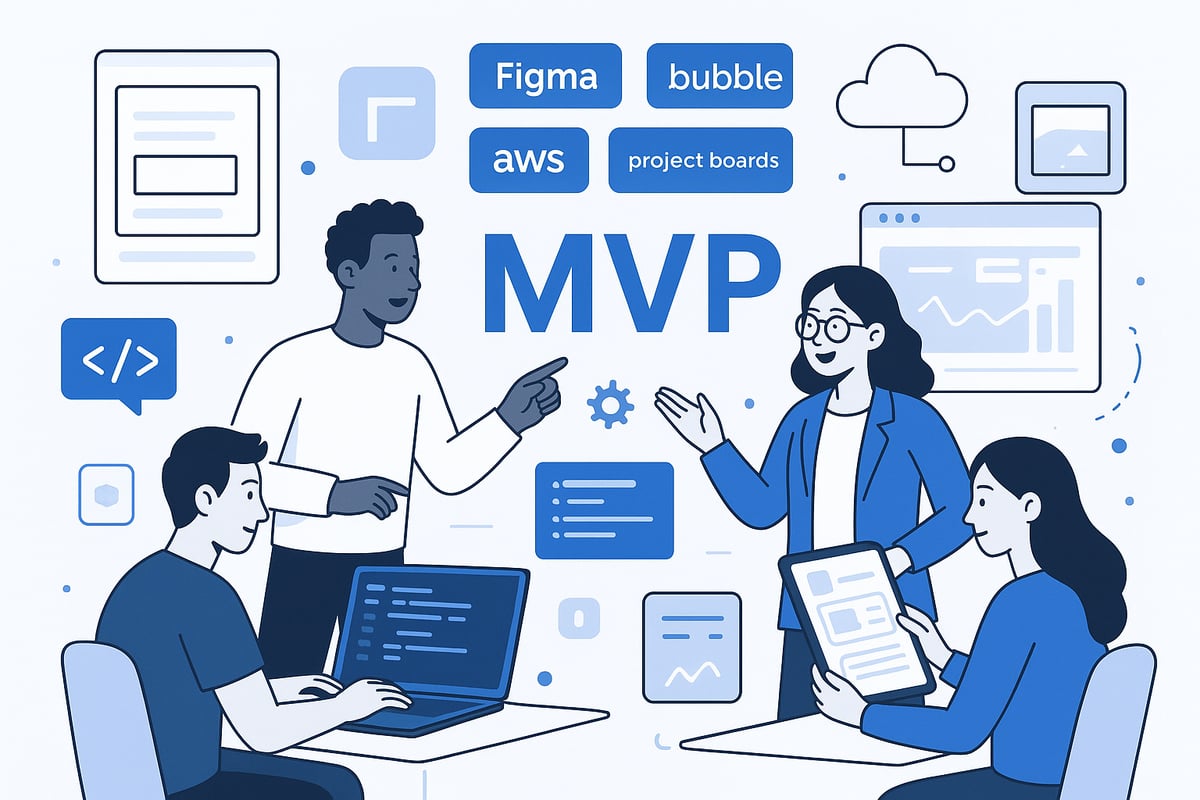
The right tools streamline every phase of MVP software creation. Here’s a quick overview:
| Role/Skill | Essential Tools |
|---|---|
| UI/UX Design | Figma, Sketch |
| No-Code/Low-Code | Bubble, Webflow |
| Version Control | GitHub |
| Project Management | Jira, Trello |
| Cloud Deployment | AWS, Azure |
| Analytics | Mixpanel, Google Analytics |
Using these tools, teams can iterate fast, track user data, and prepare MVP software for scale.
Why Cross-Functional Teams Matter
MVP software thrives when designers, developers, and marketers work together. Cross-functional teams bring diverse viewpoints, ensuring no critical aspect is overlooked. Competitor analysis shows that UI/front-end, back-end, and project management expertise are non-negotiable for MVP software success.
Startups are proving this approach works. Many now launch MVP software using no-code tools without needing a full-stack team, staying lean yet effective.
The Winning Formula for MVP Software in 2026
The most successful MVP software projects blend technical and soft skills, leverage modern tools, and build cross-functional teams. In 2026, this combination is the secret sauce for rapid validation and market traction.
No matter your background, focusing on the right skills and tools gives your MVP software a competitive edge in a fast-moving world.
MVP Software in Action: Real-World Examples and Case Studies
Real-world stories bring the power of mvp software into sharp focus. From scrappy startups to global enterprises, the path to innovation almost always starts with a well-crafted MVP. Let us dive into industry-transforming examples, both classic and cutting-edge, to see how mvp software shapes the future.
Classic MVP Software Success Stories
The roots of mvp software run deep in tech history. Amazon began as a humble online bookstore. Jeff Bezos focused on a single product category, using mvp software to validate demand before expanding. Airbnb’s first version included just one listing in their own apartment, letting founders test if people would actually book a stranger’s room. Facebook started as a Harvard-only network, using mvp software to prove students wanted a private, digital social space. Dropbox famously launched with an explainer video, gauging interest before building the product.
Here’s a quick comparison:
| MVP Software | Core Problem Solved | Initial Feature Set | Validation Method |
|---|---|---|---|
| Amazon | Book buying online | Book listings, checkout | Market demand, sales |
| Airbnb | Budget travel | Room listing, booking | Early bookings, feedback |
| Campus networking | Profiles, connections | User signups, virality | |
| Dropbox | File syncing | Video demo, signup page | Waitlist growth |
Each story highlights how mvp software delivers just enough value to test real demand, gather feedback, and iterate.
Modern 2026 MVP Software Examples
Today, mvp software is smarter, faster, and more accessible than ever. In fintech, startups use AI-powered mvp software to detect fraud in real time, rapidly adapting models based on user data. Healthtech innovators deploy mvp software for remote patient monitoring, integrating sensors and analytics to validate effectiveness before scaling. SaaS companies build AI-driven personalization into their mvp software, tracking user behavior to refine product-market fit.
According to industry experts, over 60 percent of MVPs in 2026 are built using no-code tools and advanced AI integrations. This shift accelerates development, lets teams test ideas across web, mobile, and even IoT, and reduces costs dramatically. If you want to explore how AI and no-code are reshaping MVPs, check out AI-Powered MVP Development Trends for the latest innovations.
Lessons Learned and Key Takeaways
What separates mvp software success from failure? The answer is relentless focus on validation and iteration. Startups that skip mvp software validation risk building products nobody wants. In fact, 42 percent of startups fail due to lack of market need, according to CB Insights. Analytics and user feedback are now non-negotiable for guiding every mvp software iteration.
MVP software is not only for startups. Enterprises use it to test new internal tools and business models before full deployment, slashing time-to-market by up to 4x and reducing costs. Teams that study real mvp software case studies avoid the common traps, learn from both wins and failures, and build a repeatable blueprint for success. For more on strategic approaches that help startups thrive with mvp software, visit Software Development for Startups.
After diving into the latest strategies and tools for building an MVP in 2026, you can see how much speed and flexibility matter in today’s market. If you’re ready to turn your idea into a real product without endless delays or ballooning costs, there’s a faster way to make it happen. You don’t have to do it alone or get stuck in traditional development cycles. Let’s get your MVP out there quickly so you can test, learn, and grow. Ready to build momentum? Launch Your MVP in Weeks, Not Months

About Big House
Big House is committed to 1) developing robust internal tools for enterprises, and 2) crafting minimum viable products (MVPs) that help startups and entrepreneurs bring their visions to life.
If you'd like to explore how we can build technology for you, get in touch. We'd be excited to discuss what you have in mind.
Other Articles
Unlock the power of Telegram AI with our 2026 guide Explore smart messaging features automation privacy tools and real world tips to boost productivity
Discover the future of application technology in 2026 Explore key trends AI integration cloud native architectures and best practices to drive innovation and success
Discover what an internal tool developer does, key skills needed, and how no-code platforms accelerate internal software development in 2026.