
The pace of digital innovation in 2025 is faster than ever, making the choice of application development platforms a critical decision for any business aiming to lead the market.
In this article, we reveal the top 7 application development platforms that will fuel business growth in the coming year. Whether you are a startup founder eager to launch your next big idea or an enterprise IT leader seeking robust solutions, your platform choice matters.
You will get side-by-side comparisons of each platform’s features, pricing, target users, and unique benefits. Discover which tools offer the speed, flexibility, and scalability you need.
Ready to stay ahead of the curve? Dive in for insights that will help you make the smartest move for your organization’s digital future.
What to Look for in a Modern Application Development Platform
Choosing the right application development platforms in 2025 can feel overwhelming, but knowing what to look for makes all the difference. With innovation accelerating, your platform choice impacts everything from speed to scalability.
Essential Features and Capabilities
Modern application development platforms must streamline the entire build process. Look for low-code or no-code tools that let you prototype and deploy quickly, often using intuitive drag and drop interfaces. Integration of AI and automation helps create smarter apps that adapt to user needs.
Cross-platform support is a must. Ensure your platform can handle web, mobile, and desktop from a single codebase. Security, compliance, and scalability should be built in from the start, not added as an afterthought.
Top platforms like Salesforce and Bubble combine drag-and-drop builders with workflow automation. Integration with third-party APIs and robust collaboration tools make team development seamless. If you want a deeper dive into these tool types, see No-code vs. low-code platforms.
Scalability, Flexibility, and Customization
As your business grows, application development platforms must scale with you. The best platforms support everything from small MVPs to enterprise-grade solutions. Modular architectures allow you to extend features as needed.
Customizable UI/UX components help you tailor the experience for your users. Handling increased user loads and large datasets should not slow down your app. Enterprises like OutSystems prove that reliable scalability is possible for mission-critical, high-traffic applications.
The right platform adapts to your business, whether you need rapid prototyping or robust enterprise systems.
Pricing Models and Total Cost of Ownership
Pricing for application development platforms varies widely. Common models include subscription-based, usage-based, and freemium tiers. Be mindful of hidden costs, such as integrations, premium support, or scaling beyond initial limits.
Consider return on investment. While no-code platforms may cost more upfront, they can reduce long-term development expenses by up to 75%, according to client testimonials. Balance development speed with projected costs over time.
Here’s a quick comparison:
| Model | Pros | Cons |
|---|---|---|
| Subscription | Predictable billing | May lack flexibility |
| Usage-based | Pays for growth | Can spike unexpectedly |
| Freemium | Start free | Limited features |
Support, Community, and Ecosystem
Strong support and a vibrant ecosystem are vital for application development platforms. Look for platforms with comprehensive documentation, tutorials, and responsive customer support.
Active developer communities and partner networks foster knowledge sharing and troubleshooting. Access to pre-built templates and libraries can speed up your build process.
Platforms like Microsoft Power Apps and Salesforce offer robust user forums and partner ecosystems. These resources help you overcome challenges and scale your projects with confidence.
Top 7 Application Development Platforms for 2025 Success
Choosing the right application development platforms can make or break your digital strategy in 2025. With the rapid evolution of technology, businesses must evaluate tools that offer the right balance of speed, flexibility, and scalability. If you need guidance on how to select the best fit for your enterprise, check out this Choosing the right no-code platform guide for a step-by-step approach to platform evaluation.
Below, we break down the seven leading application development platforms, each offering unique strengths for different business needs. Let’s dive in and see which one could power your next big innovation.
Big House Technologies – No-Code & AI Platform
Big House Technologies stands out among application development platforms for its powerful no-code and AI-driven approach. The platform offers flexible pricing plans, from Basic for MVPs to Growth for scaling and Enterprise for custom, robust solutions. This makes it accessible whether you are launching a startup or transforming enterprise workflows.
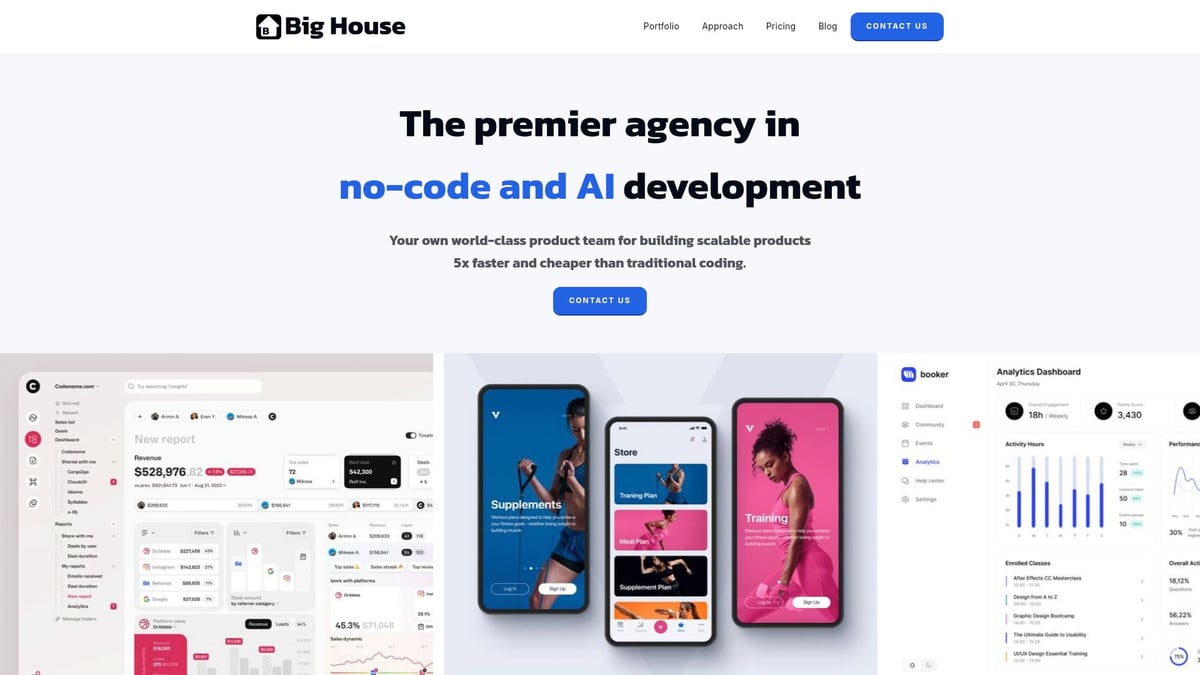
Core features include end-to-end no-code development powered by Bubble, seamless AI integration, Figma-based UI/UX design, rapid prototyping, thorough QA, and scalable deployment. These features ensure your application development platforms journey is both cost-effective and fast.
The key benefits are impressive: projects are delivered up to 5x faster and at 75% lower cost compared to traditional development. The collaborative, full-service approach suits both non-technical founders and large organizations. However, while Big House Technologies is ideal for most use cases, highly specialized projects may face limits with custom code flexibility.
Real-world success stories include Humi SR&ED, which achieved substantial cost savings and speed, and IMSI, which reduced rework and delays by €2M. For those seeking reliable, efficient application development platforms with deep no-code and AI expertise, Big House Technologies is a top contender.
Salesforce Platform
Salesforce Platform is a heavyweight among application development platforms, trusted by Fortune 500 companies worldwide. Its tiered pricing suits everyone from small businesses to large enterprises, with options for free trials and advanced paid features.

The platform boasts a drag-and-drop app builder, AI-powered automation, robust security, built-in CRM, workflow orchestration, and extensive third-party integrations. These capabilities make Salesforce Platform a unified hub for sales, service, marketing, and custom app development.
Key benefits include enterprise-grade security, a vast ecosystem, and deep customization options. However, its complexity can be a hurdle for smaller teams, and costs may rise at scale. Enterprises in regulated industries often favor Salesforce Platform for its security and compliance.
Global brands use Salesforce to drive customer engagement and automate operations, making it a reliable choice for organizations needing scalable, secure application development platforms with a proven track record.
OutSystems
OutSystems is a leading choice for enterprises seeking high-performance application development platforms. Offering a free edition for small projects and robust paid plans for scaling, it fits both entry-level and advanced needs.
Key features include visual low-code development, multi-experience support for web and mobile, advanced integrations, and automated deployment. OutSystems accelerates digital transformation, particularly for mission-critical applications in large organizations.
The platform supports rapid delivery, scalability, and strong governance. While its premium pricing and learning curve for complex customizations may deter smaller teams, OutSystems excels in scenarios where reliability and compliance matter most.
Banks and insurers rely on OutSystems to deliver secure, high-availability solutions, reinforcing its reputation as a powerhouse among application development platforms capable of handling high-traffic, enterprise-grade workloads.
Bubble
Bubble democratizes application development platforms by empowering non-developers to create sophisticated web apps. Its freemium pricing structure, with affordable paid tiers, makes advanced features and scaling accessible to startups and small businesses.

The platform offers a visual web app builder, integrated database management, a plugin marketplace, responsive design, and easy API integrations. Bubble’s active community and extensive resources lower the barrier to entry for new creators.
The main benefits are no-code flexibility, rapid MVP launches, and low costs. However, for very large-scale apps, performance may lag, and native mobile support is limited. Despite these trade-offs, Bubble is a favorite for founders who want to get to market quickly.
Many startups have used Bubble to launch MVPs in just weeks, proving its value as one of the most agile and accessible application development platforms today.
Microsoft Power Apps
Microsoft Power Apps is designed to bring application development platforms into the hands of business users. Its pricing is flexible, with per-user and per-app plans, and integrates seamlessly with Microsoft 365 and Azure environments.
Core features include a low-code app builder, AI Builder for intelligent automation, and connectors to hundreds of data sources. Native integration with Office 365 and Teams streamlines workflow creation and data access.
The platform empowers citizen developers and business analysts to automate processes and build apps without heavy IT involvement. While customization for highly unique needs can be limited, and licensing can be complex, the ease of use for Microsoft-centric organizations is unmatched.
Enterprises use Power Apps to digitize internal workflows and automate tasks, making it an essential tool for organizations already invested in the Microsoft ecosystem among application development platforms.
Appian
Appian is a top-tier choice for organizations needing application development platforms that excel at automating complex business processes. With custom enterprise pricing and a free trial, it caters mainly to large, compliance-heavy sectors.
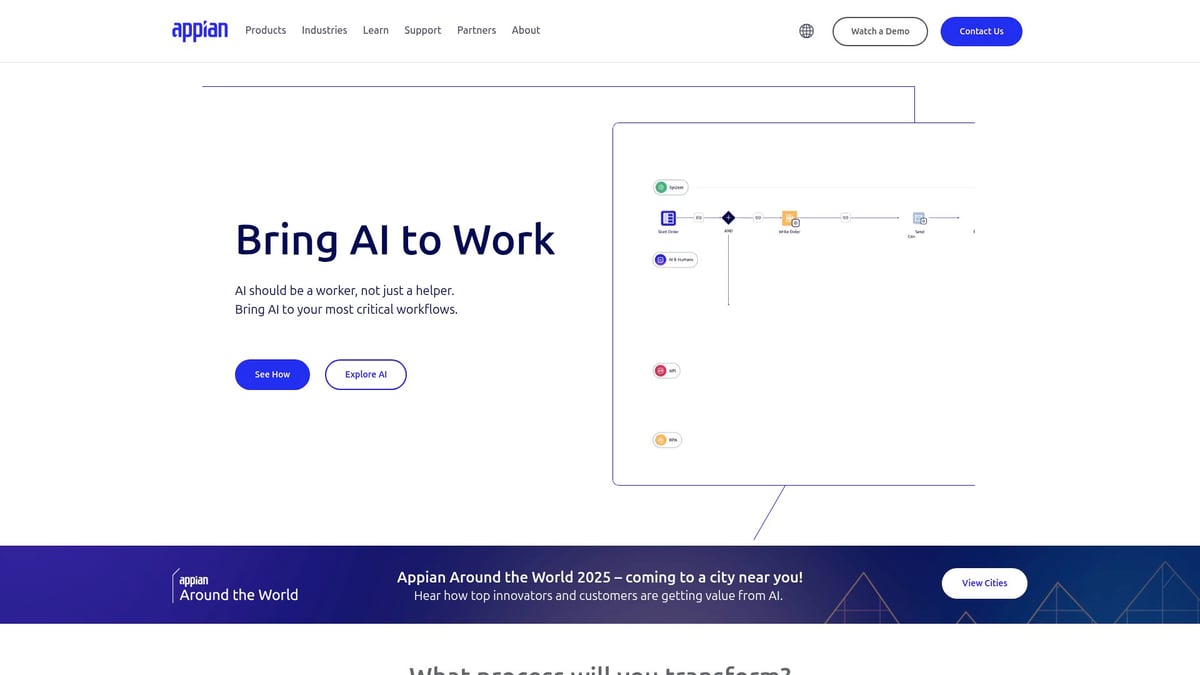
Key features include low-code automation, process modeling, AI and machine learning integration, case management, and unified data capabilities. Appian’s platform is well-known for streamlining operations in finance, healthcare, and other regulated industries.
Benefits include rapid process automation, robust compliance tools, and flexible deployment options. However, its premium pricing and feature set may be excessive for simple app requirements.
Financial institutions rely on Appian to automate compliance and risk management, highlighting its strength as a secure, efficient application development platform for demanding business environments.
Mendix
Mendix rounds out our list of top application development platforms with its collaborative, low-code environment. It provides a free community edition and scalable paid tiers for professional and enterprise users.
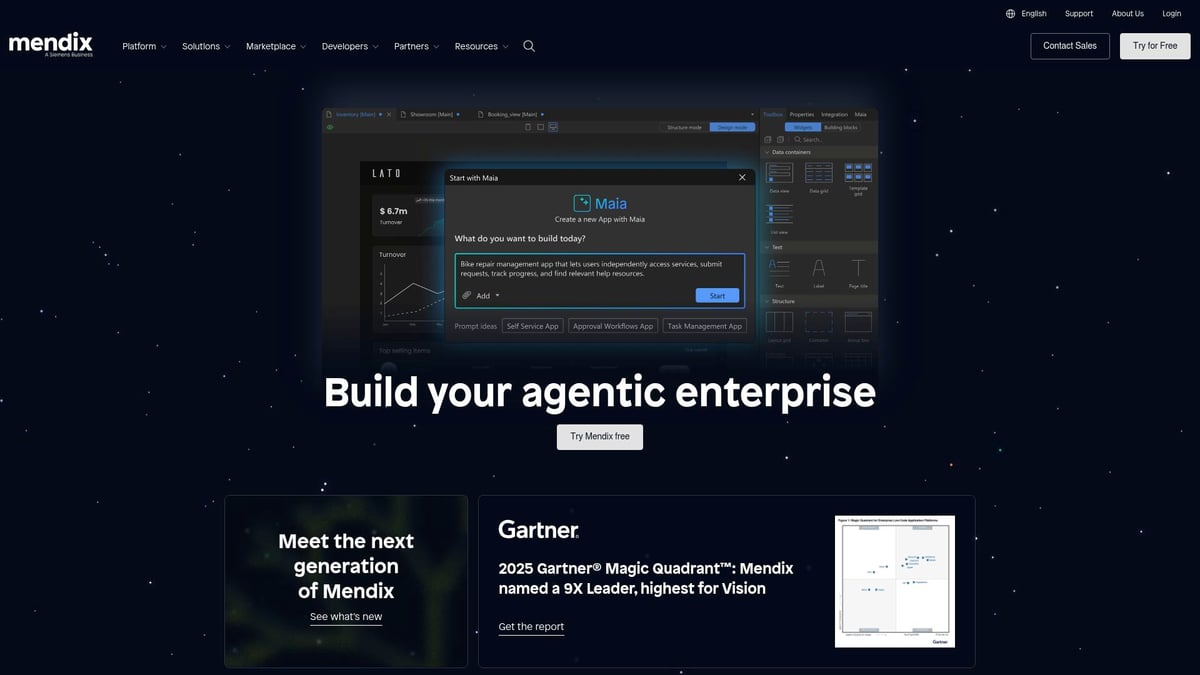
Core features include multi-cloud deployment, AI-assisted development, collaboration tools, and reusable components. Mendix bridges the gap between IT and business, supporting both citizen developers and seasoned coders.
The platform’s flexibility, support for complex and scalable apps, and strong collaborative features make it ideal for agile delivery. Advanced capabilities require higher-tier subscriptions, and organizations may need IT buy-in for optimal governance.
Manufacturing companies use Mendix to digitize supply chains and modernize operations, illustrating its value as a versatile and robust application development platform.
Comparison Table: Top 7 Application Development Platforms
| Platform | Pricing | Best For | Key Strengths | Notable Limitation |
|---|---|---|---|---|
| Big House Technologies | Flexible (Basic to Enterprise) | Startups, Enterprises | Speed, Cost-efficiency, No-code/AI | Limited for highly specialized code |
| Salesforce Platform | Tiered (Free trial, Paid) | Enterprises, Regulated Industries | Security, Ecosystem, Customization | Complexity, Cost at scale |
| OutSystems | Free, Paid plans | Large Enterprises | Scalability, Governance, Performance | Learning curve, Price |
| Bubble | Freemium, Paid tiers | Startups, Small Businesses | No-code, Affordability, MVP speed | Performance at scale, Mobile limits |
| Microsoft Power Apps | Per-user, Per-app | Microsoft-centric Enterprises | Office integration, Usability | Customization, Licensing |
| Appian | Custom Enterprise | Regulated, Automation-heavy | Compliance, Automation, Flexibility | Premium pricing, Overkill for simple |
| Mendix | Free, Paid tiers | IT & Business Collaboration | Flexibility, Collaboration, Scalability | Advanced features cost more |
With these top application development platforms, you can confidently match your business needs to the right technology, driving efficiency, scalability, and innovation in 2025.
2025 Trends Shaping Application Development Platforms
The landscape for application development platforms is evolving faster than ever in 2025. New trends are reshaping how organizations build digital solutions and respond to market demands. Let’s explore the four key trends driving change this year.
Rise of No-Code/Low-Code Solutions
No-code and low-code tools are democratizing access to application development platforms. In 2025, business users and non-developers can launch apps with minimal coding skills, accelerating innovation and reducing bottlenecks.
Gartner predicts that 70% of new applications will be built using these tools by 2025. Platforms like Bubble and Big House Technologies are leading the way, making it possible to create MVPs in record time. This shift empowers teams to experiment, iterate, and deliver business value faster than ever before. For more insights, see the Gartner's 2025 Low-Code Development Forecast.
AI and Automation Integration
AI is now at the core of modern application development platforms. Intelligent automation, predictive analytics, and smart workflows are becoming standard features.
Platforms like Salesforce with Einstein AI and Microsoft Power Apps’ AI Builder show how integrating machine learning can streamline processes. These capabilities reduce manual tasks, enhance user experience, and enable organizations to make data-driven decisions. As AI continues to evolve, expect even more powerful automation tools to emerge in application development platforms.
Focus on Security and Compliance
Security and compliance are top priorities for application development platforms in 2025. With growing regulatory requirements such as GDPR and HIPAA, businesses need built-in security features and robust audit trails.
OutSystems and Appian set the standard by offering comprehensive compliance modules, role-based access controls, and automated monitoring. This focus enables organizations to build secure, trustworthy solutions while minimizing risk and adhering to industry regulations. Security is no longer optional—it’s a fundamental requirement for every application development project.
Multi-Experience and Omnichannel Development
Today’s users expect seamless experiences across web, mobile, and connected devices. Application development platforms are responding by supporting cross-platform deployment, responsive design, and integration with IoT.
Mendix and OutSystems enable teams to deliver multi-experience apps that work everywhere users are. This trend ensures consistent branding, user satisfaction, and broader reach. By choosing platforms with strong omnichannel capabilities, businesses future-proof their digital strategies and stay ahead in a competitive landscape.
How to Choose the Right Application Development Platform for Your Business
Selecting the right application development platforms in 2025 can make or break your digital transformation goals. The sheer variety of options can feel overwhelming, but a thoughtful approach helps ensure your investment delivers speed, flexibility, and lasting value.
Start by mapping your business objectives to platform capabilities. Do you need rapid prototyping, enterprise-grade scalability, or deep integrations with existing tools? Understanding your priorities helps narrow down the vast landscape of application development platforms.
Key factors to evaluate:
- Speed and Flexibility: How quickly can you go from idea to launch? Platforms like Big House Technologies and Bubble excel at rapid MVP delivery.
- Scalability: Can the platform handle growth, spikes in users, and increased data demands?
- Customization: Does it support the unique workflows and features your business requires?
- Integration: Are there built-in connectors for tools like CRM, analytics, or payment gateways?
- Total Cost of Ownership: Look beyond sticker price. Consider pricing models, hidden costs, and ongoing support.
- Ecosystem: Access to templates, plugins, and a strong community can accelerate development and troubleshooting.
- Security & Compliance: Are built-in security controls and compliance certifications available for your industry?
When evaluating application development platforms, match their strengths to your team’s technical skill set. Low-code or no-code options can empower non-developers, speeding up delivery and reducing reliance on specialized coding skills. For enterprises considering a shift to no-code, reviewing the key benefits of no-code for enterprises can clarify the value proposition.
It pays to compare pricing models closely. Subscription-based, usage-based, and freemium pricing all impact your long-term ROI. Be sure to factor in costs for scaling, integrations, and premium support.
Security and compliance are non-negotiable for regulated industries. Platforms like Salesforce and OutSystems offer robust governance, while others prioritize speed and agility for startups. If you’re seeking a deeper dive into custom approaches, the custom application development guide 2025 provides an in-depth analysis.
7-Point Platform Evaluation Checklist:
- Align platform features with your business goals.
- Assess scalability for current and future needs.
- Evaluate ease of use for your team’s skill level.
- Compare total cost of ownership, including hidden fees.
- Check for strong ecosystem support and communities.
- Verify security, compliance, and data protection standards.
- Test with a pilot project or free trial before committing.
With these steps, you can confidently shortlist application development platforms that fit your unique needs, ensuring your next project is built for the future.
Real-World Success Stories: Application Development in Action
Businesses of all sizes are leveraging application development platforms to accelerate digital transformation and drive results in 2025. Let us examine how six organizations achieved success with leading platforms.
Humi SR&ED & Big House Technologies:
Humi SR&ED needed a fast, cost-effective way to launch a robust app. Using Big House Technologies, they built a full-featured solution in record time. The no-code approach reduced costs by 75 percent and allowed their team to iterate rapidly. This demonstrates how application development platforms empower startups to focus on growth rather than technical barriers.
Fortune 500 Company & Salesforce Platform:
A Fortune 500 enterprise sought to transform their customer engagement strategy. By adopting the Salesforce Platform, they unified sales, service, and marketing processes. The platform’s automation and integration capabilities streamlined operations, leading to improved customer satisfaction and measurable ROI.
Financial Firm & Appian:
A major financial institution turned to Appian to automate compliance and risk management workflows. With Appian’s low-code automation, they reduced manual processes and ensured regulatory adherence. The result was faster audits, fewer errors, and stronger data governance.
Startup & Bubble:
One startup needed to quickly validate their SaaS concept. Bubble’s visual builder enabled them to launch a minimum viable product in weeks with no coding skills required. This rapid prototyping allowed them to secure investor interest and gather user feedback, highlighting the agility of modern application development platforms.
Enterprise & Microsoft Power Apps:
An enterprise organization wanted to digitize internal workflows without hiring a large development team. Using Microsoft Power Apps, business analysts created custom apps that automated approvals and streamlined communications. Integration with Microsoft 365 made adoption seamless across departments.
Manufacturing Company & Mendix:
A manufacturing company used Mendix to modernize supply chain operations. By building scalable, multi-experience apps, they digitized inventory tracking and improved real-time collaboration between teams. This led to operational efficiencies and better response to market demands.
Across industries, these stories reveal common themes: faster time to market, collaborative development, and scalable solutions. According to Gartner's Magic Quadrant on Low-Code vs No-Code, organizations choosing the right application development platforms are positioned for greater agility and innovation in the evolving digital landscape.
After exploring the top application development platforms for 2025, you’ve seen how speed, flexibility, and cost-efficiency are game changers—especially when launching a new product or MVP. If you’re feeling inspired to turn your idea into a working app without getting bogged down by months of development, you’re not alone. You can take the next step and see just how quickly your vision can become a reality. Ready to start building? Launch Your MVP in Weeks, Not Months.

About Big House
Big House is committed to 1) developing robust internal tools for enterprises, and 2) crafting minimum viable products (MVPs) that help startups and entrepreneurs bring their visions to life.
If you'd like to explore how we can build technology for you, get in touch. We'd be excited to discuss what you have in mind.
Other Articles
Discover the latest software testing best practices and trends for 2025. Learn how automation, AI, and modern strategies can enhance software quality and reliability.
Discover everything about design and development in 2025. Explore trends, tools, processes, and best practices to boost your skills and achieve project success.
Discover how to select the right custom software development company in 2025 with expert tips on evaluation, pricing, and collaboration to ensure project success.