
Imagine a near future where application technology is the backbone of every business and personal experience, fueled by AI, automation, and cloud-native solutions. The pace of change is breathtaking, reshaping how we work, connect, and innovate.
This essential guide will help you navigate the trends, breakthroughs, and best practices defining application technology in 2026. We will explore its evolution, the impact of AI and no-code platforms, new architectures, industry-specific shifts, and proven implementation strategies.
Staying ahead means adapting quickly. Harnessing application technology now can unlock efficiency, growth, and new possibilities. Ready to future-proof your approach? Dive into this guide and prepare for what lies ahead.
The Evolution of Application Technology: 2020–2026
The period from 2020 to 2026 has been a whirlwind for application technology. Organizations and individuals have witnessed a dramatic shift in how applications are designed, built, and used. These years have set the stage for a new digital era, defined by rapid innovation, increased automation, and a relentless focus on delivering value faster.
Major Milestones in Application Technology
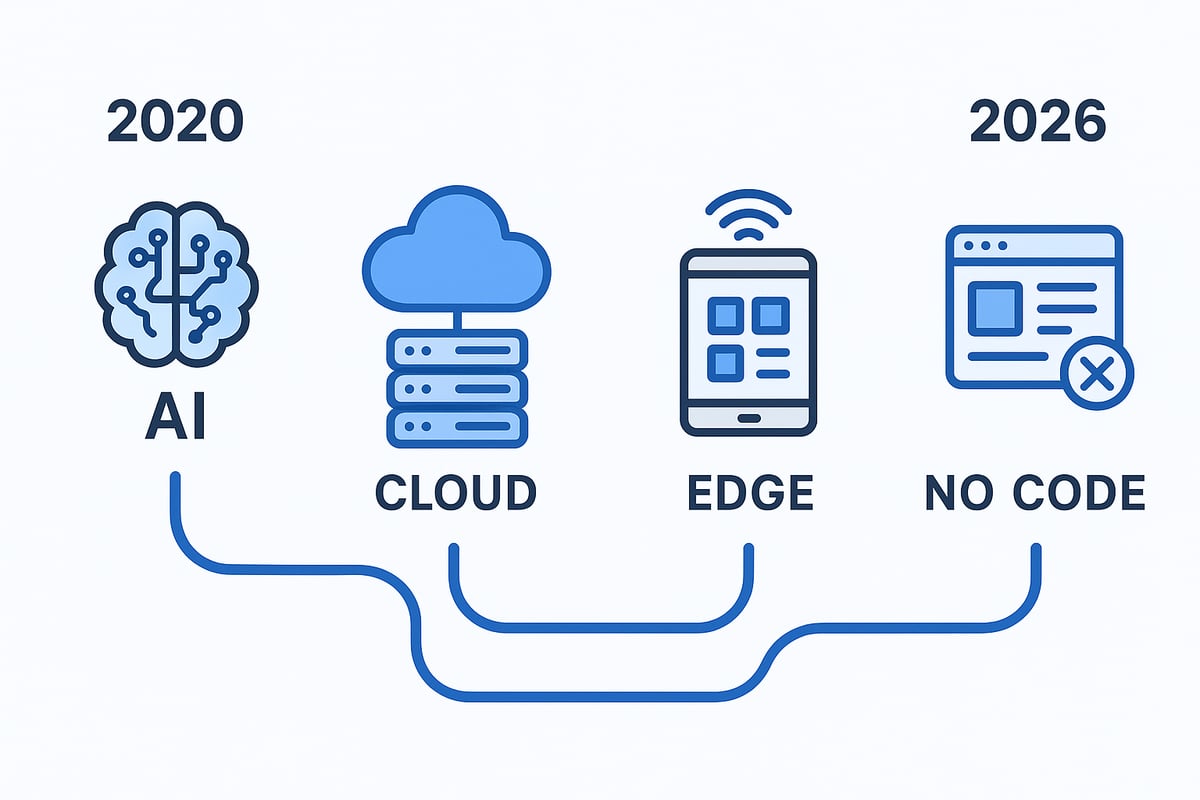
Application technology has experienced several transformative milestones since 2020. The adoption of artificial intelligence and machine learning has accelerated, with over 97% of companies integrating AI into software engineering. This widespread use of AI has not only powered automation and analytics but also improved developer productivity, as seen in a 31% reduction in code review times.
Cloud computing has become the backbone of modern application technology. By 2026, cloud adoption rates have soared, making scalable infrastructure accessible to businesses of all sizes. Edge computing has also emerged, allowing data to be processed closer to its source, which is crucial for real-time applications like autonomous vehicles and smart factories.
A significant architectural shift has occurred, moving from monolithic systems to microservices and serverless models. This transition has enabled organizations to build applications that are more modular, resilient, and easier to update. The rise of low-code and no-code platforms has further democratized application technology, empowering business users to build solutions without deep technical expertise.
Data-driven decision-making has become the norm, with real-time analytics integrated into most platforms. The application ecosystem now commonly includes IoT devices and automation tools, creating interconnected environments that drive efficiency. Security and privacy by design are now mandatory, as organizations face increasing regulatory and user expectations. For a deeper dive into these advancements, see this helpful resource on application technology advancements.
Changing Business and User Demands
The evolution of application technology has also been shaped by shifting business and user expectations. People now demand highly personalized, fast, and reliable experiences. Mobile-first design is no longer optional, as users expect seamless access across all devices and channels.
Businesses require solutions that are scalable and flexible. Interoperability is key, especially as enterprises adopt composable architectures to respond quickly to market changes. These architectures allow organizations to assemble and reassemble application components like building blocks, supporting agility and innovation.
The impact of remote and hybrid work has been profound. Development teams now collaborate across distributed environments, relying on cloud-based tools and automated workflows. This shift has influenced how application technology is developed and delivered, making adaptability a top priority.
Security remains central to business demands. With more data moving through interconnected systems, organizations are embedding privacy and compliance measures into every stage of application development. The result is a landscape where application technology must not only meet functional needs but also deliver trust and confidence.
Application technology, shaped by these milestones and demands, is set for continued transformation. As we look ahead, embracing these changes will be essential for staying ahead in a competitive world.
Key Trends Shaping Application Technology in 2026
The landscape of application technology is changing faster than ever. From artificial intelligence to serverless computing, the trends shaping 2026 are transforming how we build, deploy, and interact with software. Let’s explore the most impactful developments you need to watch.
Artificial Intelligence and Machine Learning Integration
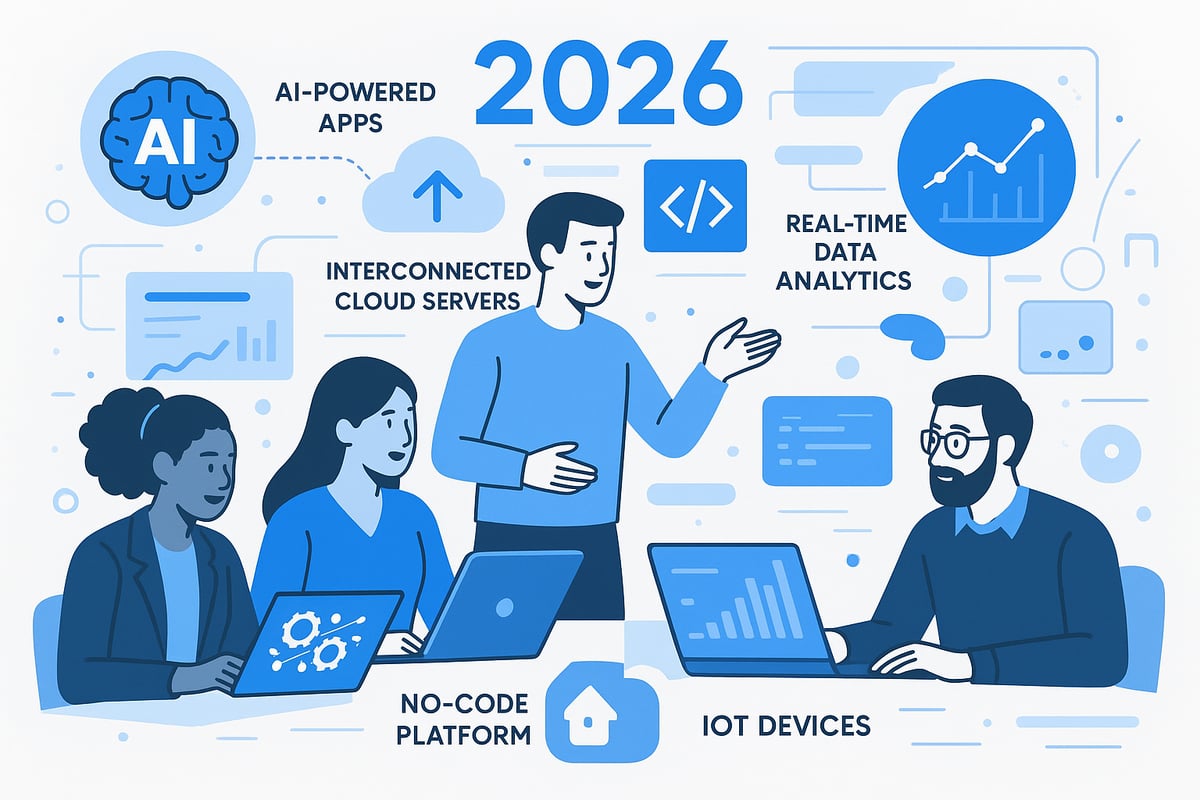
AI and machine learning are at the core of modern application technology. In 2026, nearly every new application will leverage AI for automation, analytics, and user personalization. From intelligent chatbots that handle customer service to predictive analytics that optimize business decisions, AI is everywhere.
According to a recent global survey, 97.5% of companies have already adopted AI in software engineering. This shows how deeply AI is woven into application technology. Security is also evolving, with AI-driven tools detecting and responding to threats in real time.
The result is smarter, more responsive software that learns and adapts. As AI models become more advanced, expect application technology to deliver even richer, more customized experiences for users.
The Rise of No-Code and Low-Code Platforms
No-code and low-code platforms are democratizing application technology. Now, business users can build solutions without writing a single line of code. Enterprises are embracing these platforms to develop internal tools and launch minimum viable products rapidly.
Popular platforms like Bubble and Lovable enable teams to iterate quickly. The benefits are clear: reduced development time, lower costs, and greater innovation. However, challenges remain, such as ensuring governance, integrating with existing systems, and scaling applications as needs grow.
For organizations looking to stay competitive, adopting no-code and low-code is becoming a must in the evolving application technology landscape.
Cloud-Native and Serverless Architectures
Cloud-native and serverless architectures are now the standard for application technology. Companies are moving away from monolithic designs toward microservices, containers, and serverless computing. This shift brings scalability, cost efficiency, and improved resilience.
Migrating legacy apps to cloud-native stacks allows businesses to respond quickly to market changes. Estimates suggest that by 2026, 85% of new applications will be cloud-native. This approach also simplifies maintenance and upgrades, freeing up teams to focus on innovation.
As organizations continue to migrate, cloud-native application technology will help unlock new levels of agility and performance.
Edge Computing and IoT Integration
Edge computing is transforming application technology by processing data closer to its source. This trend is crucial for real-time applications, where latency and bandwidth matter. Smart factories and autonomous vehicles are prime examples, relying on edge computing for instant decisions.
Integrating IoT devices into application technology ecosystems enhances automation and data collection. The result is faster, more reliable services for end users. As the number of connected devices grows, edge computing will become a cornerstone of modern application technology.
Organizations investing in this trend will gain a competitive edge in delivering seamless, real-time experiences.
Enhanced Security, Compliance, and Privacy
Security and privacy are now built into every stage of application technology development. Regulatory pressures like GDPR and CCPA require organizations to prioritize compliance. AI is increasingly used for automated compliance monitoring, making it easier to identify and address risks.
Application technology teams are embedding security features from the ground up. This includes encryption, access controls, and real-time monitoring. The focus on privacy by design ensures that user data is protected throughout the application lifecycle.
Staying ahead of threats and regulations means application technology will continue to evolve, keeping security and trust at the forefront.
Application Technology Architecture: Best Practices for 2026
The rapid evolution of application technology demands a strong architectural foundation. Adopting forward-thinking best practices ensures your solutions are scalable, secure, and future-ready. Let’s explore the architectural pillars shaping application technology in 2026.
Principles of Modern Application Architecture
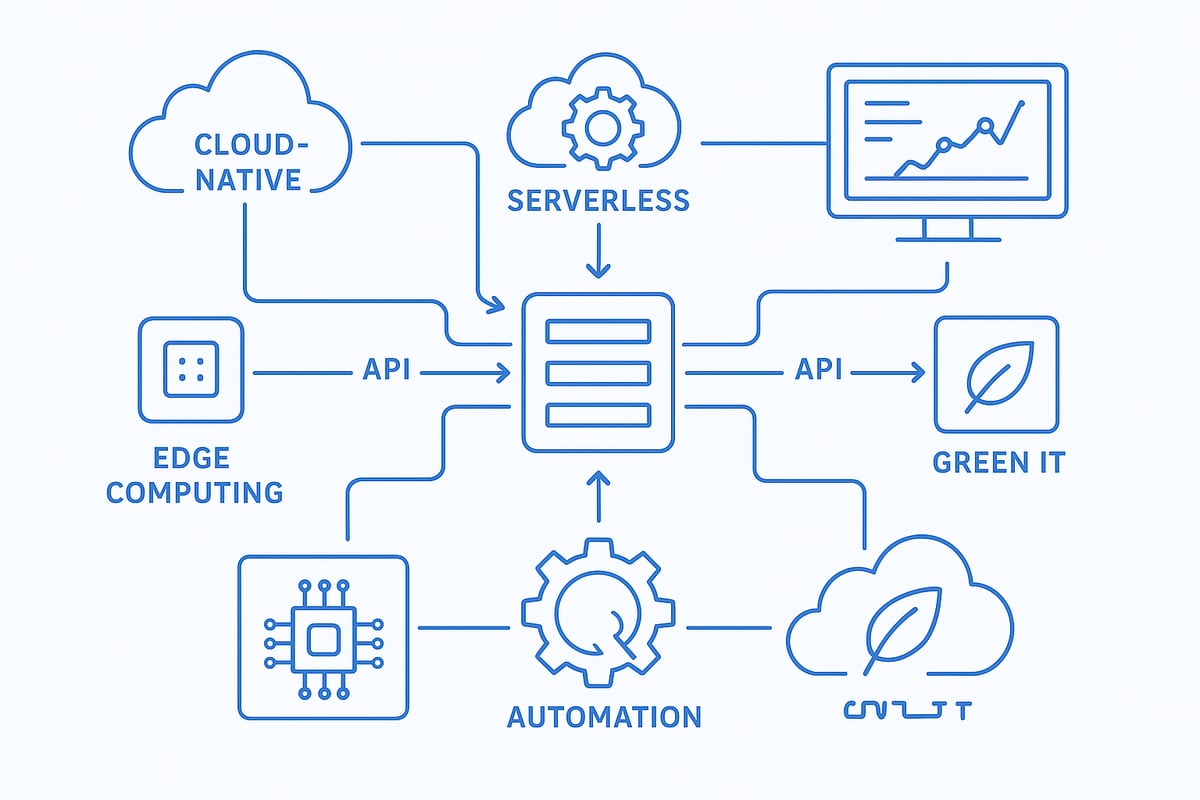
Modern application technology architecture is built on modularity, composability, and API-first design. Each component should be independently deployable, easily updated, and reusable across projects.
A focus on open standards and interoperability unlocks greater flexibility. For instance, adopting RESTful APIs and industry-standard protocols allows seamless integration with other solutions.
Scalability and maintainability are non-negotiable. Your architecture should handle growth gracefully, whether you’re deploying for ten users or ten million. Composable services and automated scaling ensure the system remains robust.
| Principle | Description | Benefit |
|---|---|---|
| Modularity | Break apps into independent, reusable components | Faster updates |
| API-First | Prioritize API design for all features | Easier integration |
| Open Standards | Use widely adopted protocols and formats | Interoperability |
| Scalability | Design for horizontal/vertical scaling | Handles growth |
| Maintainability | Simplify updates and debugging | Lower long-term cost |
By centering your strategy on these principles, you set the stage for application technology that thrives in a fast-paced digital world.
Integration and Interoperability
Connecting diverse systems is a core challenge for application technology in 2026. Businesses often rely on a mix of legacy and modern platforms, making seamless data flow essential.
APIs act as the glue, enabling different applications to communicate reliably. Middleware solutions and integration platforms orchestrate these connections, mapping dependencies and standardizing data exchange.
Enterprise architecture tools help visualize and manage these integrations. By documenting system relationships and dependencies, organizations can prevent bottlenecks and reduce downtime.
An interoperable approach ensures your application technology adapts quickly to new requirements and opportunities.
Automation and DevOps
Automation and DevOps practices have revolutionized how teams deliver application technology. Continuous integration and deployment (CI/CD) pipelines, automated testing, and infrastructure as code reduce manual errors and speed up releases.
DevOps adoption is projected to reach 80% of enterprises, reflecting its impact on agility and reliability. Teams use GitOps to manage infrastructure changes with version control, ensuring transparency and repeatability.
AI-driven tools are increasingly woven into DevOps workflows. Solutions like AI-powered application tools boost productivity by automating code reviews and suggesting improvements.
Key DevOps best practices:
- Implement automated testing for every commit
- Use IaC for consistent infrastructure provisioning
- Monitor deployments with real-time feedback
With these strategies, application technology teams deliver value faster and with greater confidence.
Observability and Monitoring
Visibility is essential for maintaining resilient application technology. Real-time monitoring, logging, and analytics provide the insights needed to detect and address issues before they impact users.
AIOps platforms analyze vast data streams to identify anomalies, predict failures, and recommend fixes. For example, process analytical technology (PAT) is widely used in manufacturing for continuous quality monitoring and optimization.
Effective observability tools help teams spot patterns, track performance, and ensure compliance. Dashboards and automated alerts keep everyone informed, supporting proactive operations.
Robust monitoring is a cornerstone of reliable application technology in complex, distributed environments.
Sustainability and Green IT
Sustainability is now a key consideration in application technology architecture. Energy-efficient design reduces environmental impact and operating costs.
Cloud providers increasingly offer carbon-neutral hosting options. By optimizing resource allocation and using serverless functions, teams can minimize waste and maximize efficiency.
Sustainable practices include:
- Designing for low energy consumption
- Choosing green-certified cloud services
- Monitoring and reporting on energy usage
Balancing high performance with environmental responsibility positions your application technology for long-term success.
Sector-Specific Impacts and Use Cases
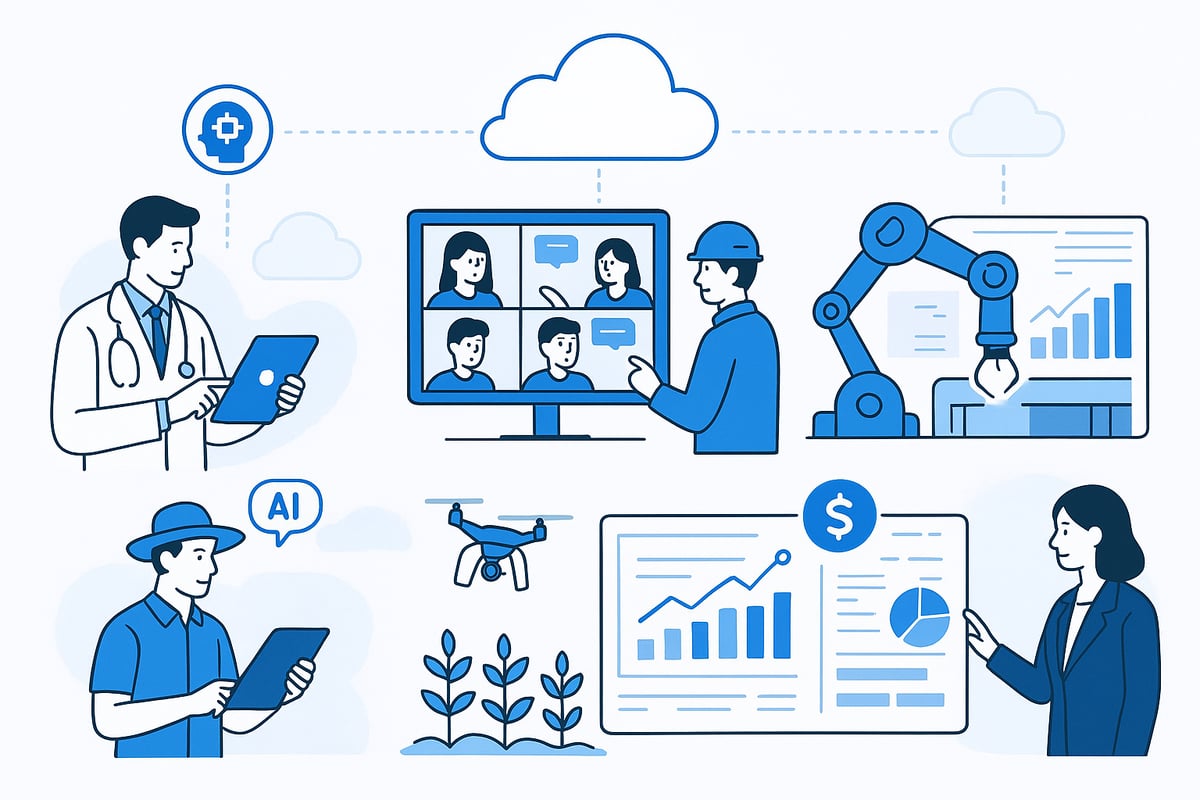
The reach of application technology is vast, with every industry experiencing its transformative power in unique ways. From healthcare to finance, its adoption is driving innovation, efficiency, and new possibilities that were unimaginable just a few years ago.
Application Technology in Healthcare
Application technology is reshaping healthcare by enabling telemedicine, remote diagnostics, and AI-driven patient care. Hospitals and clinics now rely on virtual visits and real-time data to monitor patients and deliver more personalized treatment.
For example, mental health services increasingly use telecommunications platforms, providing accessible care for patients regardless of location. The surge in healthcare app adoption after 2020 reflects a broader shift toward digital-first interactions. With application technology, providers can analyze large volumes of medical data and deliver faster, more accurate diagnoses.
Application Technology in Education
Education has seen a dramatic transformation thanks to application technology. EdTech platforms support adaptive learning, allowing students to follow customized learning paths based on their strengths and weaknesses.
Digital science probes and computer-based assessments are now common in classrooms, giving teachers real-time feedback on student progress. Schools have embraced large-scale hardware and software adoption, ensuring that learning continues, whether in person or remotely. Application technology equips educators with the data and tools needed for more effective teaching and learning.
Application Technology in Manufacturing and Industry
Manufacturing and industry are leveraging application technology to create smart factories and automate complex processes. IoT-enabled sensors monitor equipment health, enabling predictive maintenance and reducing downtime.
Process analytical technology (PAT) is especially valuable in pharmaceutical manufacturing, ensuring product quality through real-time data analytics. Automation of quality control and supply chain management has led to more efficient and resilient operations. Application technology empowers teams to make data-driven decisions and optimize production at every stage.
Application Technology in Agriculture
Agriculture benefits greatly from application technology, especially in the era of precision farming. Farmers use robotics, GPS, GIS, and advanced analytics to monitor crops and manage resources more efficiently.
Application technology supports biopesticide application, crop health monitoring, and yield prediction. Drones and smart sensors provide data that helps maximize output while reducing environmental impact. As a result, farms become more sustainable and responsive to changing conditions.
Application Technology in Finance and Retail
Finance and retail sectors depend on application technology for security, customer experience, and operational efficiency. AI-powered fraud detection systems protect transactions, while personalized banking apps cater to individual customer needs.
Retailers use real-time analytics to gain insights into consumer behavior, optimize inventory, and automate marketing campaigns. Some enterprises are even turning to no-code for enterprise app development to rapidly build internal tools that streamline business processes and enhance customer engagement. Application technology is central to staying competitive in these fast-moving markets.
Implementing Application Technology: Strategies for Success in 2026
Adopting application technology in 2026 requires more than just choosing the latest tools. Success depends on assembling the right team, selecting optimal platforms, ensuring compliance, managing change, and measuring outcomes. Each of these elements plays a vital role in driving real value from application technology investments.
Building the Right Team and Skills
A winning application technology strategy starts with the right people. Cross-functional teams that blend developers, data scientists, security experts, and business analysts are essential. As AI and automation become embedded in daily workflows, upskilling is no longer optional.
Organizations are investing in continuous learning to keep up with evolving trends in application technology. According to recent industry surveys, 77% of engineering leaders cite AI integration as a significant challenge, highlighting the need for specialized skills and adaptive mindsets. Teams that prioritize flexibility and ongoing education will remain competitive as technology evolves.
Selecting the Right Platforms and Tools
Choosing the correct platforms is central to successful application technology implementation. The landscape now includes no-code, low-code, and traditional development environments. When evaluating options, consider scalability, integration capabilities, and alignment with organizational goals.
Interoperability with existing systems is critical. Business leaders should look for platforms that support open standards and provide robust integration features. For a comprehensive review of current options, see Selecting application development platforms. Making informed decisions here can accelerate deployment and reduce long-term technical debt.
Governance, Risk, and Compliance Management
Application technology must be implemented within a robust governance framework. Establishing clear policies for security, privacy, and regulatory compliance is essential. Automated tools for compliance monitoring and audit trails can help organizations stay ahead of evolving regulations.
Embedding data management processes within enterprise architecture ensures that application technology aligns with both business and legal requirements. Regular reviews and updates to governance policies keep systems resilient in the face of new threats and standards.
Change Management and User Adoption
Even the most advanced application technology will fall short if users resist adoption. Change management is about more than training; it involves fostering a culture of innovation and open communication.
Successful organizations communicate the benefits of new technology clearly and provide ongoing support. Lessons from large-scale rollouts show that involving end users early and addressing concerns head-on can significantly boost adoption rates. This approach transforms resistance into enthusiasm for application technology.
Measuring Value and Continuous Improvement
Measuring the value of application technology investments is crucial for long-term success. Setting clear KPIs and tracking ROI enables organizations to make data-driven decisions. Analytics tools and dashboards provide real-time insights into performance and user engagement.
Continuous improvement should be a core principle. Studies show that many enterprises struggle to realize measurable impact from generative AI projects, often due to flawed integration strategies. By focusing on value and iterative optimization, organizations can maximize the benefits of application technology and stay ahead in a rapidly changing landscape.
The Future of Application Technology: What to Expect Beyond 2026
The landscape of application technology is set to transform even further beyond 2026. As new breakthroughs emerge, organizations and users alike will see shifts in both capabilities and expectations. Staying ahead means understanding not just the technologies themselves, but also the ethical, strategic, and cultural shifts that will shape tomorrow's digital world.
Emerging Technologies on the Horizon
Looking beyond 2026, several emerging technologies promise to redefine application technology. Quantum computing is moving from theory to practice, offering exponential gains in computational power. This leap will enable applications to solve previously intractable problems, from complex simulations to real-time logistics optimization.
The rollout of 6G networks will provide unprecedented speed and bandwidth. This will empower application technology to support immersive experiences, such as real-time AR collaboration and high-fidelity remote diagnostics. Advanced AI, including more robust generative models, will become deeply embedded in both consumer and enterprise software. However, a recent MIT Study on Generative AI's Business Impact found that 95% of generative AI implementations in enterprises currently lack measurable impact, highlighting the need for better integration strategies.
As these technologies mature, application technology will need to evolve to harness their full potential, driving efficiency, innovation, and entirely new business models.
Evolving User Expectations and Experiences
User expectations for application technology will continue to rise. Hyper-personalization will become the norm, with applications adapting in real time to individual needs and preferences. Immersive interfaces, including AR, VR, and voice-driven environments, will reshape how people interact with digital tools.
For example, conversational AI will be woven into customer service platforms, making interactions more natural and efficient. Users will expect seamless, intuitive experiences across all devices. Application technology will need to deliver consistent performance, security, and privacy, regardless of context.
This shift means developers and businesses must prioritize user-centric design, continuous feedback loops, and rapid iteration to stay relevant in a dynamic landscape.
The Role of Ethics and Responsible Innovation
As application technology advances, ethical considerations will move to the forefront. Issues like AI bias, transparency, and accountability will be central to both design and deployment. Regulatory pressures will only intensify, requiring organizations to build compliance into every layer of their technology stack.
A recent Gartner Survey on AI Integration Challenges highlights that 77% of engineering leaders find integrating AI into applications a significant challenge, underscoring the complexities of responsible innovation. Companies must implement robust governance frameworks, ethical AI guidelines, and transparency mechanisms to build trust with users and regulators.
Application technology teams will need to work closely with compliance officers, ethicists, and legal experts to navigate this evolving environment.
Preparing for Continuous Disruption
The pace of change in application technology shows no signs of slowing down. Organizations must build adaptable, future-proof strategies to thrive. This means investing in innovation labs, running pilot programs, and adopting agile and composable business models.
Cross-functional teams will be critical, combining technical expertise with domain knowledge and creative thinking. Application technology leaders must foster a culture of experimentation, encouraging teams to learn from both successes and failures.
By anticipating disruption and embracing change, businesses can turn uncertainty into opportunity, ensuring long-term resilience and growth.
Predictions and Expert Insights
Industry experts forecast dramatic growth for application technology in the coming years. The table below summarizes some key predictions shaping the landscape beyond 2026:
| Forecast Area | Expert Insight |
|---|---|
| AI Adoption | AI will be embedded in 90% of business-critical applications. |
| Quantum Computing | Early enterprise adoption in logistics, finance, and healthcare. |
| User Experience | 70% of apps will support immersive or conversational interfaces. |
| Compliance | Automated compliance checks will become industry standard. |
| Sustainability | Green IT and energy-efficient design will drive platform choices. |
As application technology evolves, staying informed and agile will be crucial. Analysts agree that organizations prepared to adapt will lead the next wave of digital transformation.
You’ve just explored how application technology is evolving at lightning speed, from AI and no code platforms to cloud native architectures. If you’re feeling inspired to turn your ideas into reality and want to take advantage of these trends, you don’t have to wait months to see results. With the right approach and tools, launching your MVP can be faster, easier, and more affordable than you think. Ready to see how quickly you can get your product off the ground? Launch Your MVP in Weeks, Not Months

About Big House
Big House is committed to 1) developing robust internal tools for enterprises, and 2) crafting minimum viable products (MVPs) that help startups and entrepreneurs bring their visions to life.
If you'd like to explore how we can build technology for you, get in touch. We'd be excited to discuss what you have in mind.
Other Articles
Master video creation in 2025 with this Synthesia AI guide covering features, real world uses, step by step tutorials, and future trends for business success.
Unlock the potential of no-code tools like Bubble to create scalable MVPs quickly and efficiently. Discover strategies, best practices, and essential resources for successful product development.
Master every stage of the development phase in 2025 with this expert guide. Discover proven steps, tools, and strategies for faster, smarter project success.