
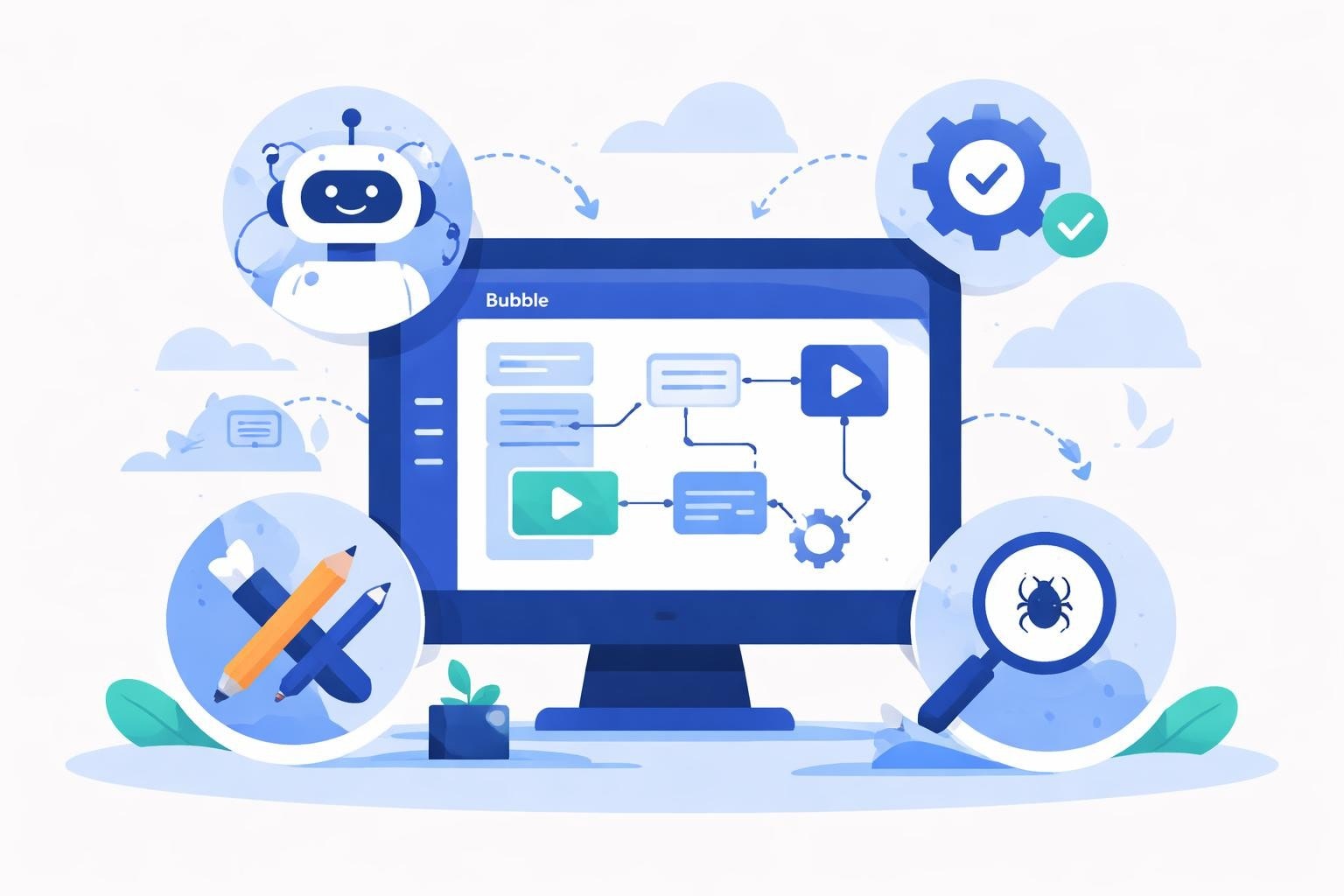
Bubble developers in 2026 are navigating an increasingly sophisticated landscape where artificial intelligence isn't just an add-on but a fundamental enhancement to their no-code workflows. The best ai tools for bubble developers transform how applications are designed, tested, and deployed, offering capabilities that range from intelligent component generation to automated quality assurance. Whether you're building enterprise-grade solutions or rapid prototypes, integrating the right AI tools into your Bubble development stack can dramatically accelerate delivery timelines while maintaining the high-quality standards that clients expect. This comprehensive guide explores the essential AI tools that are reshaping Bubble development practices and helping agencies like Big House Technologies deliver scalable solutions more efficiently.
AI-Powered Design and Prototyping Tools
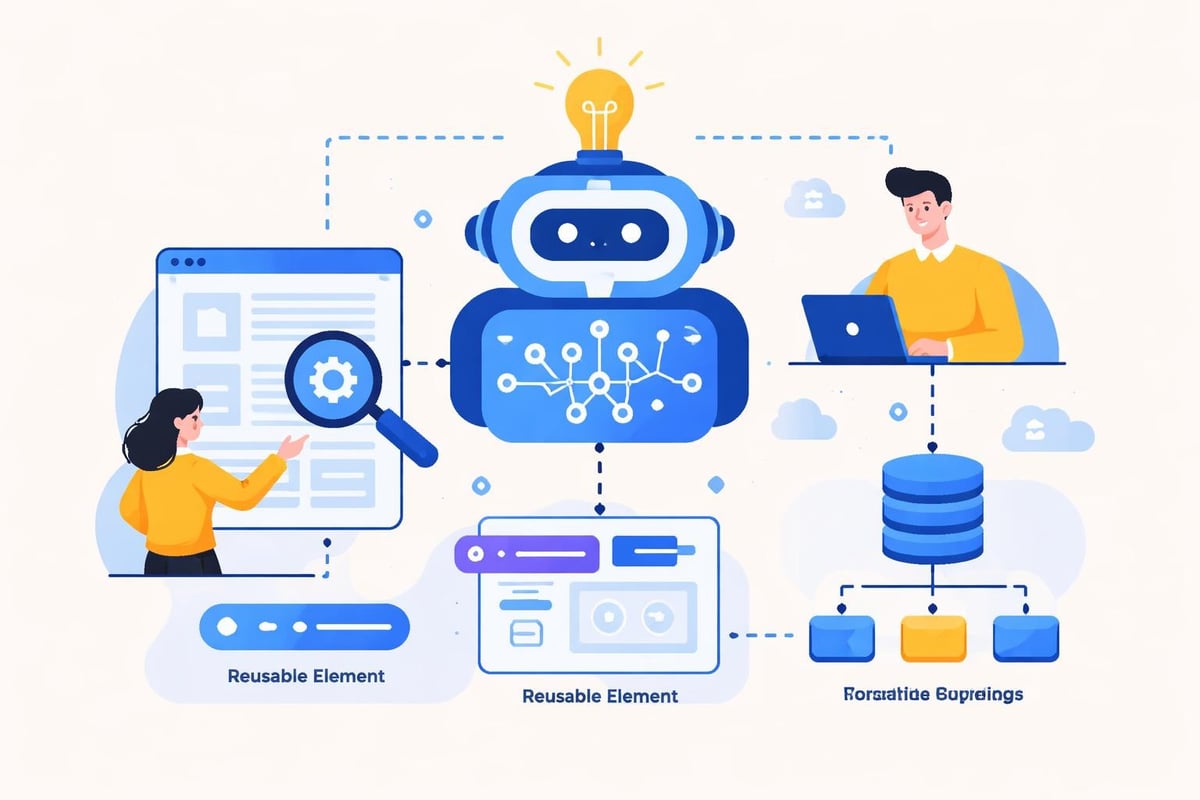
The design phase has been revolutionized by AI assistants that understand both user experience principles and Bubble's visual programming environment. Figma AI now offers intelligent component suggestions based on your existing design system, automatically adapting to Bubble-compatible layouts that translate seamlessly into responsive groups and reusable elements.
Tools like Builder.io have evolved their AI capabilities to generate entire page layouts from simple text descriptions. When you describe your intended interface, these systems create structured designs that map directly to Bubble's element hierarchy, complete with workflow suggestions and database field recommendations.
Visual Development Accelerators
Modern AI design tools understand the constraints and possibilities within Bubble's framework:
- Automated responsive breakpoint generation that considers mobile, tablet, and desktop layouts
- Component library intelligence that suggests reusable elements based on project patterns
- Color scheme optimization aligned with accessibility standards
- Typography scaling that maintains hierarchy across all device sizes
The integration between design AI and Bubble has become particularly seamless since late 2025. Many developers now use AI assistants to convert Figma designs directly into Bubble JSON that can be imported as complete pages, reducing what once took hours to mere minutes.
| Tool Category | Primary Function | Bubble Integration Level | Best For |
|---|---|---|---|
| Figma AI | Design to component conversion | High | UI/UX prototyping |
| Builder.io | Visual development automation | Medium | Landing pages |
| Uizard | Sketch to functional design | Medium | Rapid prototyping |
| Galileo AI | Complete UI generation | Low | Early-stage concepts |
Workflow Automation and Logic Enhancement
One of the most powerful applications of the best ai tools for bubble developers lies in workflow automation and logic optimization. ChatGPT and Claude have become indispensable coding assistants for Bubble developers, offering real-time guidance on database schema design, API integration patterns, and complex conditional logic.
These AI assistants excel at translating business requirements into Bubble workflow sequences. When you describe a desired user journey, they can outline the exact steps needed, including which events to trigger, what conditions to check, and how to structure data operations for optimal performance.
Database Design Intelligence
AI tools now offer sophisticated database architecture recommendations:
- Schema optimization based on your application's data relationships
- Field type selection that balances flexibility with performance
- Privacy rules generation aligned with security best practices
- Search constraint efficiency analysis for faster queries
The transformation of low-code development through AI has particularly impacted how developers approach complex data models. AI can now identify potential bottlenecks before they occur, suggesting indexing strategies and data structure modifications that prevent scaling issues down the line.
Make.com and Zapier AI features have evolved to offer intelligent automation scenarios specifically designed for Bubble applications. These platforms now suggest optimal integration patterns between Bubble and external services, automatically configuring webhooks and API calls with error handling built in.
Code Generation and API Integration Tools
While Bubble is fundamentally a no-code platform, developers often need to implement custom JavaScript, CSS, or API integrations. This is where specialized AI coding assistants become invaluable members of your development toolkit.
GitHub Copilot has proven exceptionally useful for Bubble developers working with custom code blocks and HTML elements. It understands Bubble's context and can generate code snippets that interact properly with Bubble's DOM structure and element IDs.
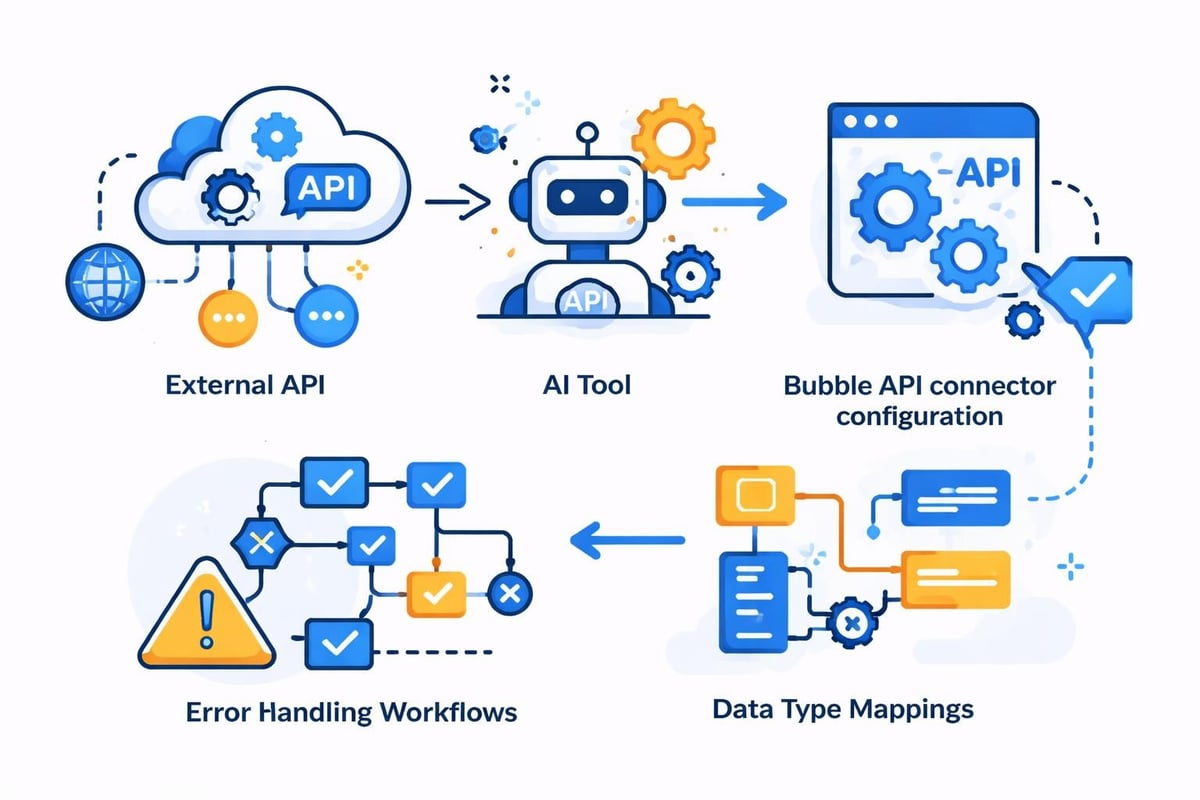
For API integration work, tools like Postman's AI assistant now generate complete API connector configurations for Bubble. You can describe the external service you want to integrate, and the AI will:
- Draft the API call structure with proper authentication
- Define all necessary parameters and headers
- Create the data type structure for returned values
- Suggest error handling workflows
Plugin Development Acceleration
The best ai tools for bubble developers have revolutionized custom plugin creation:
- Automated element property definitions based on use case descriptions
- Action generation with complete server-side code scaffolding
- Documentation creation that explains plugin functionality to end users
- Testing scenario generation covering edge cases and error states
The emergence of AI workflow platforms with no-code automation has created new possibilities for Bubble developers. These platforms can orchestrate complex multi-step processes that combine Bubble workflows with external AI services, creating sophisticated automation chains that would be extremely time-consuming to build manually.
Testing and Quality Assurance Automation
Quality assurance has traditionally been one of the most time-intensive aspects of Bubble development. AI-powered testing tools have transformed this landscape dramatically in 2026.
Testim.io and Katalon now offer Bubble-specific testing capabilities that understand the platform's unique element structure. These tools can automatically generate test scenarios based on your application's workflow logic, creating comprehensive test suites that verify both happy paths and edge cases.
Testing automation for Bubble applications now includes:
- Visual regression testing that catches unintended design changes
- Workflow validation ensuring logic executes as intended
- Performance monitoring identifying slow database queries or API calls
- Cross-browser compatibility verification across devices
The integration of AI into testing processes means that test maintenance has become largely automatic. When you update a workflow or modify a page element, AI testing tools can identify affected test cases and update them accordingly, eliminating the manual overhead that traditionally made test maintenance prohibitive.
Performance Optimization Through AI
AI analytics tools now monitor Bubble applications in production and provide actionable optimization recommendations:
| Metric Category | AI Capability | Impact on Development |
|---|---|---|
| Page load time | Identifies heavy elements and suggests lazy loading | Faster user experience |
| Database queries | Detects inefficient searches and recommends indexes | Reduced server load |
| Workflow efficiency | Maps redundant actions and suggests consolidation | Lower WU consumption |
| API call patterns | Identifies unnecessary calls and suggests caching | Faster response times |
Understanding development tooling becomes critical when implementing these AI-powered optimization strategies. The right combination of monitoring, testing, and optimization tools creates a continuous improvement cycle that keeps Bubble applications performing at peak efficiency.
Content Generation and User Experience Enhancement
Beyond the technical development aspects, the best ai tools for bubble developers extend into content creation and user experience personalization. These tools help create more engaging applications with less manual effort.
Copy.ai and Jasper have developed specific templates for generating in-app content, help documentation, and user onboarding flows. When building enterprise integration platforms with no-code, these tools can generate role-specific content that explains complex features in accessible language.
AI-powered chatbot builders like Voiceflow integrate seamlessly with Bubble applications, enabling developers to create sophisticated conversational interfaces without extensive natural language processing knowledge. These chatbots can:
- Handle user onboarding and feature discovery
- Provide context-aware help based on user location in the app
- Collect structured data through natural conversations
- Escalate complex issues to human support with full context
Personalization Engines
AI personalization tools analyze user behavior patterns within Bubble applications and automatically adjust content, layout, and feature prominence based on individual preferences. This level of dynamic customization was previously only accessible to developers with extensive machine learning expertise.
The 2025-2026 period has seen remarkable growth in no-code AI tools that specifically target user experience enhancement. These platforms integrate with Bubble through API connectors and plugins, bringing enterprise-grade personalization capabilities to applications of all sizes.
Collaborative Development and Project Management
Modern AI project management tools have evolved to understand the specific workflows of Bubble development teams. Linear AI and Height now offer intelligent sprint planning that considers Bubble development velocity, automatically estimating task duration based on element complexity and workflow logic.
These platforms integrate directly with Bubble applications through webhooks and API connections, creating bidirectional data flow between your project management system and development environment. When tasks are completed in your project tracker, the AI can verify that corresponding workflows have been properly implemented in Bubble.
Documentation generation has become dramatically more efficient with AI assistance. Tools like Scribe can watch your Bubble development process and automatically create step-by-step guides complete with screenshots and annotations. This capability is particularly valuable when:
- Onboarding new team members to existing Bubble projects
- Creating client handoff documentation for maintained applications
- Building internal knowledge bases that capture institutional expertise
- Generating compliance documentation for regulated industries
The comparative analysis provided by top AI app builders in 2025 reveals significant differences in how these platforms approach project management integration, making it essential to select tools that align with your team's specific workflow requirements.
Version Control and Collaboration
While Bubble has built-in version control, AI-enhanced collaboration tools add layers of intelligence:
- Conflict detection when multiple developers work on related workflows
- Merge recommendation for combining parallel development streams
- Change impact analysis showing downstream effects of modifications
- Rollback intelligence suggesting optimal restore points when issues arise
For teams working on application development platforms, these collaboration features ensure that complex projects maintain consistency even as multiple developers contribute simultaneously.
AI-Driven Marketing and Analytics Integration
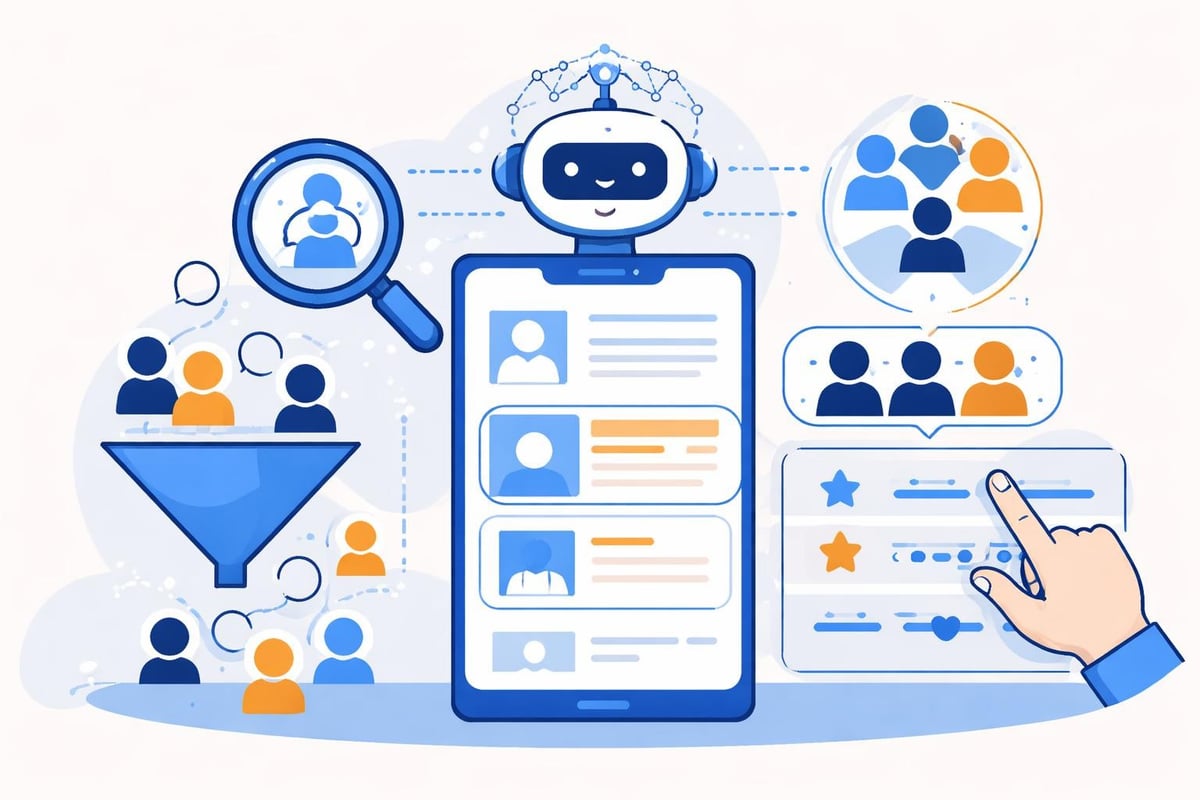
Understanding how users interact with Bubble applications has become significantly more sophisticated through AI-powered analytics platforms. Mixpanel Intelligence and Amplitude AI now offer predictive insights specifically tuned for no-code applications.
These platforms can identify which user segments are most likely to convert, which features drive engagement, and where users encounter friction. The AI generates actionable recommendations that Bubble developers can implement through conditional workflows and dynamic content.
Marketing automation integration has evolved considerably, with platforms like HubSpot AI and ActiveCampaign AI offering Bubble-specific connectors that enable:
- Automated user segmentation based on in-app behavior
- Personalized email sequences triggered by workflow events
- Predictive lead scoring integrated with Bubble user data
- Content recommendation engines powered by usage patterns
The ability to rapidly build and iterate on these integrations when building MVPs with no-code has become a significant competitive advantage. AI tools can now suggest optimal integration architectures based on your specific use case and target audience.
Conversion Optimization Through AI
AI-powered A/B testing platforms now integrate seamlessly with Bubble applications, automatically managing variant distribution and statistical significance calculations. These tools can test:
| Test Type | AI Capability | Implementation Method |
|---|---|---|
| Layout variations | Automatic winner declaration | Conditional groups |
| Workflow logic | Conversion path optimization | Custom states |
| Call-to-action text | Natural language generation | Dynamic text |
| Form field order | Friction reduction analysis | Repeating groups |
When agencies explore the best low-code agencies for outsourcing, the sophistication of their AI tool integration often serves as a key differentiator in capability and efficiency.
Security and Compliance Automation
Security testing for Bubble applications has been enhanced by AI tools that understand common vulnerability patterns in no-code platforms. Burp Suite Professional and OWASP ZAP now include Bubble-specific scanning profiles that check for issues like:
- Improperly configured privacy rules exposing sensitive data
- API workflow endpoints lacking authentication
- Client-side element visibility hiding security controls
- Custom code injections in user-generated content
Compliance automation tools have become essential for developers building in regulated industries. AI assistants can now review Bubble applications against frameworks like GDPR, HIPAA, and SOC 2, generating compliance reports and suggesting remediation steps for identified gaps.
The best ai tools for bubble developers in the security space offer continuous monitoring capabilities. They scan production applications for configuration drift that could introduce vulnerabilities, alerting developers immediately when privacy rules are modified or new workflows expose data inappropriately.
Compliance documentation generators can create detailed audit trails showing how data flows through Bubble applications, which workflows process personal information, and where data is stored or transmitted. This documentation is increasingly required for enterprise clients and regulated industries.
When selecting security tools, developers should prioritize those offering AI software development capabilities specifically designed for no-code platforms, as generic security tools often miss platform-specific vulnerabilities.
Deployment and DevOps Optimization
The deployment process for Bubble applications has been streamlined through AI-powered DevOps tools that understand the platform's unique architecture. While Bubble handles infrastructure automatically, AI tools now optimize the deployment workflow itself.
Monitoring tools like Datadog AI and New Relic AI offer Bubble-specific dashboards that track application health metrics meaningful to no-code developers. These platforms use machine learning to establish baseline performance patterns and alert developers when anomalies occur that might indicate issues.
Pre-deployment validation has become more sophisticated with AI review systems that:
- Analyze workflow changes for potential breaking impacts
- Verify database schema modifications won't corrupt existing data
- Check that new privacy rules maintain data security
- Simulate user journeys to catch broken workflows before launch
The deployment decision-making process itself has been enhanced by AI. Based on change analysis, user traffic patterns, and historical incident data, AI systems can recommend optimal deployment windows that minimize user disruption while ensuring team availability for post-deployment monitoring.
Capacity Planning Intelligence
For applications approaching Bubble's plan limits, AI capacity planning tools can:
- Predict workload unit consumption based on usage trends
- Identify optimization opportunities to stay within current plan limits
- Recommend plan upgrades at strategically optimal times
- Suggest architectural changes to improve scalability
These capabilities prove particularly valuable for no-code startups managing rapid growth while controlling infrastructure costs.
The integration of AI tools into Bubble development workflows represents a fundamental shift in how no-code applications are built, tested, and deployed in 2026. By leveraging these technologies strategically, developers can deliver more sophisticated solutions faster while maintaining the quality and reliability that enterprise clients demand. If you're looking to accelerate your Bubble development with cutting-edge AI integration, Big House Technologies combines deep no-code expertise with advanced AI capabilities to transform your ideas into scalable, production-ready applications that exceed expectations.

About Big House
Big House is committed to 1) developing robust internal tools for enterprises, and 2) crafting minimum viable products (MVPs) that help startups and entrepreneurs bring their visions to life.
If you'd like to explore how we can build technology for you, get in touch. We'd be excited to discuss what you have in mind.
Other Articles
Discover the 2026 expert guide to MVP developers for startups Learn how to select collaborate and scale with top talent for faster growth and product success
Discover proven custom development strategies and best practices for 2025. Master planning, execution, and emerging trends to optimize your next project’s success.
Discover the latest trends, tools, and best practices shaping software in development for 2025. Stay ahead with actionable insights and future-ready strategies.