
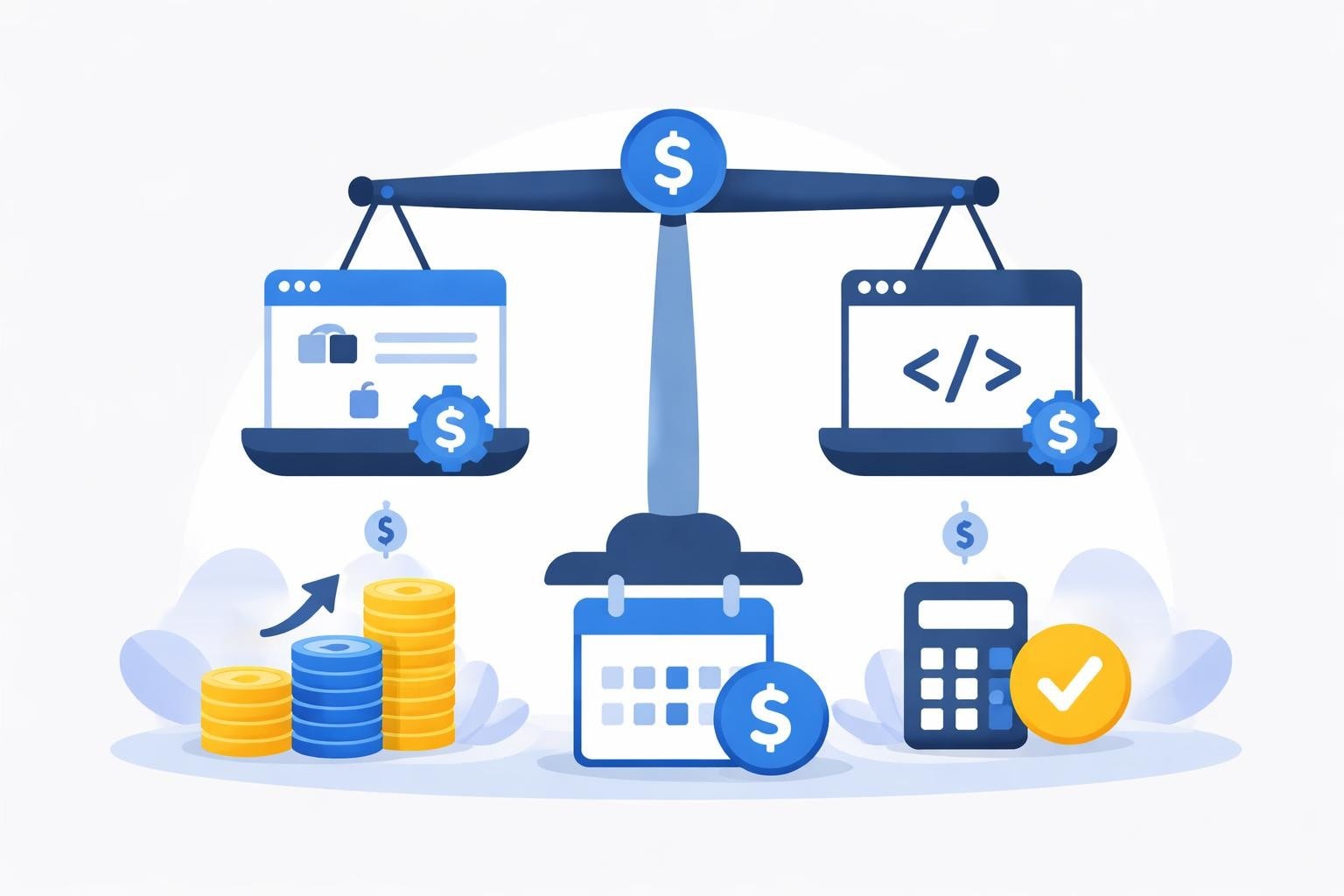
When deciding between building software with no-code platforms or traditional custom development, cost is often the deciding factor. The no-code vs custom code cost comparison reveals dramatic differences not just in upfront investment, but in ongoing maintenance, scalability expenses, and total cost of ownership over time. Understanding these financial implications helps businesses make informed decisions about which development approach aligns with their budget and long-term goals.
Understanding the Real Cost Components
The true cost of software development extends far beyond the initial build. Many businesses focus solely on upfront development expenses and overlook the substantial ongoing costs that accumulate over months and years.
Initial Development Investment
Custom development projects typically require significant upfront capital. A custom-coded MVP can range from $50,000 to $150,000 for a basic application, with enterprise-grade solutions easily exceeding $300,000. These costs stem from hiring specialized developers, designers, project managers, and quality assurance professionals.
No-code platforms dramatically reduce this barrier to entry. According to detailed analyses of MVP development costs, a comparable no-code application can be built for $10,000 to $30,000. This 70-85% cost reduction makes software development accessible to startups and small businesses previously priced out of the market.
Key upfront cost factors include:
- Developer hourly rates ($75-$250 for custom vs $50-$150 for no-code specialists)
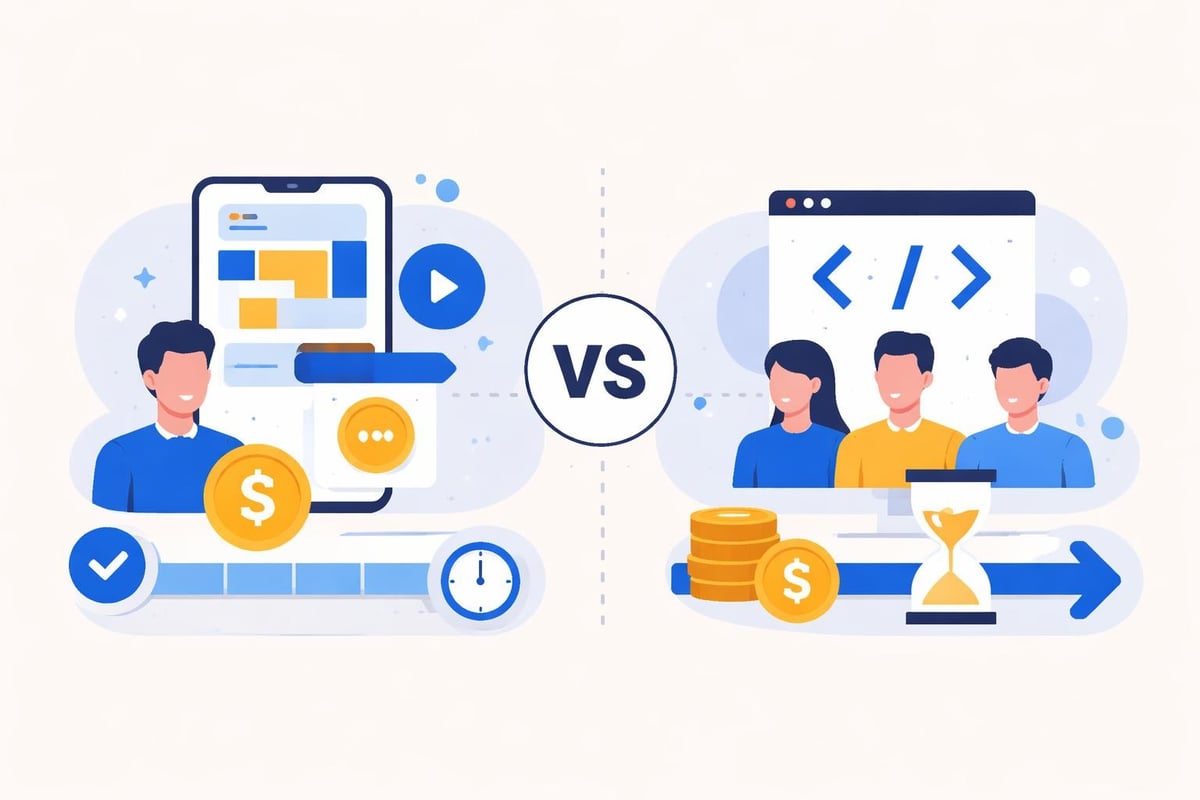
- Development timeline (6-12 months custom vs 4-8 weeks no-code)
- Team size requirements (5-8 people custom vs 2-4 people no-code)
- Infrastructure setup and configuration costs
Ongoing Maintenance and Updates
The no-code vs custom code cost comparison becomes even more revealing when examining maintenance expenses. Custom applications require continuous investment in developer time to fix bugs, apply security patches, update dependencies, and maintain compatibility with evolving operating systems and browsers.
Maintenance typically costs 15-20% of the original development investment annually. For a $100,000 custom application, budget $15,000-$20,000 yearly just to keep it running smoothly. These costs are often underestimated and can strain budgets unexpectedly.
No-code platforms shift much of this burden to the platform provider. Updates, security patches, and infrastructure improvements happen automatically. While you still need occasional adjustments and feature updates, the effort required is substantially lower. Understanding no-code tools for SaaS founders reveals how platform-managed infrastructure reduces ongoing technical debt.
| Cost Category | Custom Development | No-Code Development |
|---|---|---|
| Annual Maintenance | 15-20% of build cost | 5-10% of build cost |
| Security Updates | Manual, developer-dependent | Automatic, platform-managed |
| Infrastructure Management | In-house or DevOps team | Platform-handled |
| Bug Fixes | $100-$250 per hour | $50-$150 per hour |
Development Speed and Time-to-Market Economics
Speed directly impacts cost in software development. The longer a project takes, the more salary expenses accumulate, and the later you can begin generating revenue or validating your concept.
Resource Allocation Over Time
Custom development projects often span 6-12 months for initial launch. During this period, you're paying full salaries or contractor fees without any return on investment. A team of five developers at $120,000 average salary costs $50,000 monthly, totaling $300,000-$600,000 before your first user even sees the product.
No-code development condenses this timeline dramatically. Most MVPs built on platforms like Bubble or Lovable launch within 4-8 weeks. This acceleration means you're paying development costs for 2 months instead of 9 months, representing a massive cash flow advantage. For startups operating on limited runway, this difference can mean survival versus failure.
Timeline impact on total costs:
- Custom development: 9 months × $50,000/month = $450,000
- No-code development: 2 months × $25,000/month = $50,000
- Net savings: $400,000 available for marketing, operations, or additional features
Iteration and Pivot Costs
Markets change rapidly, and user feedback often requires significant product adjustments. The cost to iterate differs dramatically between approaches.
Changing features in custom code requires developer time to modify code, test changes, and deploy updates. A moderate feature revision might consume 40-80 developer hours at $150/hour, costing $6,000-$12,000 per iteration.
No-code platforms enable visual editing where changes happen through configuration rather than coding. The same feature revision might take 8-15 hours, costing $800-$2,250. This 5-7x cost advantage means you can afford to experiment, test, and refine your product based on real user behavior.
Scalability and Growth Cost Implications
As your application grows, costs evolve differently depending on your foundation. The no-code vs custom code cost comparison at scale reveals nuanced trade-offs that vary by business model and growth trajectory.
Infrastructure and Hosting Expenses
Custom applications give you complete control over infrastructure optimization. You can select specific hosting solutions, implement caching strategies, and optimize database queries to minimize costs. However, this requires specialized DevOps expertise and ongoing monitoring.
A custom application serving 10,000 active users might run on AWS infrastructure costing $500-$2,000 monthly, plus $3,000-$8,000 monthly for DevOps management. As you scale to 100,000 users, these costs might grow to $3,000-$8,000 for infrastructure and $8,000-$15,000 for management.
No-code platforms typically charge based on usage tiers. Bubble, for example, starts at $29/month for basic applications and scales to $529/month for production applications, with enterprise pricing beyond that. Research on custom app development versus no-code tools shows that total infrastructure costs remain competitive with custom solutions up to approximately 50,000-100,000 monthly active users.

Feature Development Velocity
Adding new features represents a recurring cost throughout your product's lifecycle. The economics here favor different approaches at different stages.
For early-stage products requiring rapid experimentation, no-code platforms offer unmatched cost efficiency. Adding a new user dashboard might take 2 weeks in custom development versus 3 days in no-code, translating to $12,000 versus $2,400 for the same functionality.
However, highly specialized or performance-critical features may prove more expensive in no-code environments. Custom solutions excel when you need:
- Complex algorithmic processing
- Real-time data manipulation at massive scale
- Highly customized user interfaces with pixel-perfect requirements
- Integration with legacy enterprise systems requiring custom protocols
| Development Stage | Custom Code Advantage | No-Code Advantage |
|---|---|---|
| MVP/Validation | Lower | Higher (5-7x faster) |
| Early Growth (0-10k users) | Lower | Higher (3-4x cheaper) |
| Scaling (10k-100k users) | Moderate | Moderate (comparable costs) |
| Enterprise (100k+ users) | Higher | Lower (depending on complexity) |
Hidden Costs and Budget Surprises
The initial no-code vs custom code cost comparison often misses several expense categories that emerge during real-world development and operation.
Technical Debt Accumulation
Custom code inherently accumulates technical debt. As frameworks update, best practices evolve, and team members change, the codebase becomes harder to maintain. Addressing technical debt typically requires major refactoring projects costing $25,000-$100,000 every 2-3 years.
No-code platforms handle platform-level technical debt automatically. When Bubble updates its underlying infrastructure or adds new capabilities, existing applications benefit without manual intervention. However, poorly structured no-code applications can accumulate their own form of technical debt through complex workflows and unmaintainable logic.
Team Training and Knowledge Transfer
Custom applications create dependency on specific technical knowledge. When developers leave, you face expensive knowledge transfer processes and potential work stoppages. The cost to onboard a new developer to a complex custom codebase ranges from $15,000-$40,000 in lost productivity during the learning curve.
No-code platforms standardize development approaches, making team transitions smoother. Building MVPs with no-code shows that new team members become productive within days rather than months. This reduced onboarding cost provides significant long-term savings.
Hidden cost checklist:
- Legacy code refactoring: $25,000-$100,000 every 2-3 years (custom only)
- Developer onboarding: $15,000-$40,000 per developer (custom) vs $3,000-$8,000 (no-code)
- Compliance and security audits: $10,000-$50,000 annually (both approaches)
- Third-party service integrations: $5,000-$20,000 per integration (higher for custom)
- Migration costs if switching platforms: $50,000-$200,000+ (both approaches)
Real-World Cost Scenarios
Examining specific use cases illustrates how the no-code vs custom code cost comparison plays out in practice. Comparative analyses across different application types reveal patterns that help predict which approach delivers better value.
Internal Business Tools
A company needs a custom CRM to manage their unique sales process. Custom development would require 4-6 months and $80,000-$150,000 to build, plus $12,000-$25,000 annually for maintenance.
The same functionality on a no-code platform takes 4-8 weeks and costs $15,000-$35,000, with $2,000-$5,000 annual maintenance. Over three years:
- Custom total cost: $116,000-$225,000
- No-code total cost: $21,000-$50,000
- Savings: $95,000-$175,000
Customer-Facing Mobile Applications
A startup wants to launch a mobile marketplace connecting buyers and sellers. Custom development for iOS and Android apps plus backend infrastructure requires 9-12 months and $200,000-$400,000 initially.
Using no-code platforms with progressive web app capabilities launches in 2-3 months for $40,000-$80,000. While custom development might perform better at massive scale, the no-code approach lets you validate your business model with 95% less capital at risk.
Data-Intensive Analytics Platforms
Not all scenarios favor no-code. A financial analytics platform processing millions of transactions requires optimized custom code. Attempting this in no-code might work initially but would hit performance walls and require costly workarounds.
For specialized, performance-critical applications, custom software development considerations suggest that the upfront investment pays off through superior long-term performance and lower scaling costs.
Strategic Decision Framework
Choosing between no-code and custom development isn't purely financial. The right choice depends on your specific circumstances, goals, and constraints.
When No-Code Delivers Superior ROI
No-code platforms provide the best cost-to-value ratio when:
- You need to validate a business concept quickly with minimal capital
- Your application follows common patterns (dashboards, forms, workflows, marketplaces)
- Your team lacks deep technical expertise
- You plan to iterate frequently based on user feedback
- Time-to-market is critical for competitive advantage
Working with specialized no-code agencies can further optimize costs by leveraging pre-built components and proven development patterns.
When Custom Development Justifies Higher Costs
Custom code becomes economically justified when:
- You're building highly specialized functionality unavailable in no-code platforms
- You need maximum performance for compute-intensive operations
- You're serving millions of users with complex, real-time interactions
- You require complete control over every aspect of the technology stack
- Your competitive advantage depends on proprietary algorithms or unique technical capabilities
Hybrid Approaches and Total Cost of Ownership
Many successful companies use hybrid strategies, combining no-code for rapid prototyping with custom development for performance-critical components. This approach optimizes the no-code vs custom code cost comparison by:
- Validating concepts quickly and cheaply with no-code
- Identifying which features actually matter to users
- Selectively rebuilding only critical paths in custom code
- Maintaining most of the application in no-code for flexibility
Analyses of AI agent development costs demonstrate how hybrid approaches can reduce total costs by 40-60% compared to pure custom development while maintaining necessary performance levels.
Migration and Exit Strategy Costs
Forward-thinking businesses consider what happens if they need to change approaches later. Migration represents a significant cost factor in the total equation.
Migrating from No-Code to Custom
If your no-code application succeeds beyond expectations, you might eventually migrate to custom code. This transition typically costs 60-80% of what building custom originally would have cost, but you've already validated your business model and generated revenue.
Example: A SaaS company built their MVP on Bubble for $30,000, grew to $500k ARR over 18 months, then migrated to custom code for $120,000. Total investment: $150,000. Building custom from day one would have cost $200,000 with 12-month delay and massive opportunity cost.
Migrating from Custom to Different Custom
Migrating between custom codebases (like moving from Ruby to Node.js) often costs 80-100% of the original build. You're essentially rebuilding while your current system continues operating, requiring parallel development teams.
Migration cost considerations:
- Data migration and validation: $10,000-$50,000
- Feature parity recreation: 60-100% of original build cost
- Parallel operation period: $15,000-$40,000 monthly
- Testing and quality assurance: $20,000-$60,000
- User transition and training: $5,000-$20,000
The financial landscape of software development in 2026 clearly demonstrates that no-code platforms deliver exceptional value for most business applications, particularly during validation and early growth phases. While custom development retains advantages for specialized, high-scale scenarios, the dramatic cost savings and speed benefits of no-code make it the rational choice for the majority of projects. Whether you're building an internal tool, launching a startup MVP, or developing customer-facing applications, Big House Technologies combines the efficiency of no-code platforms like Bubble with AI-powered development through Lovable to deliver production-ready solutions in weeks rather than months, helping you maximize your development budget while minimizing time to market.

About Big House
Big House is committed to 1) developing robust internal tools for enterprises, and 2) crafting minimum viable products (MVPs) that help startups and entrepreneurs bring their visions to life.
If you'd like to explore how we can build technology for you, get in touch. We'd be excited to discuss what you have in mind.
Other Articles
Discover how low-code digital transformation tools accelerate innovation, reduce costs, and empower teams to build enterprise solutions faster.
Unlock 2026 success with our website app development services guide Explore trends steps technology costs and tips to choose the right partner for growth
Explore the top AI plugins to supercharge your no-code Bubble app with image recognition, personalized recommendations, and predictive analytics, transforming your application’s functionality and user engagement.