

Testing software testing represents a critical yet often overlooked aspect of quality assurance in modern software development. While teams invest heavily in creating comprehensive test suites, the testing infrastructure itself requires validation to ensure reliability, accuracy, and effectiveness. For enterprises and startups building applications on no-code platforms like Bubble or AI-powered tools like Lovable, understanding how to verify your testing processes becomes essential for maintaining product quality and accelerating delivery timelines. This meta-level quality assurance approach ensures that your testing framework catches bugs reliably while avoiding false positives that waste development time.
Why Testing Your Testing Infrastructure Matters
Software testing has evolved dramatically over the past decade, shifting from manual quality checks to sophisticated automated frameworks that run thousands of test cases daily. However, as testing systems grow more complex, they introduce their own failure points. A flawed test suite can provide false confidence, missing critical bugs while reporting green builds that mask underlying issues.
The consequences of unreliable testing include:
- Deploying broken features to production despite passing tests
- Wasting developer time investigating false test failures
- Reducing trust in the entire QA process across teams
- Increasing technical debt as tests become unmaintained
- Missing edge cases that automated tests should catch
For organizations working with no-code platforms and specialized development teams, the stakes are even higher. No-code applications often integrate multiple services and APIs, creating complex dependency chains that require robust testing validation.
The No-Code Testing Challenge
No-code development accelerates software delivery, but this speed demands equally fast quality assurance processes. Traditional testing approaches designed for custom code don't always translate directly to visual development environments. Testing software testing in this context means validating that your test automation correctly interprets visual workflows, database operations, and API integrations.
The shift-left testing methodology, which emphasizes early and continuous testing throughout development, has become a critical best practice for modern software development. This approach requires testing infrastructure that can keep pace with rapid iteration cycles common in no-code development.

Core Components of Testing Software Testing
Validating your testing infrastructure requires a systematic approach that examines multiple dimensions of your QA processes. Each component plays a distinct role in ensuring test reliability and effectiveness.
Test Case Validation
Your test cases form the foundation of quality assurance. Testing software testing begins with verifying that individual test cases accurately represent user scenarios and business requirements. This involves reviewing test case design, checking assertions, and confirming that tests actually exercise the intended code paths.
| Validation Dimension | Key Questions | Tools & Techniques |
|---|---|---|
| Coverage Analysis | Do tests cover all critical user paths? | Code coverage tools, path analysis |
| Assertion Quality | Are test expectations specific and meaningful? | Manual review, assertion libraries |
| Test Independence | Can tests run reliably in any order? | Test isolation validation, dependency checks |
| Data Integrity | Do test fixtures represent realistic scenarios? | Data validation scripts, schema verification |
When working with AI-powered development tools and no-code platforms, test case validation extends to visual workflow verification. Your tests must confirm that user interface interactions, data transformations, and conditional logic execute as designed.
Continuous Integration Pipeline Verification
Modern development relies on CI/CD pipelines that automatically run tests on every code change. Testing software testing includes validating that these pipelines execute reliably, report results accurately, and integrate properly with your development workflow.
Pipeline validation checklist:
- Verify test execution triggers activate consistently
- Confirm environment configurations match production
- Check test result reporting for accuracy and completeness
- Validate artifact generation and deployment processes
- Review rollback mechanisms for failed test runs
Research on robust test automation frameworks using Cucumber BDD demonstrates the importance of modular architecture in CI/CD integration. A well-designed testing framework separates concerns, making it easier to validate individual components and identify failures quickly.
Test Data Management Verification
Test data quality directly impacts testing reliability. Invalid, outdated, or incomplete test data produces unreliable results that undermine confidence in your entire testing process. Testing software testing examines how test data is generated, managed, and refreshed throughout the testing lifecycle.
For no-code applications that often rely on complex database relationships and API integrations, test data management becomes particularly critical. Your validation should confirm that test databases accurately mirror production schemas while protecting sensitive information through proper anonymization.
Implementing Meta-Testing Strategies
Testing software testing requires deliberate strategies that go beyond simply running tests. These approaches help identify weaknesses in your testing infrastructure before they impact product quality.
Mutation Testing for Test Effectiveness
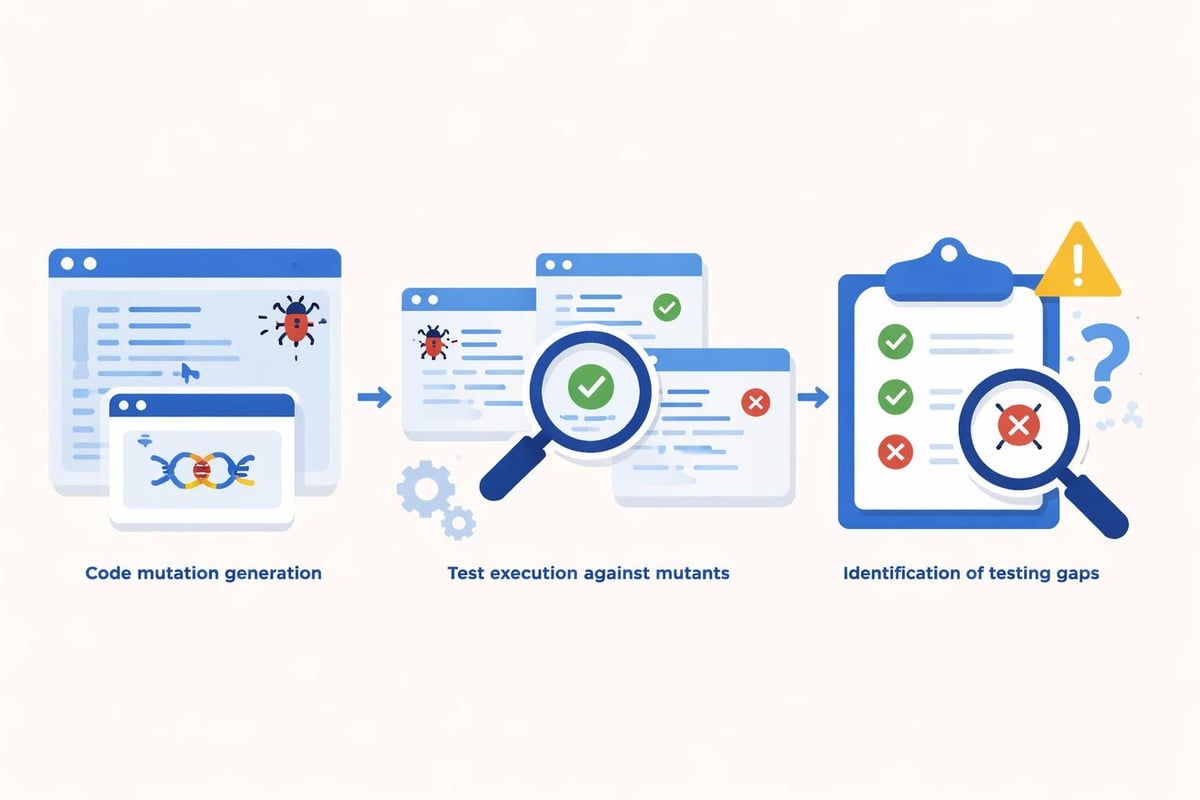
Mutation testing intentionally introduces bugs into your codebase to verify that your test suite catches them. This powerful technique reveals gaps in test coverage and identifies weak assertions that pass even when code behaves incorrectly.
The process works by creating "mutants" - versions of your code with small, deliberate changes. If your test suite still passes with a mutant active, you've identified a gap in testing coverage. This approach is particularly valuable when building scalable software solutions that require comprehensive quality assurance.
Test Flakiness Detection
Flaky tests that pass and fail inconsistently without code changes erode team confidence and waste development time. Testing software testing must identify and eliminate flakiness to maintain testing reliability.
Common flakiness sources include:
- Race conditions in asynchronous operations
- Timing dependencies between test steps
- Environmental inconsistencies across test runs
- Shared state between supposedly independent tests
- External service dependencies with variable response times
Modern software testing methodologies emphasize maintaining stable test suites over time. Tracking test failure patterns, monitoring execution times, and analyzing environmental factors helps identify flakiness before it becomes a chronic problem.
Coverage Gap Analysis
Code coverage metrics indicate which parts of your application tests actually exercise, but raw coverage percentages tell an incomplete story. Testing software testing includes analyzing coverage gaps to understand what remains untested and why.
| Coverage Type | What It Measures | Limitations |
|---|---|---|
| Line Coverage | Percentage of code lines executed | Doesn't verify code correctness |
| Branch Coverage | Decision point paths tested | Misses logical combinations |
| Function Coverage | Functions called during tests | Ignores parameter variations |
| Integration Coverage | Service interactions tested | Difficult to measure across platforms |
For teams using no-code tools for building applications, coverage analysis extends beyond traditional code metrics. Visual workflows, database operations, and API integrations require specialized coverage measurement approaches.
Automating Testing Validation Processes
Manual validation of testing infrastructure doesn't scale with modern development velocity. Automation enables continuous monitoring and validation of your testing processes, catching issues before they impact development cycles.
Automated Test Review Systems
Automated review systems analyze test code quality, identify anti-patterns, and suggest improvements. These tools examine test structure, naming conventions, assertion quality, and dependency management.
Automated validation capabilities:
- Static analysis of test code for common mistakes
- Duplicate test detection to reduce maintenance burden
- Assertion strength evaluation to ensure meaningful checks
- Test isolation verification to prevent interdependencies
- Performance profiling to identify slow-running tests
Research on automated test generation using machine learning demonstrates promising approaches for creating comprehensive test suites. While these techniques primarily target test creation, the same principles apply to test validation and quality assessment.
Continuous Test Quality Monitoring
Testing software testing isn't a one-time activity but an ongoing practice integrated into your development workflow. Continuous monitoring tracks test suite health metrics over time, identifying degradation before it impacts product quality.
Key metrics to monitor include test execution time trends, failure rate patterns, coverage changes, and test maintenance frequency. Establishing baselines and alerting on significant deviations helps teams respond quickly to testing infrastructure issues.
Testing Frameworks and Tool Validation
The tools and frameworks you choose for testing require their own validation. Understanding framework limitations, verifying configurations, and ensuring proper integration with your development stack all contribute to reliable testing software testing.
Framework Selection Criteria
Different testing frameworks offer varying capabilities, and choosing the right tools impacts long-term testing success. When working with development tooling for no-code platforms, framework compatibility with visual development environments becomes crucial.
Evaluate frameworks based on integration capabilities, community support, documentation quality, and alignment with your testing methodology. Tools like specialized test automation platforms provide comprehensive testing capabilities but require proper configuration and validation.
Tool Configuration Verification
Even the best testing tools fail when improperly configured. Testing software testing includes verifying that tool configurations match your testing requirements and integrate correctly with your development environment.
Configuration validation areas:
- Environment variables and secrets management
- Test data source connections and credentials
- Reporting integrations and notification settings
- Parallel execution configurations and resource limits
- Timeout settings and retry policies
For manual testing best practices, configuration extends to test case documentation, testing metrics implementation, and real device testing setups. Comprehensive documentation ensures testing processes remain consistent across team members.

Organizational Practices for Testing Validation
Technical approaches to testing software testing work best when supported by organizational practices that prioritize quality assurance. Team culture, documentation standards, and knowledge sharing all contribute to sustainable testing validation.
Building a Testing Quality Culture
Organizations that excel at testing software testing embed quality validation into their development culture. Teams regularly review testing practices, share learnings from testing failures, and continuously improve their QA processes.
This cultural foundation proves particularly valuable for agencies and development teams working across multiple client projects. Standardized testing validation approaches ensure consistent quality regardless of project specifics.
Documentation and Knowledge Management
Comprehensive documentation transforms testing validation from tribal knowledge into repeatable processes. Document testing strategies, validation procedures, tool configurations, and known limitations to enable team members to maintain testing quality independently.
Essential documentation includes:
- Test case design guidelines and templates
- Framework configuration and setup procedures
- Common testing pitfalls and resolution strategies
- Test data management policies and procedures
- Integration testing requirements and examples
Training and Skill Development
Testing software testing requires specialized skills that develop through practice and education. Invest in team training on testing methodologies, tool capabilities, and validation techniques to build internal expertise.
Regular training sessions, hands-on workshops, and knowledge sharing forums help teams stay current with evolving testing practices. For organizations building no-code solutions, this includes training on platform-specific testing approaches and limitations.
Measuring Testing Validation Success
Effective testing software testing requires measurable outcomes that demonstrate improved quality and reduced risk. Establishing metrics and tracking improvements over time validates the investment in testing validation practices.
Key Performance Indicators
| KPI | What It Measures | Target Range |
|---|---|---|
| Test Stability Rate | Percentage of tests passing consistently | >95% |
| Mean Time to Detect | Hours between bug introduction and detection | <4 hours |
| False Positive Rate | Tests failing without actual bugs | <5% |
| Coverage Completeness | Critical paths with adequate test coverage | >90% |
| Test Execution Time | CI/CD pipeline duration for full test suite | <15 minutes |
These metrics provide objective indicators of testing infrastructure health. Track trends over time rather than focusing on absolute values, as improvement trajectories matter more than single snapshots.
Return on Investment Analysis
Testing software testing represents an investment of time and resources. Quantifying the return helps justify continued focus on testing validation and guides resource allocation decisions.
Calculate ROI by measuring prevented production incidents, reduced debugging time, faster deployment cycles, and improved developer confidence. While some benefits prove difficult to quantify precisely, even conservative estimates typically demonstrate strong positive returns.
Adapting Testing Validation for No-Code Platforms
No-code and AI-powered development platforms introduce unique testing challenges that require adapted validation approaches. Visual workflows, generated code, and platform-specific limitations all impact how you validate testing infrastructure.
Visual Workflow Testing Validation
No-code platforms like Bubble represent application logic visually rather than through traditional code. Testing software testing in this context means validating that tests correctly interpret visual workflows and verify user interactions accurately.
Consider how workflow automation impacts testing requirements when designing validation strategies. Automated tests must account for platform-specific behaviors and limitations that don't exist in traditional development environments.
AI-Generated Code Verification
AI development tools generate code based on natural language specifications, introducing additional testing validation requirements. Verify that tests adequately cover generated code variations and account for potential AI output inconsistencies.
This becomes particularly important when using platforms that combine no-code visual development with AI-powered code generation. Your testing validation must span both paradigms, ensuring comprehensive quality assurance across the entire application.
Platform Constraint Testing
No-code platforms impose constraints that differ from traditional development environments. Testing software testing must verify that your tests account for these limitations while still providing adequate coverage of critical functionality.
Common constraints include API rate limits, database query restrictions, and concurrent user limitations. Your testing validation should confirm that tests execute within platform boundaries while still exercising realistic usage scenarios.
Testing software testing ensures your quality assurance processes deliver reliable results that accelerate delivery without compromising quality. By validating test cases, automating testing infrastructure checks, and continuously monitoring test suite health, organizations build confidence in their software releases. Whether you're building enterprise applications or startup MVPs, Big House Technologies brings expertise in comprehensive testing validation across no-code and AI-powered platforms, helping transform your ideas into production-ready solutions with quality assurance you can trust.

About Big House
Big House is committed to 1) developing robust internal tools for enterprises, and 2) crafting minimum viable products (MVPs) that help startups and entrepreneurs bring their visions to life.
If you'd like to explore how we can build technology for you, get in touch. We'd be excited to discuss what you have in mind.
Other Articles
Discover how ai simulation accelerates innovation, reduces costs, and enables data-driven decisions for enterprises and startups in 2026.
Discover the top 7 application development platforms for 2025. Compare features, pricing, and trends to choose the best platform for business success.
Master the app runwayml in 2025 with this step by step expert guide covering features setup creative workflows pricing tips and troubleshooting for creators.