
The software development landscape has undergone a remarkable transformation with the emergence of ai-assisted app builder platforms that combine artificial intelligence with visual development environments. These platforms empower both technical and non-technical users to create sophisticated applications through natural language instructions, intelligent automation, and streamlined workflows. As businesses face mounting pressure to deliver digital solutions faster and more cost-effectively, ai-assisted app builder platforms have become essential tools for enterprises and startups alike in 2026.
The Rise of AI-Powered Development Tools
The traditional software development cycle has long been characterized by lengthy timelines, high costs, and technical barriers that limited who could participate in the creation process. AI-assisted app builder platforms are fundamentally changing this dynamic by introducing intelligent automation at every stage of development.
Key drivers behind platform adoption include:
- Accelerated time-to-market for new applications
- Reduced dependency on specialized technical resources
- Lower development costs compared to traditional coding
- Enhanced accessibility for business users and citizen developers
- Improved quality through AI-powered testing and optimization
Modern platforms now integrate sophisticated language models that understand development intent from conversational input. Google's integration of AI tools into its development ecosystem demonstrates how major technology companies are betting on this transformation. Users can describe what they want to build in plain language, and the AI translates these requirements into functional code or visual workflows.
Understanding Platform Capabilities
Not all ai-assisted app builder platforms offer the same features or target the same use cases. The market has evolved to include specialized solutions for web applications, mobile apps, internal tools, and enterprise systems.
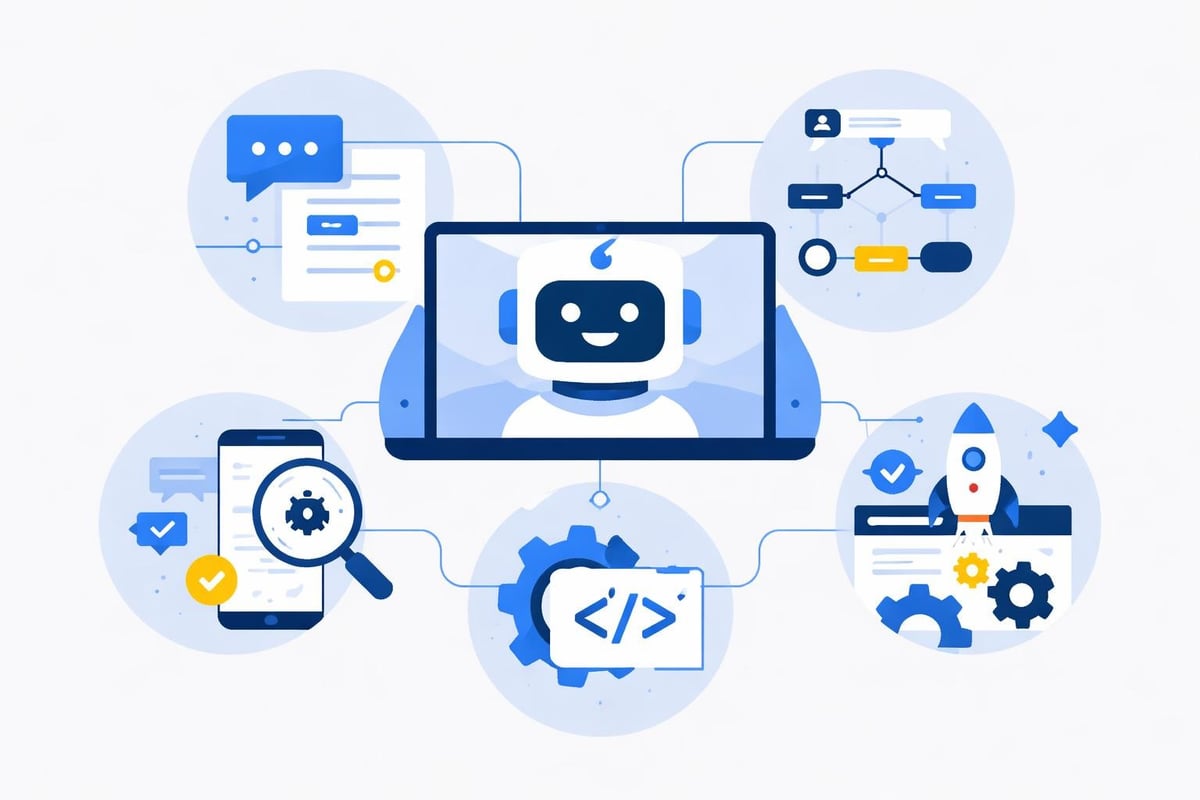
Leading platforms typically offer these foundational capabilities:
- Natural language interface for describing app requirements and features
- Visual development environment with drag-and-drop components
- Automated code generation from specifications and prompts
- Built-in database management with AI-optimized data structures
- Responsive design automation across device types
- Integration connectors for third-party services and APIs
- AI-powered testing and quality assurance
The sophistication of these features varies significantly. Research on AI-assisted development platforms shows that multi-agent collaboration approaches can dramatically improve the quality of generated applications by having specialized AI agents handle different aspects of the development process.
Evaluating Platform Options for Your Needs
Selecting the right platform requires careful consideration of your specific requirements, technical constraints, and business objectives. The decision framework should account for multiple factors beyond just the AI capabilities.
| Evaluation Criteria | Why It Matters | Questions to Ask |
|---|---|---|
| Development Speed | Time-to-market advantage | How quickly can the platform generate working prototypes? |
| Customization Depth | Long-term flexibility | Can I access and modify underlying code or logic? |
| Integration Ecosystem | Existing tool compatibility | Does it connect with our current systems? |
| Scalability | Growth potential | Will it handle increased users and data volume? |
| AI Accuracy | Output quality | How often does the AI generate correct implementations? |
| Support & Training | Team enablement | What resources are available for learning? |
Platforms reviewed for AI app building capabilities reveal significant variation in how different tools balance ease of use with advanced functionality. Some prioritize simple app creation for basic use cases, while others target complex enterprise applications requiring sophisticated logic and integrations.
Industry-Specific Considerations
Different industries have unique requirements that influence platform selection. Financial services applications need robust security and compliance features. Healthcare apps must meet HIPAA requirements. E-commerce platforms require payment processing and inventory management.
Specialized AI app builders for different industries have emerged to address these sector-specific needs. When building applications for regulated industries, verify that your chosen platform supports necessary compliance frameworks and security standards.
Implementation Strategies That Drive Success
Successfully deploying ai-assisted app builder platforms requires more than just selecting the right tool. Organizations must develop clear implementation strategies that align technology capabilities with business objectives.
Start with a pilot project approach:
- Choose a well-defined use case with clear success metrics
- Assemble a cross-functional team including business and technical stakeholders
- Set realistic timelines that account for learning curves
- Document lessons learned for scaling to additional projects
Many enterprises begin with building an MVP using no-code approaches to validate concepts before committing to larger-scale implementations. This strategy minimizes risk while demonstrating value quickly.
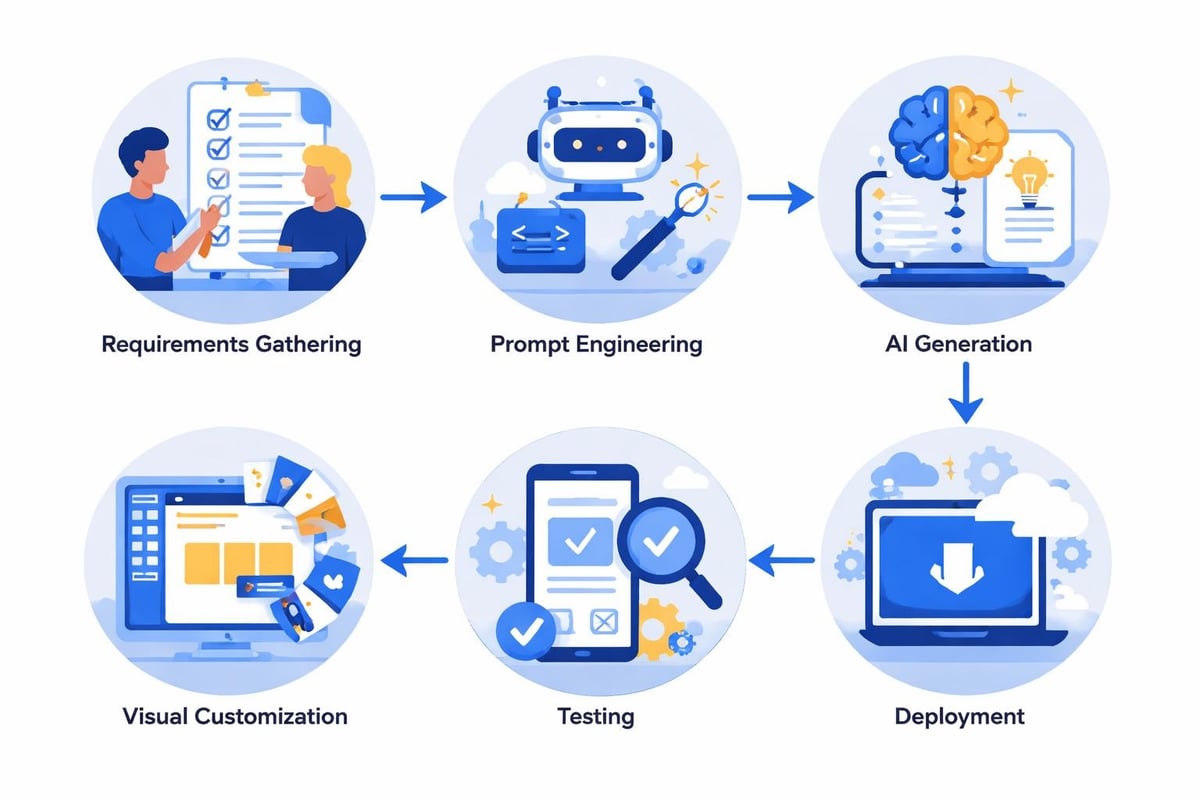
Optimizing AI Prompt Engineering
The quality of outputs from ai-assisted app builder platforms depends heavily on how well you communicate requirements to the AI. Effective prompt engineering has become a critical skill for maximizing platform value.
Best practices for prompt construction include:
- Be specific about functionality: Instead of "user login," specify "email-based authentication with password reset via email link"
- Describe data structures explicitly: Define what information you're storing and relationships between data types
- Indicate user flows clearly: Walk through step-by-step how users will interact with features
- Specify business rules: Articulate conditions, validations, and edge cases
- Provide examples: Reference similar features or applications to establish context
Advanced AI tools for development continue improving their understanding of natural language instructions, but precision in communication still significantly impacts results. Iterative refinement of prompts based on initial outputs helps train both the AI and your team.
Integration and Ecosystem Connectivity
Modern applications rarely exist in isolation. They need to connect with CRMs, payment processors, analytics platforms, communication tools, and countless other services. The integration capabilities of ai-assisted app builder platforms determine how well your new applications fit into existing technology ecosystems.
Critical integration considerations:
- API availability and documentation: Can you connect to your essential services?
- Authentication mechanisms: Does the platform support OAuth, API keys, and other security protocols?
- Data synchronization: How does information flow between systems?
- Webhook support: Can applications respond to events from external services?
- Rate limiting and reliability: Are integrations production-ready?
Application development platforms vary widely in their native integration libraries. Some offer hundreds of pre-built connectors, while others require custom API configuration. For enterprise deployments, integration capabilities for no-code platforms become particularly important when connecting to legacy systems.
Real-Time Collaboration Features
As teams become more distributed, ai-assisted app builder platforms increasingly emphasize collaboration features that allow multiple stakeholders to contribute to application development simultaneously.
| Collaboration Feature | Business Impact | Platform Examples |
|---|---|---|
| Multi-user editing | Faster development cycles | Multiple developers work on different screens simultaneously |
| Comment threads | Better communication | Stakeholders provide feedback directly on components |
| Version control | Risk management | Roll back changes and track modification history |
| Role-based access | Security and governance | Control who can view, edit, or publish applications |
| Real-time preview | Stakeholder alignment | Non-technical users see changes as they're made |
These features transform application development from a solitary technical activity into a collaborative business process where domain experts, designers, and developers work together seamlessly.
Performance Optimization and Scalability
While ai-assisted app builder platforms excel at rapid development, ensuring applications perform well under real-world conditions requires attention to optimization. The AI may generate functional code, but performance tuning often demands human expertise.
Performance optimization areas to monitor:
- Database query efficiency and indexing strategies
- API call batching and caching mechanisms
- Client-side rendering versus server-side processing
- Asset optimization including images, scripts, and stylesheets
- Network request minimization and compression
Google's enhancement of AI agent builders focuses specifically on deployment speed and performance, recognizing that generated applications must meet production requirements. The platform's AI can suggest optimizations, but understanding these recommendations requires some technical knowledge.
Monitoring and Maintenance Considerations
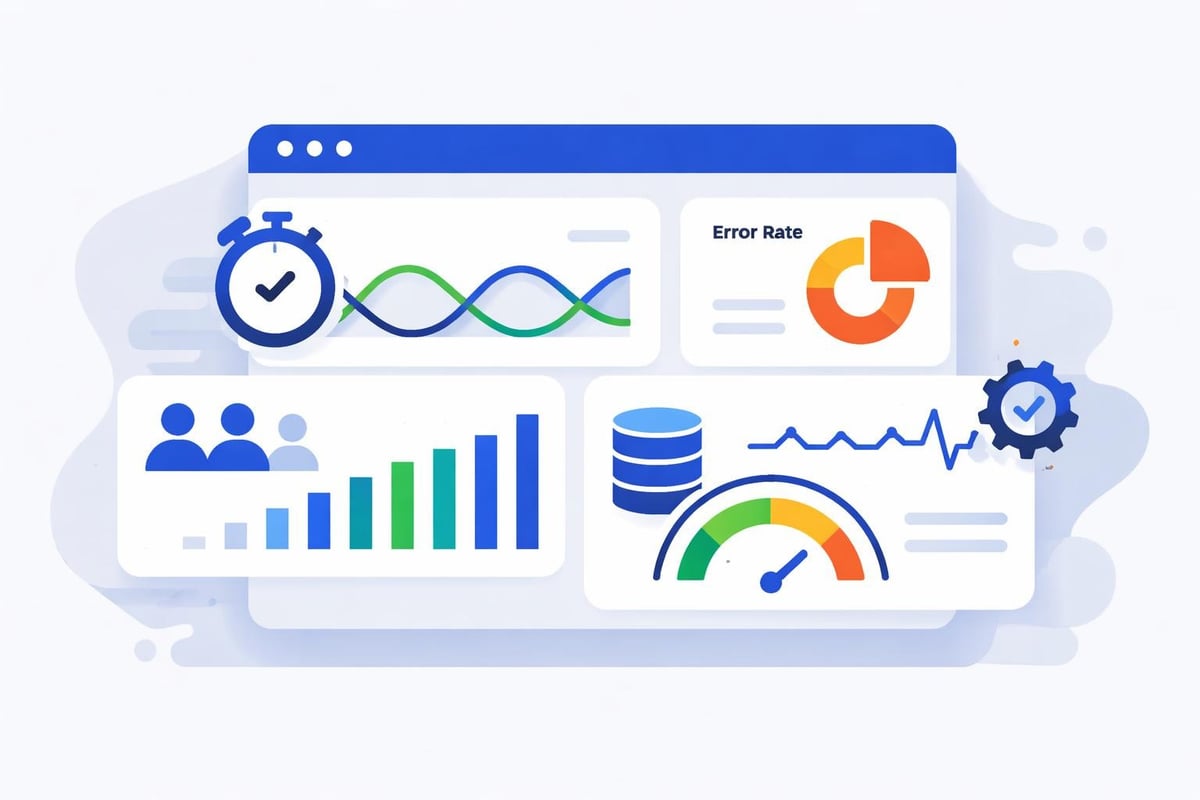
Applications built with AI assistance still require ongoing monitoring and maintenance. Establish processes for:
- Error tracking and logging: Implement comprehensive error monitoring from day one
- Performance metrics: Track load times, database query performance, and user experience indicators
- Security updates: Stay current with platform updates and security patches
- User feedback loops: Create mechanisms to collect and act on user input
- Capacity planning: Monitor usage trends to anticipate scaling needs
The advantage of ai-assisted app builder platforms is that many maintenance tasks can be automated or simplified through AI-powered tools that identify issues and suggest fixes.
Cost Analysis and ROI Calculations
Understanding the total cost of ownership for ai-assisted app builder platforms requires looking beyond subscription fees to account for training, customization, integrations, and ongoing maintenance.
Complete cost components include:
- Platform licensing or subscription fees (typically per user or per application)
- Training and onboarding for team members
- Custom development for specialized features beyond AI capabilities
- Integration development and maintenance
- Hosting and infrastructure costs
- Support and consulting services
- Migration costs if switching from existing solutions
When comparing no-code agencies for outsourcing, factor in their expertise with specific ai-assisted app builder platforms. Agencies with deep platform knowledge can accelerate development and help avoid costly mistakes.
Calculating Development Time Savings
The primary ROI driver for most organizations is the reduction in development time compared to traditional coding approaches. Industry data suggests ai-assisted app builder platforms can reduce development time by 60-80% for common application types.
| Development Stage | Traditional Coding | AI-Assisted Platform | Time Savings |
|---|---|---|---|
| Requirements | 2-3 weeks | 1 week | 50-67% |
| Design & Prototyping | 3-4 weeks | 1-2 weeks | 50-75% |
| Development | 8-12 weeks | 2-4 weeks | 67-83% |
| Testing | 2-3 weeks | 1 week | 50-67% |
| Deployment | 1-2 weeks | 2-3 days | 71-86% |
| Total | 16-24 weeks | 5-8 weeks | 63-75% |
These estimates vary based on application complexity, team experience, and how well requirements are defined upfront. No-code startups often achieve even greater time savings because they design their products around platform capabilities from the beginning.
Security and Compliance Frameworks
Security remains a top concern when adopting ai-assisted app builder platforms, particularly for enterprises handling sensitive data or operating in regulated industries. Understanding platform security models is essential for risk management.
Security evaluation checklist:
- Data encryption at rest and in transit
- Authentication and authorization mechanisms
- Compliance certifications (SOC 2, GDPR, HIPAA, etc.)
- Access control granularity
- Audit logging capabilities
- Vulnerability scanning and patching processes
- Data residency options for geographic compliance
Web creation platforms incorporating AI increasingly emphasize security features as they target enterprise customers. Verify that platforms meet your organization's security requirements before committing to development.
Data Governance Considerations
Beyond security, comprehensive data governance addresses how information is collected, stored, processed, and shared within applications built on ai-assisted app builder platforms.
Establish clear policies for:
- Data classification: Define sensitivity levels for different data types
- Retention policies: Determine how long data should be stored
- Access controls: Specify who can view or modify different data categories
- Data processing agreements: Ensure platform vendors meet compliance requirements
- Backup and recovery: Plan for data protection and business continuity
These governance frameworks become particularly important when building internal dashboards and tools that may handle confidential business information or personal data subject to privacy regulations.
Team Training and Skill Development
Maximizing value from ai-assisted app builder platforms requires investing in team capabilities. While these platforms reduce technical barriers, they don't eliminate the need for structured thinking about application design, user experience, and business logic.
Recommended training progression:
- Week 1-2: Platform fundamentals and basic app creation
- Week 3-4: Advanced features, integrations, and customization
- Week 5-6: Performance optimization and best practices
- Week 7-8: Real project implementation with mentorship
- Ongoing: Regular updates on new features and capabilities
Many platforms offer certification programs that validate expertise levels. These certifications help organizations build internal centers of excellence and identify qualified external partners.
Building Cross-Functional Teams
The most successful implementations involve diverse team compositions that bring together technical skills, domain expertise, and user experience knowledge. Effective teams typically include:
| Role | Contribution | Skills Needed |
|---|---|---|
| Business Analyst | Requirements definition | Process understanding, user needs analysis |
| Citizen Developer | Core development | Platform proficiency, logical thinking |
| UX Designer | Interface design | User experience principles, visual design |
| Technical Architect | Complex integrations | API knowledge, system architecture |
| QA Specialist | Testing and validation | Quality assurance, edge case identification |
This collaborative approach ensures applications meet both functional requirements and usability standards while leveraging the AI platform's capabilities effectively.
Future Trends and Platform Evolution
The ai-assisted app builder platform market continues evolving rapidly as AI models become more sophisticated and platforms incorporate new capabilities. Understanding emerging trends helps organizations make strategic platform selections that remain relevant as technology advances.
Key trends shaping 2026 and beyond:
- Multi-modal AI integration: Platforms accepting voice, image, and video inputs alongside text
- Intelligent refactoring: AI that improves existing applications automatically
- Predictive analytics built-in: Native AI models for data analysis and forecasting
- Edge deployment capabilities: Running AI-built apps on IoT and edge devices
- Blockchain integration: Simplified creation of decentralized applications
- Advanced testing automation: AI that generates comprehensive test scenarios
Research on UI design benchmarks for AI tools provides frameworks for evaluating how well platforms translate requirements into user interfaces. As standards emerge, expect platforms to compete increasingly on design quality, not just functionality.
The Convergence of AI and No-Code
The boundaries between traditional no-code platforms and ai-assisted app builder platforms continue blurring as established no-code tools add AI capabilities and AI-first platforms incorporate visual builders. This convergence creates powerful hybrid approaches that combine the control of visual development with the speed of AI generation.
Development tooling increasingly incorporates AI assistants that suggest components, identify errors, and optimize workflows. This symbiotic relationship between human creativity and AI capability represents the future of software development for most application types.
AI-assisted app builder platforms have fundamentally transformed how organizations approach software development, offering unprecedented speed and accessibility while maintaining the quality enterprises demand. As these technologies continue maturing, the gap between business requirements and functional applications shrinks further. Whether you're launching a startup MVP or building enterprise internal tools, Big House Technologies combines expertise in both no-code platforms like Bubble and AI-assisted development with Lovable to deliver scalable solutions that meet your timeline and budget requirements. Our comprehensive approach from scoping through deployment ensures your vision becomes reality with the right platform and strategy for your unique needs.

About Big House
Big House is committed to 1) developing robust internal tools for enterprises, and 2) crafting minimum viable products (MVPs) that help startups and entrepreneurs bring their visions to life.
If you'd like to explore how we can build technology for you, get in touch. We'd be excited to discuss what you have in mind.
Other Articles
Discover proven custom development strategies and best practices for 2025. Master planning, execution, and emerging trends to optimize your next project’s success.
Comparing Cursor vs VSCode for 2026: AI capabilities, performance, pricing, and which code editor best suits no-code and AI development workflows.
Discover the top 7 website app development company picks for 2025 Compare features pricing and trends to choose the best partner for digital success