

Speed matters more than perfection when launching a new product. Founders who spend months building features nobody wants learn this lesson the hard way. Learning how to validate an MVP fast separates successful startups from those that burn through resources chasing assumptions. The validation process isn't about creating a polished product. It's about gathering real data from real users as quickly as possible to confirm whether your solution solves a genuine problem worth solving.
Why Speed Matters in MVP Validation
Traditional development cycles can stretch for months or even years before a product reaches actual users. This approach carries enormous risk because assumptions remain untested until significant resources are already spent.
Fast validation fundamentally changes this equation. When you learn how fast MVP validation shapes startup success, you discover that speed provides three critical advantages:
- Reduced financial risk by limiting investment before validation
- Faster iteration cycles that incorporate real user feedback
- Competitive advantage through earlier market entry
No-code platforms have revolutionized this timeline. What once required teams of developers and substantial budgets can now be accomplished in days or weeks. By building an MVP with no-code, founders can test core assumptions without writing a single line of traditional code.
Market conditions change rapidly in 2026. Customer preferences shift, competitors launch, and technological capabilities evolve constantly. The faster you validate, the more relevant your data remains. Quick validation also preserves founder motivation and team momentum, both essential ingredients for startup success.
Define Your Core Hypothesis First
Before building anything, crystallize exactly what you're testing. Vague goals produce vague results.
Your core hypothesis should answer three specific questions:
- Who experiences this problem?
- What specific pain point are you solving?
- How does your solution address it better than alternatives?
Write this hypothesis as a testable statement. "Freelance designers struggle to manage client payments and would pay $20/month for automated invoicing" is testable. "People need better project management" is not.

Identify Your Riskiest Assumption
Every MVP contains multiple assumptions. Not all carry equal weight. The YCombinator approach to validating tech startups quickly emphasizes identifying your riskiest assumption first.
Ask yourself: If this one thing isn't true, does the entire business model collapse?
For a marketplace, the riskiest assumption might be supply-side acquisition. For a B2B tool, it could be willingness to pay. For a consumer app, it might be frequency of use. Validate this assumption before anything else.
Choose the Right Validation Method
Different MVPs require different validation approaches. The key to learning how to validate an MVP fast is matching your method to your hypothesis.
| Validation Method | Best For | Time Required | Cost |
|---|---|---|---|
| Landing Page | Testing demand signals | 1-3 days | $50-500 |
| Prototype | User experience feedback | 1-2 weeks | $500-2000 |
| Concierge MVP | Service validation | 1-2 weeks | Time investment |
| Wizard of Oz | Complex feature testing | 2-4 weeks | $1000-5000 |
| No-Code MVP | Full product validation | 2-6 weeks | $2000-15000 |
Landing page validation works exceptionally well for initial demand testing. A focused landing page strategy validates MVP demand by measuring conversion rates, email signups, or pre-orders before building the actual product.
Concierge MVPs deliver your service manually to early customers. This approach validates willingness to pay and reveals workflow requirements without building automation. You learn what customers actually need versus what they say they need.
Wizard of Oz testing makes users believe they're interacting with a fully functional product while you manually process everything behind the scenes. This technique tests complex features without complex development.
No-code platforms enable rapid prototyping and AI-powered no-code development tools accelerate this process even further. These platforms let you build functional products that real users can actually use, providing the most comprehensive validation data.
Build Only What You Need to Test
Feature creep kills fast validation. Every additional feature multiplies development time and obscures your core hypothesis.
Start with the absolute minimum functionality required to test your riskiest assumption. If you're validating demand for a scheduling tool, you don't need calendar integrations, team features, or custom branding. You need the ability to book an appointment and confirm it worked.
The One-Feature Focus
Identify the single feature that represents your core value proposition. Build only that. Everything else can wait.
This ruthless prioritization feels uncomfortable. Founders worry their MVP looks too simple or incomplete. That discomfort is actually a good sign. If you're not slightly embarrassed by your first version, you probably waited too long to launch.
The four-week MVP roadmap approach demonstrates how aggressive timelines force this necessary focus. When you have limited time, you naturally eliminate anything non-essential.
Leverage No-Code for Speed
No-code platforms fundamentally change the MVP validation timeline. Traditional development requires writing code, managing databases, handling infrastructure, and coordinating multiple team members. No-code eliminates these bottlenecks.
Bubble enables complex web applications with sophisticated workflows and database structures. Founders can build SaaS products, marketplaces, and internal tools without traditional development teams.
Lovable uses AI to generate functional applications from natural language descriptions. This technology compresses weeks of development into days or even hours.
The speed advantage compounds when you consider iteration cycles. Making changes to a no-code MVP takes minutes or hours instead of days or weeks. When validation reveals necessary pivots, you can adjust quickly and test again.
No-code startups have proven this approach works at scale. Companies have grown to millions in revenue starting with no-code MVPs, validating demand before eventually migrating to custom code if needed.
Set Up Meaningful Metrics
You can't validate what you don't measure. Before launching your MVP, define exactly what success looks like.
Avoid vanity metrics like total signups or page views. Focus on metrics that indicate real value:
- Activation rate: Percentage of users who complete your core action
- Retention: Users who return after first use
- Engagement frequency: How often users engage with your solution
- Willingness to pay: Conversion rate to paid plans or pre-orders
- Net Promoter Score: Would users recommend your product?
| Metric Type | What It Measures | Validation Signal |
|---|---|---|
| Activation | Product understanding | >40% activation suggests clear value prop |
| D7 Retention | Ongoing value | >30% week-1 retention indicates product-market fit potential |
| Engagement | Feature utilization | Daily active users indicate habit formation |
| Revenue | Willingness to pay | Actual payment validates pricing assumptions |
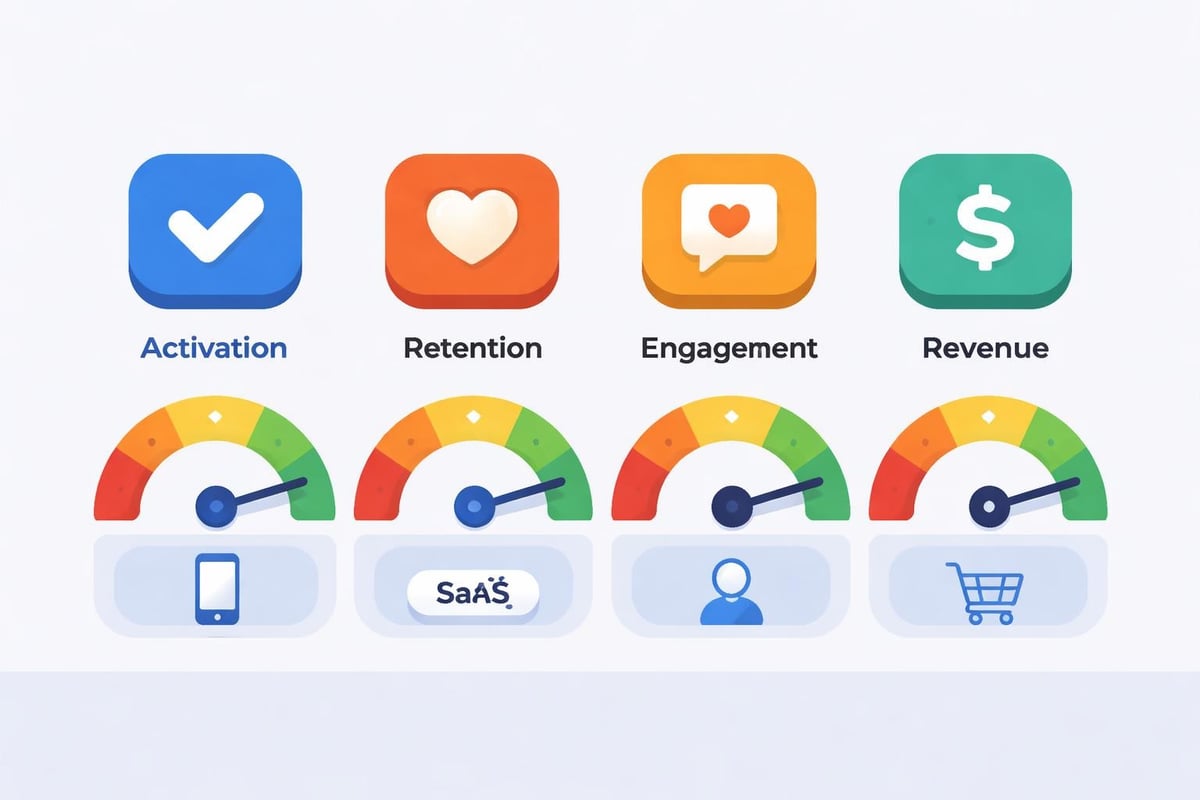
These benchmarks vary by industry and product type, but they provide directional guidance. The most important metric is the one tied to your core hypothesis. If you're testing whether users will pay, revenue conversion matters most. If you're testing engagement, retention is key.
Launch to a Targeted Audience
Mass launches rarely provide quality validation data. Noise overwhelms signal when you release to everyone at once.
Instead, identify a highly specific initial audience. This group should:
- Experience your target problem acutely
- Have easy access to your solution
- Be willing to provide detailed feedback
- Represent your broader target market
Personal networks offer the fastest path to initial users. While friends and family may provide biased feedback, professional contacts facing your target problem give genuine insights.
Online communities relevant to your niche provide concentrated audiences. Product Hunt, Reddit communities, LinkedIn groups, and industry-specific forums connect you with engaged users actively seeking solutions.
Paid acquisition in limited quantities tests your marketing messaging and acquisition costs. Spending $200-500 on targeted ads reveals whether your value proposition resonates and what customer acquisition actually costs.
The 16 techniques to validate and improve your MVP include specific audience targeting strategies that maximize learning while minimizing noise.
Gather Qualitative and Quantitative Data
Numbers tell you what's happening. Conversations tell you why.
Learning how to validate an MVP fast requires both data types working together. Quantitative data shows patterns across many users. Qualitative data reveals motivations, frustrations, and opportunities.
Quantitative Collection Methods
Set up analytics from day one. Track every user action, page view, and conversion event. Modern analytics platforms make this trivial to implement.
Monitor your dashboard daily during validation. Look for unexpected patterns. Which features do users engage with most? Where do they drop off? What paths do successful users take?
Run A/B tests on critical elements like headlines, pricing, and onboarding flows. Even with small sample sizes, you'll spot clear winners.
Qualitative Research Techniques
Schedule user interviews with your first 20-30 users. Ask open-ended questions:
- What problem were you trying to solve when you found us?
- How did you solve this problem before?
- What almost stopped you from trying our product?
- What would make this more valuable to you?
Watch users interact with your product via screen sharing. Their actual behavior often contradicts what they say they do. These sessions reveal usability issues and unmet needs that analytics miss.
Follow-up emails to churned users uncover why people leave. This negative feedback provides essential improvement direction.
Iterate Based on Real Feedback
Validation without iteration wastes the entire exercise. The goal isn't just to collect data but to act on it.
After gathering initial feedback, analyze for patterns. Single user requests might be outliers. Multiple users expressing the same need indicates a real gap.
Prioritize changes that address your core hypothesis first. If you're validating willingness to pay but users love the product yet won't upgrade, pricing or positioning needs adjustment before adding features.
The five steps to validate your MVP emphasize this continuous feedback loop. Launch, measure, learn, improve, and launch again.
Version 1.1 should launch within 1-2 weeks of collecting initial feedback. This rapid cycle maintains momentum and shows users you're listening. Each iteration provides fresh validation data, refining your understanding of what works.
No-code platforms excel at rapid iteration. Development tooling built for speed enables same-day changes based on morning user interviews. This velocity is impossible with traditional development.
Test Willingness to Pay Early
Free products generate misleading validation signals. Users who won't pay won't sustain your business.
Introduce pricing as early as possible, even in MVP stage. You don't need to actually charge immediately, but present pricing and measure conversion intent.
Ask for payment information upfront, even for a free trial. This small friction filters casual browsers from serious prospects. Freemium vs free trial models each validate different aspects of your business model.
Offer pre-orders or founding member pricing before the product is fully built. Customers who pay in advance provide the strongest possible validation signal. Their money represents real commitment.
Test multiple price points with different audience segments. You might discover customers value your solution more than you assumed. Or you might find your target market can't support your planned price, forcing a pivot to different customers or value delivery.

Monitor not just conversion rates but also customer quality at each price tier. Sometimes lower prices attract higher-maintenance customers who create support burdens that outweigh revenue.
Validate Technical Feasibility Simultaneously
Fast validation isn't just about market demand. Technical feasibility matters equally.
Your MVP might prove users want your solution but reveal that delivering it profitably is impossible with current technology. Test both simultaneously.
Build with scalable architecture even in MVP stage. No-code platforms like Bubble handle this automatically, but ensure your data structure and workflows can support growth. Rebuilding foundations later wastes validation momentum.
Test integration requirements with third-party services you'll need. APIs sometimes have rate limits, costs, or capabilities that change your business model. Discover these constraints during validation, not after signing customers.
Measure performance under realistic load. If your MVP handles ten users but your business model requires thousands, that's a validation failure. Load testing reveals whether your technical approach actually works.
Enterprise integration platforms using no-code demonstrate how modern tools handle sophisticated technical requirements without custom development. This capability lets you validate complex solutions quickly.
Know When You've Validated
Validation isn't binary. You'll never have perfect certainty before scaling. The question is whether you've reduced risk enough to justify the next investment level.
Strong validation signals include:
- Consistent retention above your industry benchmark
- Organic growth through word-of-mouth and referrals
- Paying customers achieving measurable outcomes
- Repeatable acquisition through identified channels
- Unit economics that support sustainable growth
Weak validation despite initial enthusiasm shows up as:
- High signup rates but poor activation
- Strong initial engagement but rapid dropoff
- Lots of feedback but no willingness to pay
- Success only with heavily discounted pricing
- Growth requiring unsustainable customer acquisition costs
The timeline for validation depends on your product cycle. Daily-use apps show retention patterns within weeks. Monthly SaaS tools require 3-6 months to validate properly. Enterprise solutions might need 6-12 months for adequate validation.
Set clear thresholds before you start. "We need 100 paying customers maintaining 60%+ monthly retention" provides objective validation criteria. This prevents moving goalposts when data disappoints.
Avoid Common Validation Pitfalls
Even experienced founders make predictable validation mistakes. Awareness helps you avoid them.
Building too much before testing defeats the purpose of fast validation. Every hour spent on non-essential features delays learning. When you hire no-code product teams, ensure they focus on validation-critical features first.
Confusing interest with commitment leads to false positives. People say they want things they won't actually use or buy. Measure behavior, not intentions.
Testing with the wrong audience produces irrelevant data. College students might love your enterprise tool, but they won't buy it. Validate with actual target customers.
Ignoring negative signals because they contradict your vision wastes everyone's time. Users telling you they don't need your solution are giving you valuable data. Listen to it.
Validation paralysis happens when founders endlessly test without committing to a direction. Set deadlines for validation phases. Make decisions based on available data.
Scale Your Validation Process
After initial validation proves your core hypothesis, expand testing to confirm results at larger scale.
Increase your user base systematically. If 50 users showed positive signals, test with 500. If those 500 validate further, move to 5,000. Each order of magnitude reveals new insights.
Different user segments may respond differently. Test across customer types, geographies, use cases, and acquisition channels. Validation with one segment doesn't guarantee success with others.
Monitor how metrics change as you scale. Early adopters forgive rough edges that mainstream users won't. Features that seemed unnecessary with 50 users become critical with 500.
Working with enterprise product development teams helps scale validation processes for complex B2B products. Enterprise customers require different validation approaches than consumer products but the fundamental principles remain the same.
Fast MVP validation isn't about cutting corners but about focusing ruthlessly on learning what matters most before investing heavily in development. By combining no-code tools with proven validation frameworks, you can test critical assumptions in weeks instead of months, dramatically reducing risk while maintaining quality. Big House Technologies specializes in helping startups and enterprises validate ideas quickly using Bubble and Lovable platforms, turning concepts into testable MVPs that generate real market data. Whether you're launching a new product or testing a feature expansion, the right approach to validation can mean the difference between building something people want and building something nobody needs.

About Big House
Big House is committed to 1) developing robust internal tools for enterprises, and 2) crafting minimum viable products (MVPs) that help startups and entrepreneurs bring their visions to life.
If you'd like to explore how we can build technology for you, get in touch. We'd be excited to discuss what you have in mind.
Other Articles
Discover essential app development strategies, trends, and best practices for 2026. Learn how no-code platforms are transforming software creation.
Discover how internal tools deepen AI capabilities in modern enterprises, from automation to predictive analytics, using no-code platforms.
No-code solutions are revolutionizing software development, making it faster, more affordable, and scalable. Learn how platforms like Bubble and agencies like Big House can help bring your ideas to life.