
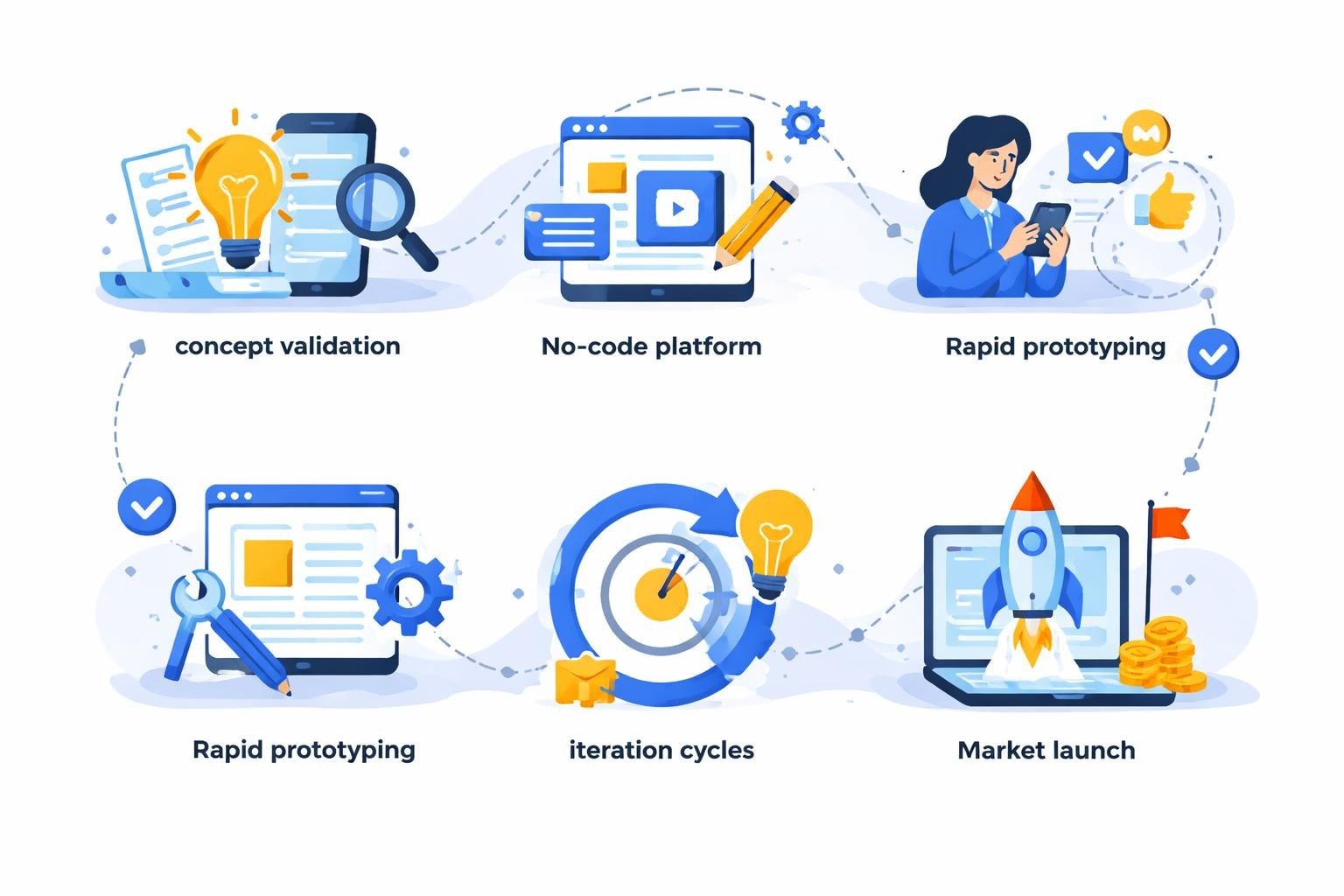
The landscape of product development has fundamentally shifted in 2026, with businesses of all sizes turning to no-code MVP development services to bring their ideas to market faster and more cost-effectively than ever before. Traditional development cycles that once took months or years can now be compressed into weeks, allowing entrepreneurs and enterprises to validate their concepts with real users before committing significant resources. This democratization of technology development has created new opportunities for innovation while dramatically reducing the barriers to entry for founders who lack technical expertise or substantial development budgets.
Understanding No-Code MVP Development Services
No-code MVP development services represent a specialized approach to building minimum viable products using visual development platforms that eliminate the need for traditional programming. These services combine strategic planning, user experience design, and platform expertise to deliver functional products that can be tested with actual customers. Unlike traditional development approaches, no-code development focuses on speed and iteration rather than building perfect, feature-complete systems from the outset.
The core philosophy behind these services centers on validation through action. Rather than spending months debating features or building comprehensive technical specifications, teams can create working prototypes in days. This rapid development cycle enables businesses to test assumptions, gather user feedback, and pivot quickly based on real-world data.
The Strategic Value of Professional No-Code Services
Working with experienced no-code MVP development services provides advantages that extend far beyond simple cost savings. Professional agencies bring platform expertise, design thinking methodologies, and battle-tested processes that help avoid common pitfalls. They understand which platforms work best for specific use cases, how to structure data models for future scalability, and which features truly matter for early-stage products.
Key benefits include:
- Platform selection guidance based on specific project requirements and long-term goals
- Architecture planning that prevents technical debt as products scale
- Design systems that ensure consistent user experiences across all touchpoints
- Integration strategies for connecting third-party services and APIs
- Testing protocols that identify issues before user-facing launches
These services also provide strategic partnership throughout the development journey. Rather than simply building what clients request, experienced providers challenge assumptions, suggest alternatives, and ensure the final product addresses genuine market needs.
Choosing the Right No-Code Platform for Your MVP
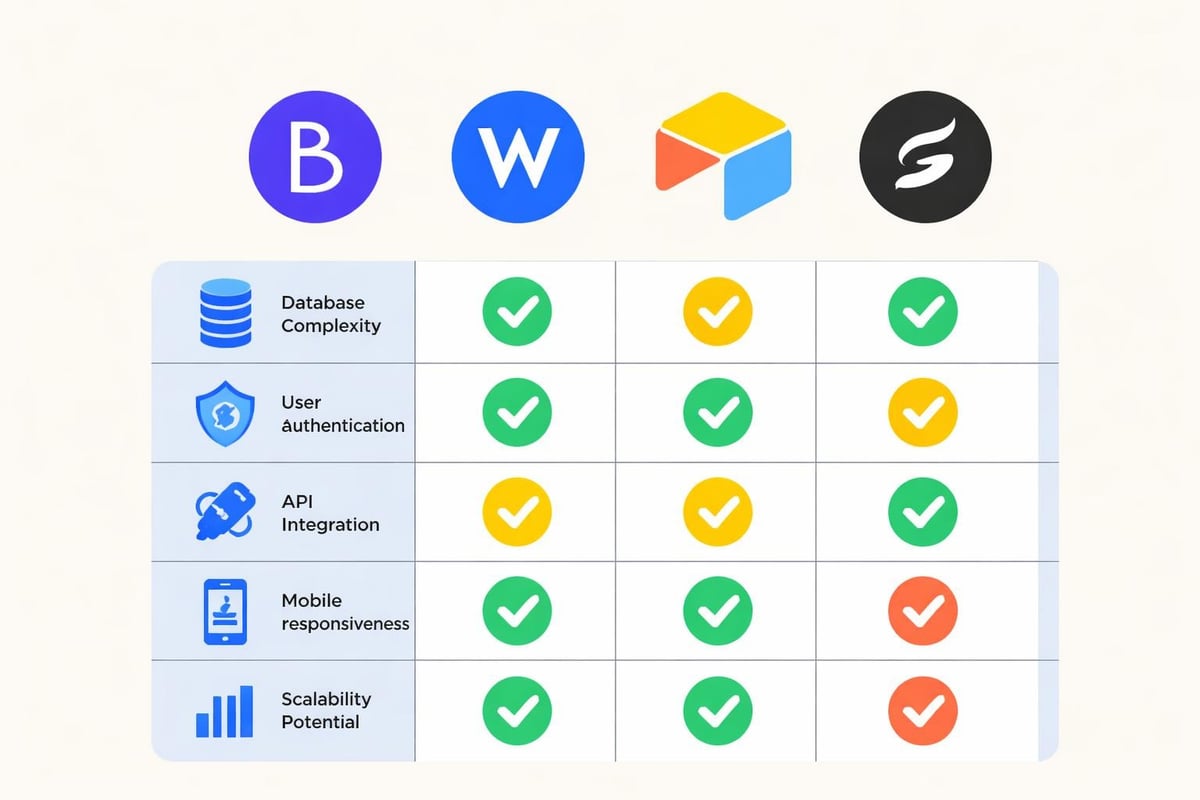
The platform selection process represents one of the most critical decisions in no-code MVP development. Different platforms excel at different use cases, and choosing incorrectly can create limitations that become costly to overcome later. Best no-code tools for SaaS founders vary significantly based on product complexity, target audience, and growth trajectory.
| Platform Type | Best For | Key Strengths | Limitations |
|---|---|---|---|
| Bubble | Complex web applications | Custom workflows, database relationships | Learning curve, mobile apps require wrappers |
| Webflow | Marketing sites, simple products | Design flexibility, CMS capabilities | Limited application logic |
| Airtable + Softr | Database-driven tools | Rapid prototyping, spreadsheet familiarity | Scalability constraints |
| Glide | Mobile-first MVPs | Native mobile feel, simple setup | Limited customization options |
Bubble has emerged as the leading platform for building sophisticated SaaS applications without code. Its visual programming interface allows developers to create complex conditional logic, manage intricate database relationships, and integrate with virtually any API. For enterprises seeking low-code digital transformation tools, Bubble offers the perfect balance between speed and capability.
Platform Selection Criteria
Determining the optimal platform requires evaluating several dimensions of your product vision. First, consider the data complexity. If your MVP requires multiple interconnected data types with complex relationships, platforms like Bubble provide the necessary database sophistication. Simpler directory-style products might work perfectly well on more basic platforms.
Second, assess your authentication and user management needs. Products requiring role-based access control, complex permission systems, or enterprise SSO integration demand more robust platforms. Consumer-focused apps with simpler login requirements have broader platform options.
Third, evaluate your integration requirements. Most MVPs need to connect with payment processors, email services, or industry-specific APIs. Understanding these dependencies upfront helps ensure platform compatibility and prevents costly migrations later.
The No-Code MVP Development Process
Professional no-code MVP development services follow a structured process that maximizes efficiency while maintaining quality standards. This process differs significantly from traditional development methodologies, emphasizing rapid iteration and continuous validation over comprehensive upfront planning.
Discovery and Scoping Phase
The journey begins with understanding the problem you're solving and the audience you're serving. During discovery, development teams work to identify the core value proposition and the minimum feature set required to test that proposition. This phase typically includes:
- Market research and competitive analysis to understand the landscape
- User persona development to define target audience segments
- User story mapping to prioritize features based on user value
- Technical feasibility assessment to confirm platform capabilities
- Timeline and budget alignment to set realistic expectations
Many founders make the mistake of including too many features in their initial MVP. Experienced no-code MVP development services help pare down feature lists to the essential elements that validate core assumptions. The goal isn't building a complete product but rather creating the simplest version that generates meaningful user feedback.
Design and Prototyping
Once the scope is defined, teams move into design and prototyping. This phase creates the visual blueprint for the product, establishing information architecture, user flows, and interface designs. Unlike traditional development where design happens separately from implementation, no-code allows for rapid design-to-build cycles.
Professional services typically create:
- Wireframes showing layout and navigation structure
- Interactive prototypes demonstrating key user journeys
- Design systems defining colors, typography, and component styles
- Responsive layouts ensuring mobile compatibility
- Accessibility considerations for inclusive design
The fastest no-code platforms for startups enable teams to build functional prototypes during the design phase itself, allowing for user testing before committing to full development. This iterative approach catches usability issues early when they're cheap and easy to fix.
Development and Implementation Strategies
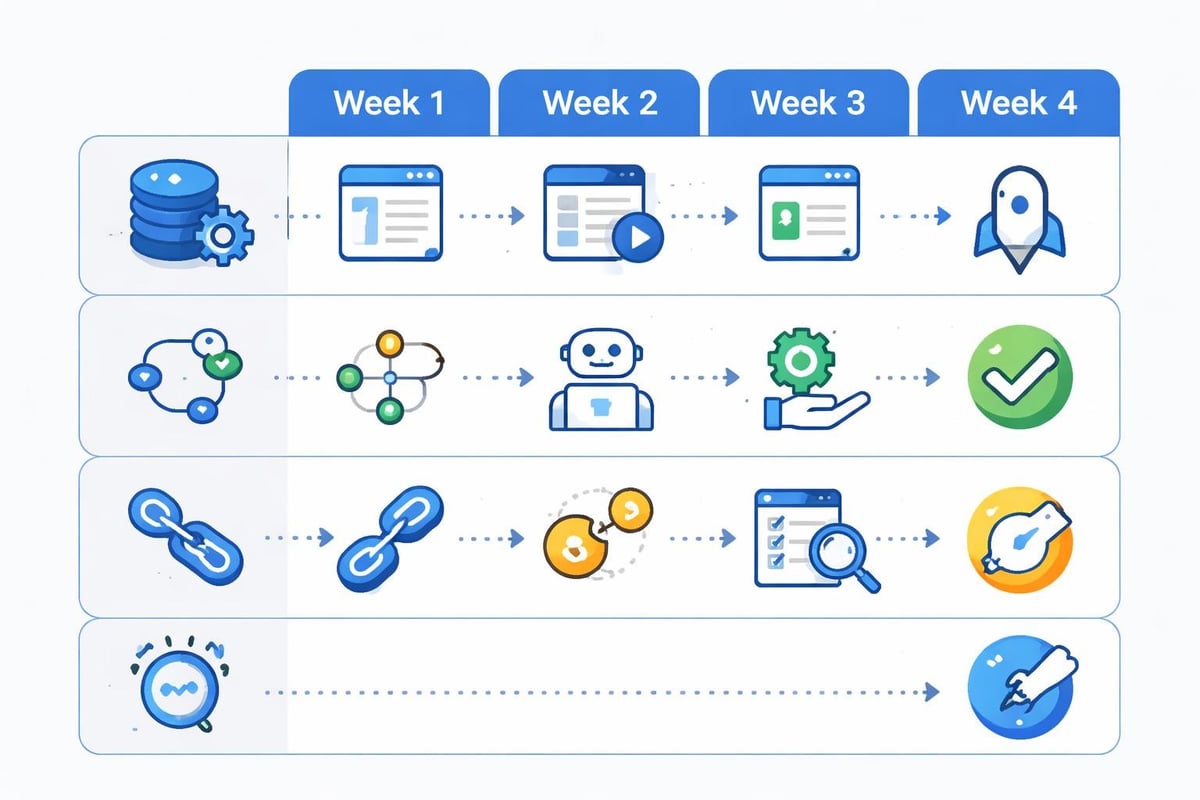
The actual development phase in no-code MVP services differs fundamentally from traditional coding. Instead of writing thousands of lines of code, developers use visual interfaces to assemble components, define logic, and configure integrations. However, this doesn't mean the work is simple or requires less expertise.
Core development activities include:
- Database architecture creating efficient data structures that support required functionality
- Workflow automation building the business logic that powers user interactions
- API integrations connecting third-party services for payments, communications, and data
- Responsive design implementation ensuring consistent experiences across devices
- Performance optimization configuring caching, indexing, and resource loading
Quality no-code MVP development services understand that speed should never compromise quality. They implement best practices around naming conventions, documentation, and system organization that make products maintainable and scalable. This attention to detail becomes crucial when products succeed and need to expand beyond their initial scope.
Testing and Quality Assurance
Comprehensive testing represents a critical component of professional services. While no-code platforms reduce certain types of technical bugs, they don't eliminate the need for thorough quality assurance. Testing protocols should cover:
| Testing Type | Focus Areas | Tools and Methods |
|---|---|---|
| Functional | Feature completeness, workflow accuracy | Manual testing, user scenarios |
| Usability | User experience, navigation clarity | User testing sessions, feedback surveys |
| Performance | Page load times, database queries | Platform analytics, speed testing tools |
| Security | Data protection, authentication | Security audits, penetration testing |
| Cross-browser | Compatibility across browsers/devices | Multi-device testing protocols |
Professional services conduct testing throughout development rather than treating it as a final phase. This continuous quality assurance catches issues early and ensures a polished product at launch.
Cost Considerations and ROI
One of the most compelling advantages of no-code MVP development services is their cost efficiency compared to traditional development. However, understanding the true cost structure helps businesses budget appropriately and maximize return on investment. Low-cost MVP development tools have made it possible to launch sophisticated products for a fraction of traditional development costs.
Pricing Models for No-Code Services
No-code MVP development services typically offer several pricing structures:
Fixed-price projects work well when scope is clearly defined and unlikely to change. These arrangements provide budget certainty but require comprehensive upfront planning. Agencies assess the feature list, estimate development hours, and quote a total project cost. This model suits businesses with clear product visions and limited flexibility needs.
Time and materials billing offers greater flexibility for evolving requirements. Clients pay for actual hours worked, allowing for pivots and adjustments as user feedback emerges. This approach aligns well with the iterative nature of MVP development but requires trust and ongoing budget management.
Monthly retainer arrangements provide ongoing development capacity, ideal for businesses that anticipate continuous iteration post-launch. This model ensures consistent development resources and often includes maintenance, updates, and feature enhancements.
Hidden Costs to Consider
Beyond development fees, successful MVPs require budget for platform subscriptions, third-party integrations, and operational expenses. Building MVPs with no-code platforms involves understanding these recurring costs and planning accordingly.
Budget for:
- Platform hosting and subscription fees (typically $30-500/month depending on usage)
- Third-party service integrations (payment processing, email, SMS)
- Domain registration and SSL certificates
- User testing and feedback collection tools
- Marketing and user acquisition expenses
The total cost advantage of no-code MVP development services becomes clear when comparing total project expenses. Traditional development for a similar scope might cost $50,000-150,000 and take 4-6 months. No-code approaches typically range from $10,000-40,000 and deliver in 4-8 weeks, representing both significant cost savings and dramatically faster time-to-market.
Scaling Beyond the MVP
A common concern about no-code MVP development services involves scalability. Can products built without code handle real user growth? The answer depends largely on platform selection, architecture decisions, and the nature of scaling required.
Modern no-code platforms like Bubble support applications with hundreds of thousands of users and complex functionality. However, achieving this scale requires thoughtful architecture from the beginning. Professional services structure databases, optimize workflows, and implement caching strategies that support growth.
Migration and Evolution Paths
Some businesses eventually outgrow their no-code platforms and need to transition to custom code. Professional no-code MVP development services plan for this possibility by:
- Documenting all business logic and data relationships
- Using standard APIs and data formats that facilitate migration
- Structuring databases in ways that align with traditional development patterns
- Creating comprehensive system documentation
- Building modular architectures where components can be replaced incrementally
However, many successful companies never migrate away from no-code platforms. The platforms themselves continue evolving, adding capabilities that eliminate traditional coding advantages. For businesses focused on solving customer problems rather than building technology infrastructure, no-code platforms often remain the optimal choice indefinitely.

Selecting the Right No-Code Development Partner
The quality of your no-code MVP development services provider dramatically impacts project outcomes. Not all agencies possess equivalent expertise, even when working with the same platforms. Selecting the right partner requires evaluating several critical dimensions.
Essential qualifications include:
- Platform certifications and partnerships demonstrating technical expertise
- Portfolio of similar projects showing relevant experience in your industry
- Strategic consulting capabilities beyond pure implementation
- Testing and quality assurance processes ensuring reliable products
- Post-launch support options for maintenance and iteration
When evaluating potential partners, request case studies that demonstrate their problem-solving approach. The best agencies don't just build what clients request but challenge assumptions, suggest alternatives, and ensure solutions address genuine user needs. Look for evidence of strategic thinking, not just technical execution.
Questions to Ask Prospective Agencies
During the vetting process, ask prospective no-code MVP development services providers these critical questions:
How do you approach scope definition and feature prioritization? This reveals their strategic capabilities and whether they'll help you build the right product, not just any product.
What's your process for incorporating user feedback during development? Quality agencies build feedback loops into their process rather than treating development as a linear path from requirements to delivery.
How do you handle project changes and scope adjustments? Flexibility is essential in MVP development, and agencies should have clear processes for managing evolution.
What post-launch support do you provide? Understanding maintenance, bug fixes, and ongoing optimization helps avoid surprises after delivery.
Can you provide client references for similar projects? Speaking with past clients reveals how agencies handle challenges, communicate, and deliver on commitments.
Industry-Specific Applications
No-code MVP development services have proven effective across virtually every industry, though implementation approaches vary based on sector requirements. Understanding how no-code applies to your specific market helps set realistic expectations and identify relevant case studies.
SaaS and B2B Applications
Business software represents an ideal use case for no-code development. Internal tools, customer portals, and workflow automation applications often require complex logic but serve defined user bases where perfect scalability isn't immediately critical. Companies leverage enterprise workflow automation tools built on no-code platforms to streamline operations and improve efficiency.
Common B2B applications include:
- CRM and customer management systems
- Project management and collaboration tools
- Inventory and supply chain tracking
- Employee onboarding and HR systems
- Client reporting and analytics dashboards
Consumer Applications and Marketplaces
Consumer-facing products benefit from no-code's rapid iteration capabilities. Rather than spending months building comprehensive feature sets, founders can launch with core functionality and expand based on actual user behavior. Understanding no-code and low-code tools for MVP development helps founders choose appropriate platforms for their specific market.
Successful consumer applications include:
- On-demand service marketplaces
- Community and social networking platforms
- Educational course delivery systems
- Event management and booking tools
- Subscription box and membership sites
Common Pitfalls and How to Avoid Them
Even with experienced no-code MVP development services, projects can encounter challenges. Understanding common pitfalls helps businesses avoid costly mistakes and set appropriate expectations.
Scope creep and feature bloat represent the most frequent challenges. The ease of adding features in no-code platforms can tempt teams to continuously expand scope. Professional services combat this by establishing clear success metrics and ruthlessly prioritizing features against those metrics.
Inadequate user research leads to building products nobody wants. The speed of no-code development doesn't eliminate the need for customer discovery and validation. Quality agencies incorporate user research throughout development, not just at the beginning.
Platform limitations ignored create problems when products need capabilities their platform can't support. Experienced agencies assess technical requirements during scoping and select platforms accordingly, preventing painful discoveries mid-project.
Poor data architecture becomes expensive to fix as products scale. While no-code platforms make it easy to create databases, structuring them for growth and performance requires expertise. Professional services design data models that support both current needs and anticipated expansion.
Security and compliance oversights create legal and business risks. Quality no-code MVP development services understand regulatory requirements for different industries and implement appropriate data protection, user privacy, and security measures from the beginning.
The Future of No-Code MVP Development
The no-code movement continues accelerating in 2026, with platforms adding sophisticated capabilities that blur the lines between no-code and traditional development. Artificial intelligence integration, advanced automation, and improved performance characteristics make no-code increasingly viable for complex, large-scale applications.
Professional no-code MVP development services are evolving alongside platforms, incorporating AI-powered development tools, automated testing frameworks, and sophisticated DevOps practices. The combination of human expertise and AI assistance promises even faster development cycles and higher-quality outputs.
For businesses considering the advantages of no-code development, 2026 represents an ideal time to explore these services. Platform maturity, agency expertise, and proven success stories have eliminated much of the risk that existed in earlier years. Whether you're a startup founder validating a new concept or an enterprise building internal tools, no-code MVP development services offer a compelling alternative to traditional development approaches.
The democratization of technology creation continues reshaping how businesses innovate. Rather than treating software development as a specialized domain requiring rare technical skills, no-code approaches make product creation accessible to anyone with vision and determination. As platforms evolve and agencies refine their methodologies, the gap between idea and implementation continues shrinking, enabling more innovation from more diverse creators than ever before.
No-code MVP development services have fundamentally transformed how businesses bring products to market, offering speed, cost efficiency, and flexibility that traditional development cannot match. Whether you're validating a startup concept or building enterprise tools, choosing the right development partner and approach sets the foundation for success. Big House Technologies specializes in transforming ideas into fully functional products using Bubble and Lovable platforms, delivering scalable solutions that meet real market needs on accelerated timelines and controlled budgets. Ready to bring your vision to life? Let's build something remarkable together.

About Big House
Big House is committed to 1) developing robust internal tools for enterprises, and 2) crafting minimum viable products (MVPs) that help startups and entrepreneurs bring their visions to life.
If you'd like to explore how we can build technology for you, get in touch. We'd be excited to discuss what you have in mind.
Other Articles
Master build tooling in 2025 with this beginner-friendly guide. Learn key concepts, choose the right tools, and set up efficient workflows for faster development.
Discover how Atlassian AI revolutionizes team collaboration, project management, and workflow automation for modern development teams.
Discover the 2026 expert guide to MVP developers for startups Learn how to select collaborate and scale with top talent for faster growth and product success