
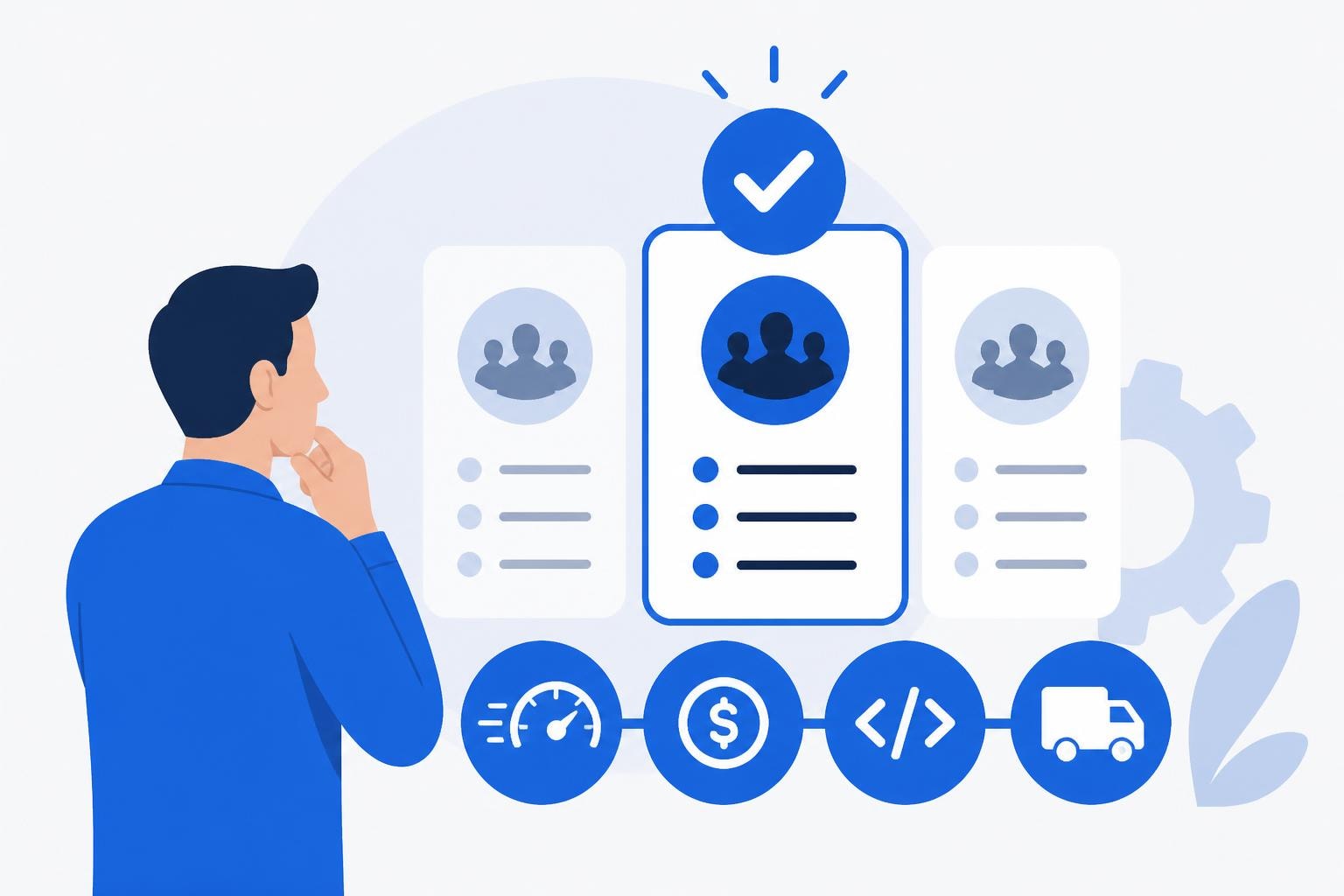
Choosing the right sw development company can make or break your digital transformation initiative. In 2026, the software development landscape has evolved dramatically with AI-powered tools, no-code platforms, and hybrid development approaches reshaping how companies build applications. Whether you're a startup racing to launch an MVP or an enterprise modernizing legacy systems, understanding how to evaluate potential development partners has never been more critical. This guide walks through the essential considerations, emerging trends, and decision-making frameworks that will help you select a sw development company aligned with your business goals.
Understanding the Modern SW Development Landscape
The software development industry has undergone seismic shifts over the past few years. Traditional coding-heavy approaches now compete with no-code platforms, AI-assisted development tools, and low-code solutions that promise faster delivery at lower costs.
According to recent research on AI in coding, AI tools have dramatically reduced development time but introduced new stability challenges. This creates a paradox for businesses: should you prioritize speed or reliability?
The current development ecosystem includes:
- Traditional software development firms using languages like Python, Java, and JavaScript
- No-code agencies leveraging platforms like Bubble and Webflow
- AI-first development companies utilizing tools like Lovable and GitHub Copilot
- Hybrid shops combining multiple approaches based on project requirements
The Rise of No-Code and AI Development
No-code development has matured from a niche curiosity into a legitimate enterprise solution. Platforms have evolved to handle complex business logic, integrations, and scalability requirements that were previously impossible without traditional coding.
Companies exploring how to build an MVP with no-code are discovering significant advantages in time-to-market and cost efficiency. The speed difference is substantial: what might take 6-9 months with traditional development can often be completed in 4-8 weeks using no-code platforms.
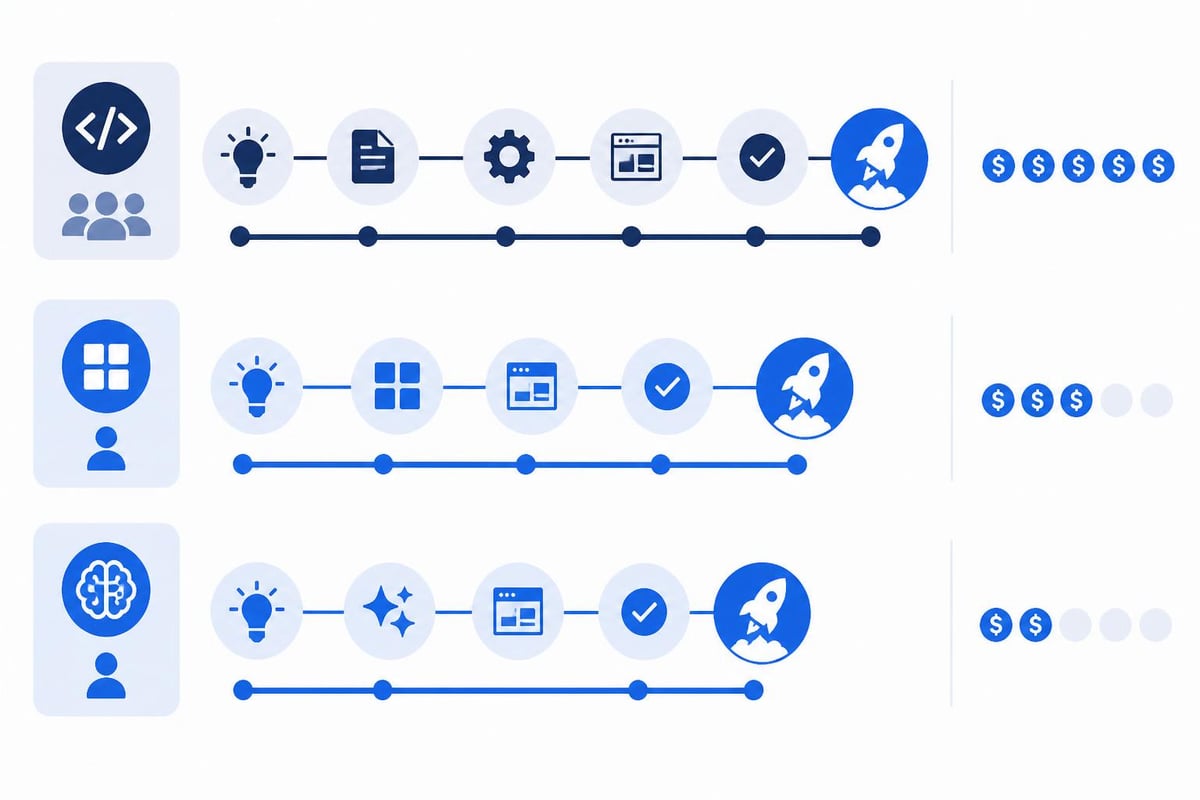
However, not every sw development company has adapted to these new paradigms. Many still rely exclusively on traditional coding, which can be appropriate for certain projects but unnecessarily expensive and slow for others.
Evaluating Technical Capabilities and Expertise
When assessing a potential sw development company, technical capabilities extend far beyond knowing specific programming languages. You need to evaluate their entire technical toolkit and their ability to recommend the right approach for your specific needs.
Core Technical Competencies to Assess
| Capability Area | What to Look For | Why It Matters |
|---|---|---|
| Platform Expertise | Deep knowledge of chosen platforms (Bubble, React, etc.) | Prevents costly architectural mistakes |
| Integration Experience | API connections, third-party services, legacy systems | Most apps don't exist in isolation |
| Scalability Planning | Performance optimization, database design | Ensures growth doesn't require rebuilding |
| Security Practices | Data protection, authentication, compliance | Protects your business and customers |
A competent sw development company should ask probing questions about your user base, expected growth, and technical constraints before proposing solutions. If they immediately jump to a specific technology without understanding your context, that's a red flag.
Specialized Knowledge Areas
Beyond general capabilities, consider whether you need specialized expertise:
- AI Integration: Does the company have experience building AI-powered features?
- Enterprise Systems: Can they navigate complex corporate IT environments?
- Mobile Development: Do they build native apps, progressive web apps, or both?
- Real-time Features: Can they implement websockets, live updates, and collaboration tools?
For startups and enterprises looking at no-code development for internal tools, platform-specific expertise becomes even more critical. The nuances of platforms like Bubble require deep knowledge to build production-ready applications.
Development Process and Methodology
The process a sw development company follows matters as much as their technical skills. A brilliant developer working in a chaotic environment will deliver worse results than a good developer following structured processes.
Agile vs. Waterfall vs. Hybrid Approaches
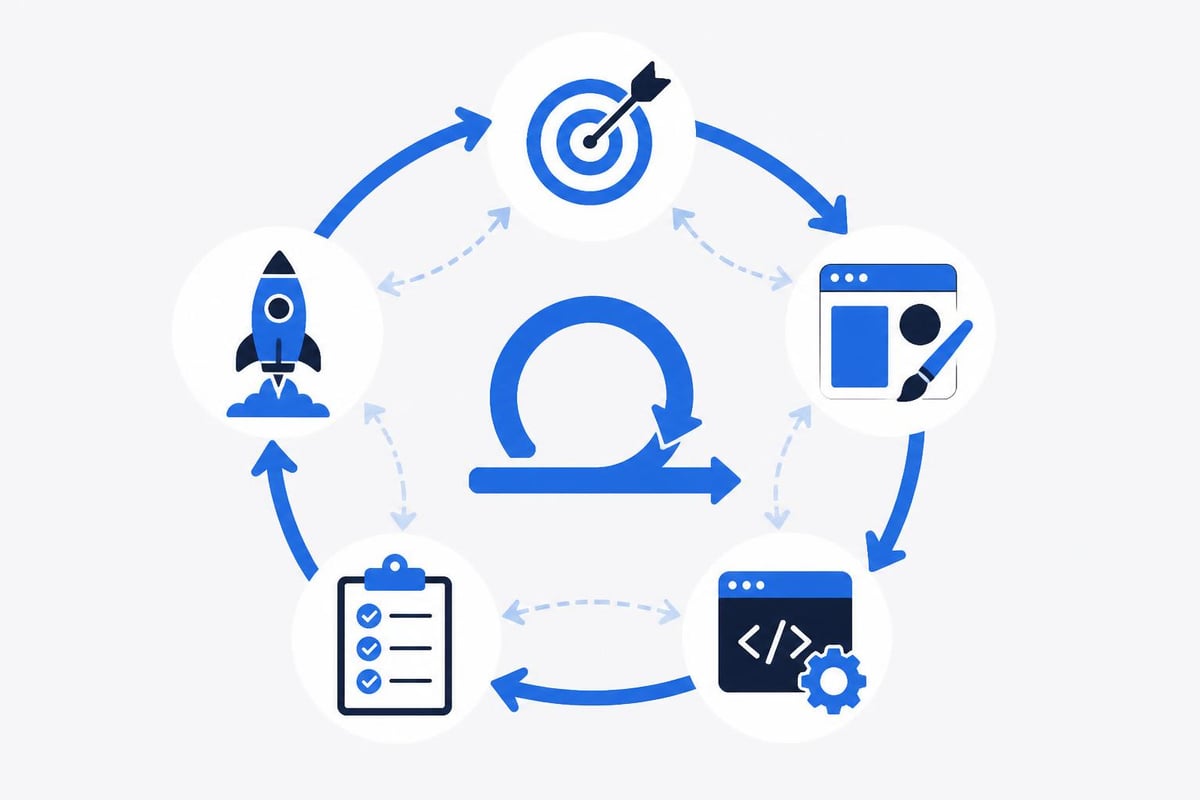
Most modern development shops claim to be "Agile," but the reality varies widely. True Agile development involves:
- Sprint-based delivery cycles (typically 1-2 weeks)
- Regular stakeholder reviews and feedback incorporation
- Iterative refinement based on real-world usage
- Continuous testing and quality assurance
- Adaptive planning that responds to changing requirements
Some projects benefit from more structured waterfall approaches, particularly when requirements are fixed and well-understood. The best sw development company will adapt their methodology to your project rather than forcing every client into the same process.
Research on integrating AI into Agile development highlights both opportunities and challenges as development teams incorporate AI tools into their workflows. Forward-thinking agencies are establishing new quality gates specifically for AI-generated code.
Communication and Collaboration Standards
Effective development partnerships require:
- Weekly progress meetings with clear agendas
- Access to project management tools (Jira, Asana, Notion)
- Regular demos of working features
- Transparent reporting on blockers and risks
The communication structure should be established upfront. Will you have a dedicated project manager? How quickly will they respond to questions? What happens if you need to change priorities mid-sprint?
Cost Structures and Budget Considerations
Pricing models for sw development companies vary significantly, and understanding the implications of each approach helps you make informed decisions.
Common Pricing Models
Fixed Price Projects work well when:
- Requirements are clearly defined and unlikely to change
- The scope is relatively small and bounded
- You need budget certainty upfront
Time and Materials makes sense when:
- Requirements will evolve based on user feedback
- You're exploring a new market or product concept
- Long-term partnership and ongoing development is expected
Retainer Arrangements suit situations where:
- You need dedicated capacity each month
- Work volumes are predictable
- You want priority access to the development team
A transparent sw development company will explain the trade-offs of each model and help you choose based on your situation rather than their preference. Companies focused on low-cost MVP development often favor hybrid approaches that combine fixed-price scoping and design with time-and-materials development.
Hidden Costs to Watch For
Beyond the base development rate, consider:
- Third-party service costs (hosting, APIs, tools)
- Maintenance and support after initial launch
- Training for your team to manage the platform
- Future enhancement work and technical debt management
According to industry consulting trends, demonstrating value quickly has become paramount in 2026. This shifts focus toward incremental delivery rather than big-bang launches.
Portfolio Review and Case Study Analysis
Past work provides the most reliable indicator of future performance. When evaluating a sw development company's portfolio, look beyond surface-level aesthetics.
What to Look for in Case Studies
- Problem articulation: Do they clearly explain the client's challenge?
- Solution rationale: Why did they choose their specific approach?
- Measurable outcomes: What results did the client achieve?
- Technical complexity: Can they handle projects of your scope?
- Industry relevance: Have they worked in your sector before?
Request to speak with references, particularly clients with projects similar to yours. Ask specific questions about:
- How they handled unexpected challenges
- Whether they delivered on time and budget
- The quality of communication throughout the project
- Post-launch support and responsiveness
- Whether they'd work with the company again
Agencies like CreateSell demonstrate the importance of teaching sustainable digital product development, not just building one-off projects. A good sw development company should empower your team with knowledge, not create permanent dependency.
Team Structure and Resource Allocation
Understanding who will actually work on your project matters tremendously. A sw development company might have impressive credentials, but if they assign junior developers to your project while senior staff focus elsewhere, you won't get the expertise you're paying for.
Key Roles in Development Teams
| Role | Responsibilities | When You Need Them |
|---|---|---|
| Product Manager | Requirements gathering, prioritization, stakeholder communication | Complex projects with multiple stakeholders |
| UX/UI Designer | User research, wireframing, visual design | Customer-facing applications |
| Developer(s) | Building features, implementing logic, integrations | All projects |
| QA Specialist | Testing, bug identification, quality assurance | Critical or complex applications |
| DevOps Engineer | Deployment, monitoring, infrastructure | Production applications at scale |
For smaller projects, individuals may wear multiple hats. The key is understanding the allocation upfront. Will you get dedicated resources or shared capacity across multiple clients?
Onshore vs. Offshore vs. Hybrid Teams
Geographic distribution affects communication, cost, and cultural alignment:
- Onshore teams typically cost more but offer timezone alignment and cultural familiarity
- Offshore teams reduce costs but may introduce communication challenges
- Hybrid models balance cost and convenience with strategic role placement
The best sw development company will be transparent about their team structure and how it impacts your project. Evaluating agencies for MVP development requires understanding not just capabilities but also availability and commitment.
Technology Stack Decisions
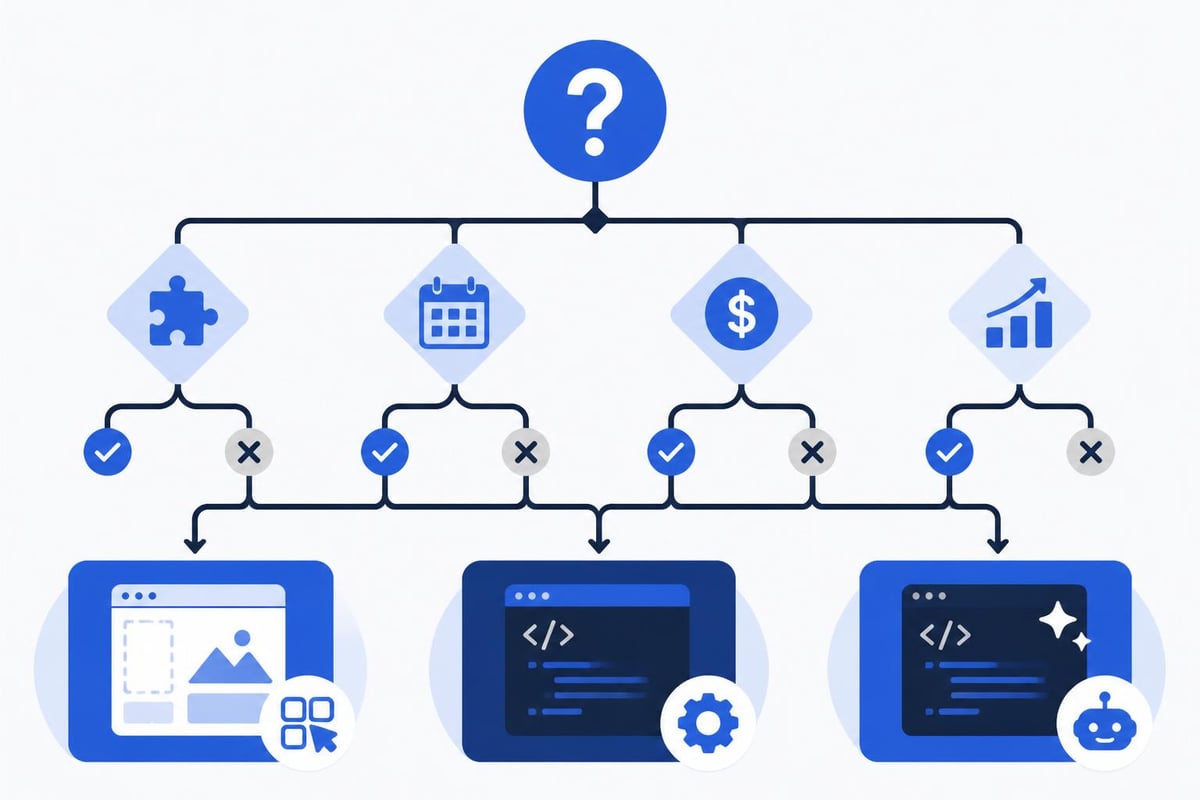
The technologies a sw development company recommends will have long-term implications for your product's maintainability, scalability, and total cost of ownership.
Modern Technology Considerations
No-code platforms like Bubble offer rapid development but:
- May have limitations for highly custom requirements
- Create platform dependency
- Require specific expertise for optimization
Traditional code provides maximum flexibility but:
- Takes significantly longer to develop
- Requires ongoing technical maintenance
- Costs more for both initial build and updates
AI-assisted development accelerates coding but comes with caveats. According to recent developer surveys, nearly half of developers don't fully trust AI-generated code accuracy, requiring additional time for debugging and verification.
Platform Ecosystem Considerations
When a sw development company recommends specific platforms, investigate:
- Community size and activity: Larger communities mean more resources and third-party plugins
- Long-term viability: Is the platform actively maintained and improved?
- Exit options: Can you migrate away if needed, or are you locked in?
- Integration capabilities: Does it connect with your existing systems?
Research from Forrester on application development trends emphasizes that successful teams balance innovation with practical considerations around maintenance and long-term support.
Security, Compliance, and Risk Management
Security breaches and compliance failures can destroy businesses. Your sw development company must take these concerns seriously from project inception, not as afterthoughts.
Essential Security Practices
A professional development partner should implement:
- Secure authentication using industry-standard protocols (OAuth, JWT)
- Data encryption both in transit and at rest
- Regular security audits and penetration testing
- Dependency management to address vulnerabilities in third-party libraries
- Access controls with proper role-based permissions
For regulated industries like healthcare, finance, or education, compliance requirements add additional layers. Your sw development company should have specific experience with relevant frameworks (HIPAA, SOC 2, GDPR, etc.).
Risk Mitigation Strategies
Beyond security, comprehensive risk management includes:
- Code repositories with proper version control and backup
- Disaster recovery planning for critical applications
- Performance monitoring to catch issues before users notice
- Clear ownership of intellectual property and code
- Service level agreements defining response times and uptime guarantees
Articles highlighting how AI democratizes web app building underscore new security challenges as development becomes more accessible to non-technical users. Your sw development company should have strategies to address these evolving risks.
Long-Term Partnership Potential
The relationship with your sw development company shouldn't end at launch. Software requires ongoing maintenance, updates, and enhancements to remain competitive and secure.
Post-Launch Support Models
Different support structures include:
- Monthly retainers for ongoing enhancements and maintenance
- On-demand support with minimum response time commitments
- Training and handoff for in-house team management
- Hybrid models combining internal and external resources
The right approach depends on your team's technical capabilities and the complexity of your application. For platforms like Bubble, learning to manage basic updates yourself while outsourcing complex features often provides the best balance.
Scaling and Evolution
As your business grows, your software needs will evolve. A forward-thinking sw development company should:
- Architect solutions with future growth in mind
- Document systems thoroughly for knowledge transfer
- Build modular, maintainable code that supports changes
- Proactively recommend optimizations before problems emerge
Companies focused on building internal dashboards and tools understand that initial requirements represent just the starting point of an evolving solution.
Making Your Final Decision
After evaluating technical capabilities, processes, costs, and cultural fit, you still need a framework for making the final decision.
Decision Matrix Approach
Weight the following factors based on your priorities:
| Factor | Weight (1-5) | Company A Score | Company B Score | Company C Score |
|---|---|---|---|---|
| Technical Expertise | ||||
| Relevant Experience | ||||
| Cost and Value | ||||
| Communication Quality | ||||
| Timeline Feasibility | ||||
| Cultural Alignment | ||||
| Long-term Partnership |
Multiply each score by its weight, then total for each company. This quantitative approach helps when you're torn between options that feel similarly qualified.
Red Flags to Avoid
Walk away if a sw development company:
- Refuses to provide references or case studies
- Guarantees specific outcomes without understanding your requirements
- Pressures you to sign contracts before detailed scoping
- Cannot explain their development process clearly
- Shows no interest in your business goals, only technical specifications
- Offers prices dramatically below market rates without clear explanation
Trust your instincts. If something feels off during the evaluation process, it's unlikely to improve during actual development.
The No-Code Advantage in 2026
No-code development has reached a tipping point where it's no longer experimental but mainstream for many use cases. A sw development company that understands when to leverage no-code versus traditional coding provides significant value.
The economics are compelling. Traditional development for a moderate-complexity application might cost $150,000-300,000 and take 6-9 months. The same application built on a platform like Bubble might cost $30,000-60,000 and launch in 6-12 weeks.
No-code excels for:
- MVPs and market validation projects
- Internal tools and workflows
- Customer portals and dashboards
- Database-driven applications
- Standard business logic and workflows
Traditional code remains superior for:
- Highly custom algorithms and processing
- Applications requiring specific performance optimization
- Projects with unique architectural requirements
- Complex real-time collaboration features
- Systems with unusual security or compliance needs
Analysis of software architecture trends shows increasing sophistication in cloud-native practices and containerization, technologies that no-code platforms increasingly support natively.
For businesses exploring AI-powered applications, hybrid approaches combining no-code interfaces with AI service integrations often deliver the fastest time-to-market.
Selecting the right sw development company requires balancing technical capabilities, cost considerations, process maturity, and cultural alignment. In 2026's fast-paced development landscape, partners who embrace modern approaches like no-code and AI while maintaining rigorous quality standards deliver the best outcomes. Whether you're launching an MVP or scaling an enterprise application, Big House Technologies combines the speed of no-code development with comprehensive processes from scoping through deployment, ensuring your vision becomes reality on time and within budget.

About Big House
Big House is committed to 1) developing robust internal tools for enterprises, and 2) crafting minimum viable products (MVPs) that help startups and entrepreneurs bring their visions to life.
If you'd like to explore how we can build technology for you, get in touch. We'd be excited to discuss what you have in mind.
Other Articles
Discover the best chat gpt app picks for 2025 Compare top features pricing and real world use cases to find the perfect AI chatbot for your needs
Unlock the potential of no-code tools like Bubble to create scalable MVPs quickly and efficiently. Discover strategies, best practices, and essential resources for successful product development.
Discover how Odoo AI revolutionizes business operations with intelligent automation, predictive analytics, and custom AI agents in 2026.