

Artificial intelligence has revolutionized how businesses interact with customers, and Telegram provides one of the most developer-friendly platforms for implementing these capabilities. A telegram bot ai combines the instant messaging power of Telegram with sophisticated machine learning models to create automated assistants that understand context, respond intelligently, and handle complex tasks. Whether you're building customer support automation, data collection systems, or interactive product recommendations, understanding how to leverage telegram bot ai technology effectively can transform your business operations and customer engagement strategies.
Understanding Telegram Bot AI Architecture
Modern telegram bot ai systems rely on a multi-layered architecture that processes user input, generates intelligent responses, and maintains conversation context. At the foundation, these bots connect to Telegram's infrastructure through the official Bot API, which provides endpoints for sending messages, handling callbacks, and managing user interactions.
The intelligence layer typically incorporates natural language processing models that parse user intent, extract entities, and determine appropriate responses. Many businesses now integrate large language models or custom-trained AI systems to power their Telegram bots, creating experiences that feel remarkably human.
Key architectural components include:
- Message routing systems that direct incoming requests to appropriate handlers
- Context management databases that track conversation history and user preferences
- AI inference engines that generate responses based on training data
- Webhook or polling mechanisms that receive updates from Telegram servers
- Integration layers connecting external APIs and business systems
When designing a telegram bot ai solution, selecting the right no-code development approach can significantly reduce time to market. Platforms like Bubble's no-code system enable rapid prototyping of bot logic without extensive programming knowledge, while AI-powered development tools streamline the creation of sophisticated conversation flows.
Business Applications for Telegram Bot AI
Organizations across industries have discovered creative applications for telegram bot ai technology that deliver measurable ROI. Customer service automation represents one of the most common use cases, with bots handling routine inquiries, troubleshooting common issues, and escalating complex problems to human agents only when necessary.
E-commerce and Sales Automation
Retail businesses deploy telegram bot ai systems to manage product catalogs, process orders, and provide personalized shopping recommendations. These bots analyze purchase history, browsing patterns, and user preferences to suggest relevant products, increasing conversion rates by 25-40% compared to traditional catalog browsing.
Sales automation capabilities include:
- Product search and filtering based on natural language queries
- Cart management and checkout processing
- Order tracking and delivery notifications
- Upselling and cross-selling based on AI-driven recommendations
- Abandoned cart recovery through automated follow-up messages
The integration of payment processing directly within Telegram creates seamless purchasing experiences. When combined with AI-powered product recommendations, businesses report significant improvements in average order value and customer lifetime value.

Internal Operations and Team Productivity
Beyond customer-facing applications, telegram bot ai solutions streamline internal workflows and team coordination. HR departments use bots for onboarding automation, answering policy questions, and scheduling interviews. IT teams deploy technical support bots that help employees troubleshoot common issues, reset passwords, and request system access.
| Use Case | Time Saved | User Satisfaction | Implementation Complexity |
|---|---|---|---|
| Customer Support | 60-70% | 85% | Medium |
| Order Processing | 50-60% | 90% | Low |
| HR Onboarding | 40-50% | 80% | Medium |
| IT Helpdesk | 55-65% | 82% | High |
| Lead Qualification | 65-75% | 88% | Low |
Companies implementing telegram bot ai for internal operations typically see productivity gains within the first month of deployment. The asynchronous nature of Telegram messaging allows employees to interact with bots on their schedule, reducing interruptions while maintaining accessibility.
Development Strategies and No-Code Approaches
Building a telegram bot ai solution traditionally required extensive programming expertise, but modern no-code platforms have democratized access to this technology. The development process now centers on visual workflow design, API integration, and training conversation models rather than writing thousands of lines of code.
Starting with the Telegram Bot API documentation provides essential context for understanding available features and limitations. The platform supports rich media, inline keyboards, custom commands, and webhook integrations that enable sophisticated interactions without complex infrastructure.
Selecting the Right Development Platform
No-code platforms offer varying levels of AI integration capabilities, and choosing the right foundation impacts long-term scalability. Some platforms excel at visual workflow design but lack robust AI integration, while others provide powerful machine learning tools but require steeper learning curves.
When evaluating platforms for telegram bot ai development, consider these factors:
- Native API connectivity for seamless Telegram integration
- AI model accessibility through pre-built connectors or custom endpoints
- Database flexibility for storing conversation history and user data
- Scalability provisions to handle growing user bases
- Cost structure aligned with usage patterns and growth projections
The comparison between no-code and custom development costs reveals significant savings when using visual development platforms, particularly for initial implementations and MVPs. Organizations can launch functional telegram bot ai prototypes in weeks rather than months, gathering user feedback and iterating rapidly.
Implementation Workflow and Best Practices
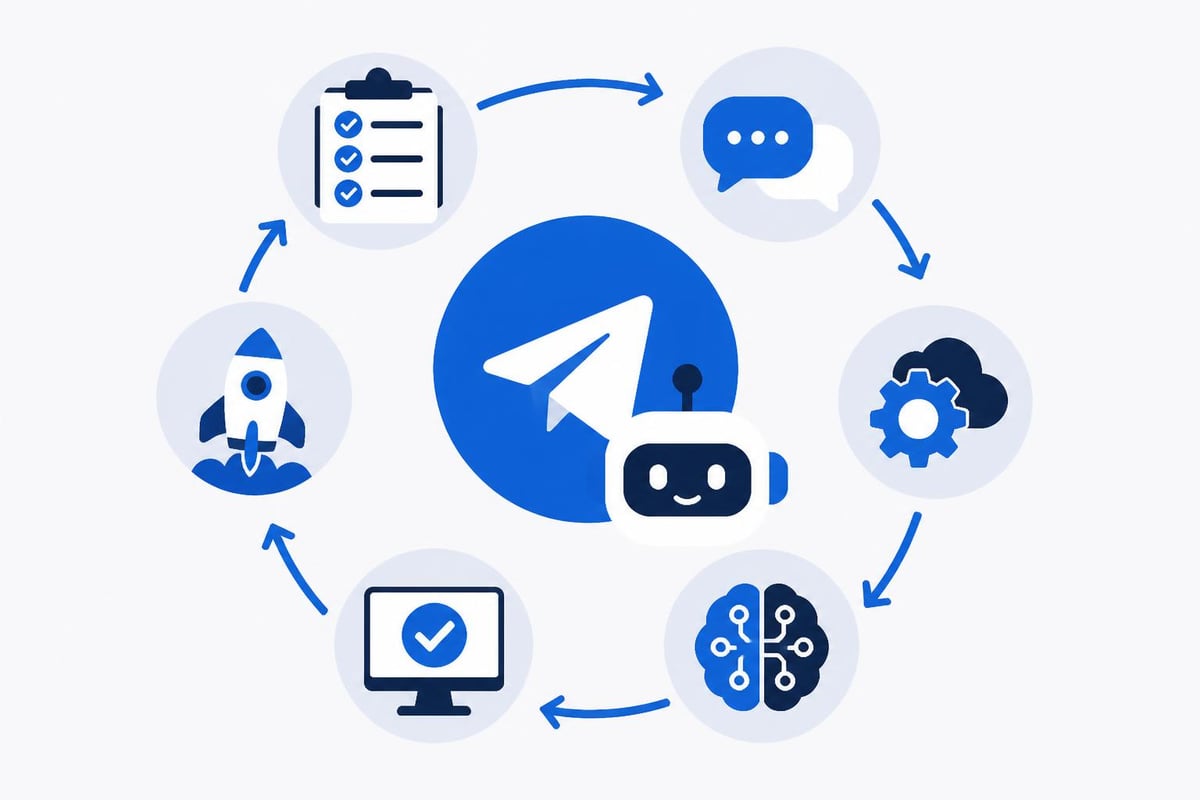
Successful telegram bot ai projects follow structured development workflows that balance speed with quality. Begin by mapping conversation flows on paper or in diagramming tools, identifying key user intents and corresponding bot actions. This planning phase prevents scope creep and clarifies technical requirements.
Development phases typically include:
- Requirements gathering to define bot objectives and success metrics
- Conversation design mapping user journeys and bot responses
- Platform setup configuring Telegram bot credentials and webhooks
- AI integration connecting natural language processing models
- Testing cycles validating functionality across diverse scenarios
- Deployment launching to production with monitoring systems
- Optimization refining responses based on usage analytics
Understanding which database solutions work best with no-code platforms ensures your telegram bot ai can scale efficiently. Conversation history, user preferences, and analytics data require thoughtful schema design to support fast queries and meaningful insights.
AI Integration Techniques and Model Selection
The intelligence powering telegram bot ai solutions comes from various AI models, each suited to different use cases and complexity levels. Rule-based systems handle straightforward interactions through predefined patterns and responses, while machine learning models process natural language with greater flexibility and understanding.
Natural Language Processing Options
Modern telegram bot ai implementations leverage multiple NLP techniques simultaneously. Intent classification determines what users want to accomplish, entity extraction identifies specific data points within messages, and sentiment analysis gauges emotional tone to adjust responses appropriately.
Pre-trained language models like GPT variants, BERT, or specialized conversational AI systems can be integrated through API calls, eliminating the need to train custom models from scratch. This approach accelerates development timelines while delivering sophisticated language understanding capabilities.
Organizations serving specialized industries often fine-tune base models on domain-specific data. A healthcare telegram bot ai benefits from training on medical terminology and patient interaction patterns, while a financial services bot requires understanding of investment terminology and regulatory compliance language.
Model selection considerations:
- Response latency requirements and user patience thresholds
- Accuracy expectations for intent recognition and entity extraction
- Training data availability and quality for custom model development
- API costs versus self-hosted infrastructure expenses
- Privacy requirements for handling sensitive user information
The recent integration of xAI's Grok chatbot into Telegram demonstrates the platform's commitment to advanced AI capabilities. This partnership showcases how major AI providers recognize Telegram as a strategic channel for delivering intelligent conversational experiences.
Context Management and Conversation Memory
Effective telegram bot ai systems maintain conversation context across multiple message exchanges, creating coherent dialogues rather than isolated question-answer pairs. This requires storing conversation history, tracking user state, and referencing previous interactions when generating responses.
| Context Strategy | Memory Depth | Use Case Fit | Implementation Complexity |
|---|---|---|---|
| Stateless | None | Simple commands | Very Low |
| Session-based | Current conversation | Customer support | Low |
| User profile | All interactions | Personalization | Medium |
| Hybrid | Contextual relevance | Complex workflows | High |
Session management becomes particularly important for multi-step processes like order placement, form completion, or troubleshooting workflows. The telegram bot ai must remember user selections from previous messages and adjust subsequent questions based on accumulated information.
Security, Privacy, and Compliance Considerations
Deploying telegram bot ai solutions requires careful attention to data security and privacy regulations, especially when handling personal information or payment data. Telegram provides end-to-end encryption for secret chats, but standard bot interactions occur through Telegram's servers, necessitating additional security measures.
Data Protection Strategies
Implement encryption for sensitive data stored in your bot's database, ensuring that even if unauthorized access occurs, the information remains protected. Use secure API connections (HTTPS/TLS) for all communication between your bot infrastructure and external services, including AI model endpoints and business system integrations.
User authentication adds a critical security layer for bots that access private information or perform sensitive operations. Telegram supports bot login mechanisms that verify user identity before granting access to protected features or data.
Security best practices include:
- Rate limiting to prevent abuse and API exhaustion
- Input validation to block malicious payloads and injection attacks
- Access logging for audit trails and security monitoring
- Regular security audits of bot code and infrastructure
- Compliance with GDPR, CCPA, and relevant data protection regulations
When selecting development platforms for telegram bot ai projects, evaluate their security certifications and compliance frameworks. The AI-powered design to code tools emerging in 2026 increasingly incorporate security scanning and vulnerability detection directly into development workflows.

Performance Optimization and Scaling Strategies
As telegram bot ai adoption grows, performance optimization becomes essential for maintaining responsive user experiences. Response latency directly impacts user satisfaction, with research showing that delays exceeding two seconds increase abandonment rates significantly.
Infrastructure and Response Time
Optimize AI model inference by caching common responses, pre-loading frequently requested data, and implementing efficient database query patterns. For telegram bot ai systems serving thousands of concurrent users, consider deploying models to dedicated GPU infrastructure or using optimized inference engines that reduce processing time.
Geographic distribution of bot infrastructure minimizes network latency for global user bases. Cloud providers offer regional deployment options that position bot servers closer to user concentrations, reducing round-trip communication times.
Monitoring and analytics provide visibility into bot performance, conversation success rates, and user satisfaction metrics. Track key performance indicators like:
- Average response time from user message to bot reply
- Conversation completion rates for multi-step workflows
- Error rates and failure pattern analysis
- User retention and engagement frequency
- AI accuracy metrics for intent recognition and response relevance
The integration approaches used when building AI applications significantly impact scalability potential. Modular architectures that separate bot logic, AI processing, and data storage allow independent scaling of each component based on demand patterns.
Emerging Trends and Future Developments
The telegram bot ai landscape continues evolving rapidly as new AI capabilities emerge and user expectations increase. Multimodal interactions combining text, voice, images, and video create richer conversational experiences. Advanced telegram bot ai implementations now process image uploads for visual search, analyze voice messages for sentiment, and generate custom graphics in response to user requests.
Voice and Multimedia Integration
Voice message processing adds accessibility and convenience for users who prefer speaking over typing. Modern speech recognition models achieve near-human accuracy, enabling telegram bot ai systems to transcribe, understand, and respond to voice inputs seamlessly.
According to research on Telegram bot ecosystems, multimedia capabilities significantly enhance user engagement, with bots supporting image and video processing seeing 40% higher interaction rates compared to text-only implementations.
The convergence of AI technologies enables sophisticated feature combinations. A retail telegram bot ai might analyze product photos uploaded by customers, identify items through computer vision, retrieve detailed specifications from databases, and provide personalized styling recommendations, all within a single conversation thread.
Emerging capabilities include:
- Real-time language translation for global customer support
- Predictive text and smart reply suggestions
- Emotional intelligence and empathy modeling
- Proactive outreach based on user behavior analysis
- Cross-platform integration with voice assistants and smart devices
Developments in AI tools specifically designed for developers accelerate telegram bot ai creation by automating code generation, suggesting optimal conversation flows, and identifying potential user experience improvements through machine learning analysis of interaction patterns.
Business ROI and Success Metrics
Measuring telegram bot ai success requires defining clear objectives and tracking relevant metrics aligned with business goals. Customer service automation projects typically focus on ticket deflection rates, average handling time reduction, and customer satisfaction scores, while sales-oriented bots emphasize conversion rates, average order value, and customer acquisition costs.
Calculating Implementation Value
The cost comparison between different development approaches reveals that no-code telegram bot ai implementations typically deliver positive ROI within 3-6 months for businesses with moderate to high customer interaction volumes. Reduced labor costs, improved response times, and increased customer satisfaction contribute to measurable financial impact.
| Metric Category | Example KPIs | Target Improvement | Measurement Frequency |
|---|---|---|---|
| Efficiency | Response time, resolution rate | 50-70% reduction | Daily |
| Quality | Satisfaction score, accuracy | 80%+ positive | Weekly |
| Business Impact | Conversion rate, revenue | 20-30% increase | Monthly |
| User Engagement | Active users, session length | 40%+ growth | Weekly |
A/B testing different conversation flows, response styles, and AI models helps optimize telegram bot ai performance continuously. Small improvements in conversion rates or user satisfaction compound over time, generating significant business value.
Specialized applications like BotRf for radio link planning demonstrate how telegram bot ai can address complex technical challenges in specific industries, creating competitive advantages through innovative automation.
Integration with Business Systems and Workflows
Standalone telegram bot ai solutions provide limited value compared to implementations integrated with existing business systems. Connecting bots to CRM platforms, inventory management systems, payment processors, and analytics tools creates cohesive digital ecosystems that automate end-to-end workflows.
API Connectivity and Data Synchronization
Modern integration platforms provide pre-built connectors for popular business applications, reducing custom development requirements. When building telegram bot ai solutions on no-code platforms, evaluate connector availability for your critical systems before committing to a specific technology stack.
Real-time data synchronization ensures bot responses reflect current inventory levels, order statuses, and customer information. Scheduled updates work for less time-sensitive data, reducing API call volumes and associated costs.
The comprehensive features available to Telegram bots through the platform enable sophisticated integrations including payment processing, location sharing, and contact information exchange. These native capabilities simplify development while ensuring compliance with Telegram's guidelines and best practices.
Common integration patterns:
- CRM systems for customer data management and interaction tracking
- E-commerce platforms for product catalogs and order processing
- Payment gateways for secure transaction handling
- Analytics platforms for performance monitoring and insights
- Marketing automation tools for campaign management and segmentation
When selecting application development platforms for telegram bot ai projects, prioritize those offering robust API management capabilities, webhook support, and flexible data transformation tools that simplify integration work.
Conversation Design and User Experience
Technical capabilities mean little if users find telegram bot ai interactions frustrating or confusing. Effective conversation design balances automation efficiency with human-centered design principles, creating experiences that feel natural and helpful rather than robotic and constraining.
Crafting Effective Dialog Flows
Begin conversations with clear value propositions and capabilities explanations. Users should immediately understand what the bot can help them accomplish and how to access different features. Provide example commands or quick reply buttons that guide users toward successful outcomes.
Handle errors gracefully by acknowledging limitations and offering alternatives. When telegram bot ai systems encounter queries beyond their capabilities, suggest related topics they can address or provide pathways to human assistance.
Personality and tone significantly impact user perception and engagement. Match bot voice to brand identity and audience preferences, whether that means professional and efficient, friendly and casual, or witty and entertaining.
Studies on interactive bots like Atreya for chemical scientists highlight the importance of domain-specific conversation design. Specialized telegram bot ai implementations require understanding user expertise levels, common workflows, and technical vocabulary to create truly valuable experiences.
Testing and Quality Assurance
Rigorous testing ensures telegram bot ai systems perform reliably across diverse scenarios and user inputs. Unlike traditional software with defined input parameters, conversational AI must handle infinite variations in phrasing, spelling, and intent expression.
Comprehensive Testing Strategies
Functional testing validates that bot commands work as intended, database queries return accurate results, and integrations with external systems complete successfully. Create test scripts covering common user journeys and edge cases to catch issues before production deployment.
Testing focus areas include:
- Intent recognition accuracy across varied phrasings and synonyms
- Entity extraction handling misspellings and unexpected formats
- Context management maintaining conversation coherence across sessions
- Error handling gracefully managing unexpected inputs and system failures
- Performance under various load conditions and concurrent users
User acceptance testing with real users provides invaluable insights into conversation flow effectiveness and areas for improvement. Beta testing programs allow early adopters to interact with telegram bot ai implementations before full launch, surfacing usability issues and feature requests that internal testing might miss.
The common questions addressed in Telegram's bot FAQ offer guidance on testing best practices and debugging techniques specific to the platform. Understanding these platform-specific considerations prevents common pitfalls and accelerates troubleshooting.
Telegram bot ai represents a powerful convergence of messaging convenience and artificial intelligence capabilities, enabling businesses to automate customer interactions, streamline operations, and deliver personalized experiences at scale. The combination of Telegram's robust platform features with modern AI models creates opportunities for innovation across industries and use cases. Whether you're building customer service automation, sales assistants, or specialized technical tools, understanding the architectural considerations, development strategies, and best practices outlined above provides a foundation for success. Big House Technologies specializes in developing sophisticated telegram bot ai solutions using no-code platforms like Bubble and AI-powered development tools, delivering scalable implementations that transform business operations while maintaining cost efficiency and rapid deployment timelines.

About Big House
Big House is committed to 1) developing robust internal tools for enterprises, and 2) crafting minimum viable products (MVPs) that help startups and entrepreneurs bring their visions to life.
If you'd like to explore how we can build technology for you, get in touch. We'd be excited to discuss what you have in mind.
Other Articles
Discover the best AI coding assistant alternatives for no-code and AI developers in 2026. Compare features, pricing, and capabilities.
Master Google Sheets AI in 2026 with expert tips on automation, integrations, and predictive analytics. Unlock smarter data management and futureproof your workflow.
Discover 7 innovative ways to use Bubble No Code in 2025 for AI integration, workflow automation, analytics, and more Unlock new digital potential today